
When January’s job growth numbers were released this week, the headlines trumpeted that the news was surprisingly good. “Employers Hired Swiftly in January After a Dismal 2025,” said the New York Times. “U.S. employers added 130,000 jobs in January, the strongest gain in months,” said the Washington Post. “Employers added 130,000 jobs in January, blowing past expectations,” said CBS News. Hooray!
This framing is partly true but mostly false; it was a better month than expected, but the news is mostly bad. In any case here’s what we need to understand: While the economy will go up and down over the next three years, nothing will stop Donald Trump from acting as an anchor pulling it down. However it looks in a given day, month, or year, it will be worse than it might have been.
First, let’s look at what we just learned. While 130,000 added jobs is indeed the best monthly number of Trump’s second term, the report also contained some extremely bad news (which, to be clear, most major outlets also discussed). Namely, revisions to previous data showed that total job growth in 2025 was just 181,000. In a year with no recession, that is positively catastrophic. As a contrast, no fewer than 34 times during Joe Biden’s term, a single month’s job growth exceeded what Trump achieved in the entire first year of his term.
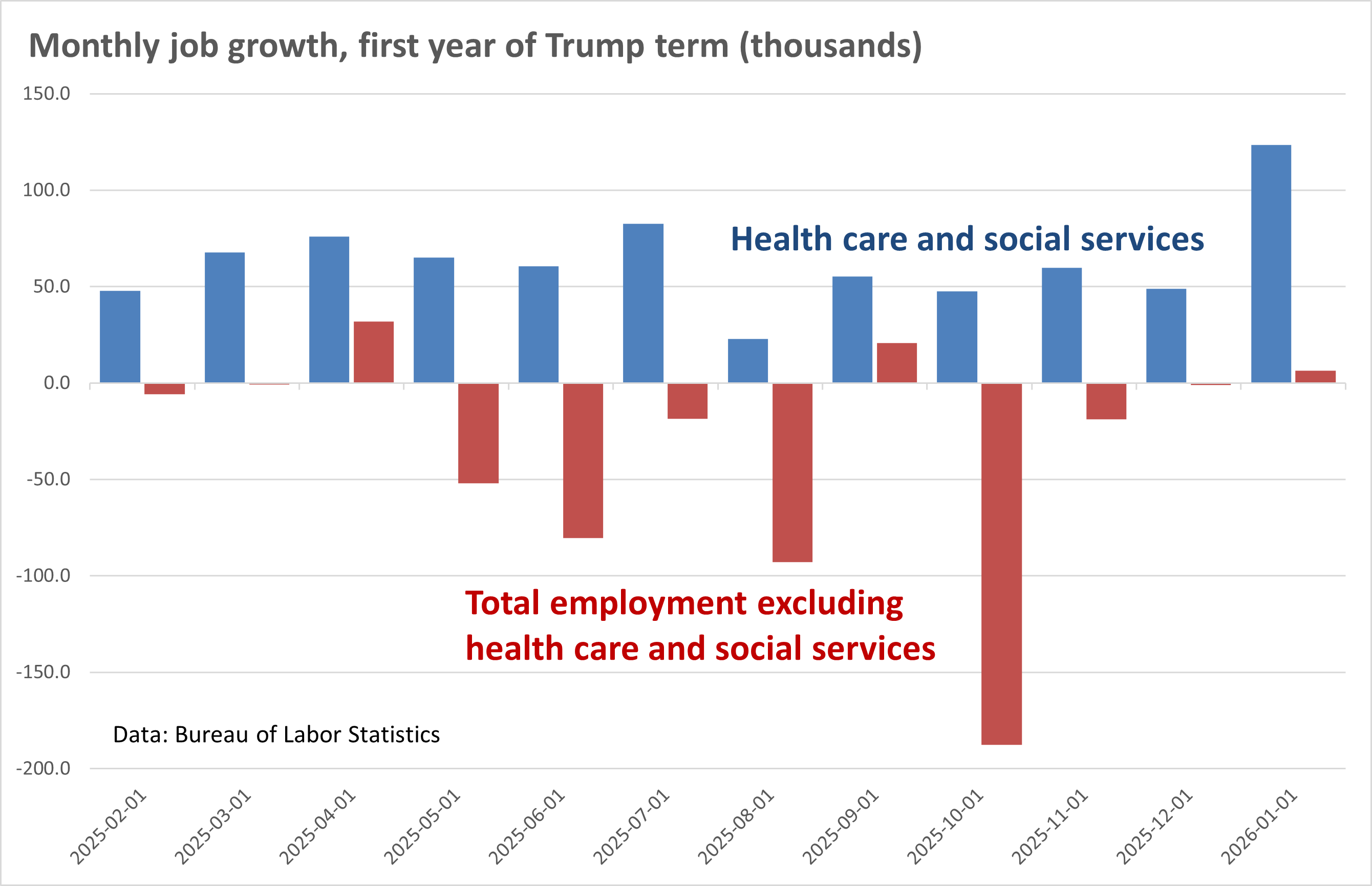
But that’s just the beginning. The bigger picture is that almost all the job growth we have seen lately has come in one area: health care. I made this graph to illustrate: It shows that while we keep adding more jobs in health care, as a whole the rest of the economy has been adding little or nothing in new jobs. In fact, in nine of Trump’s first twelve months, the rest of the economy lost jobs:
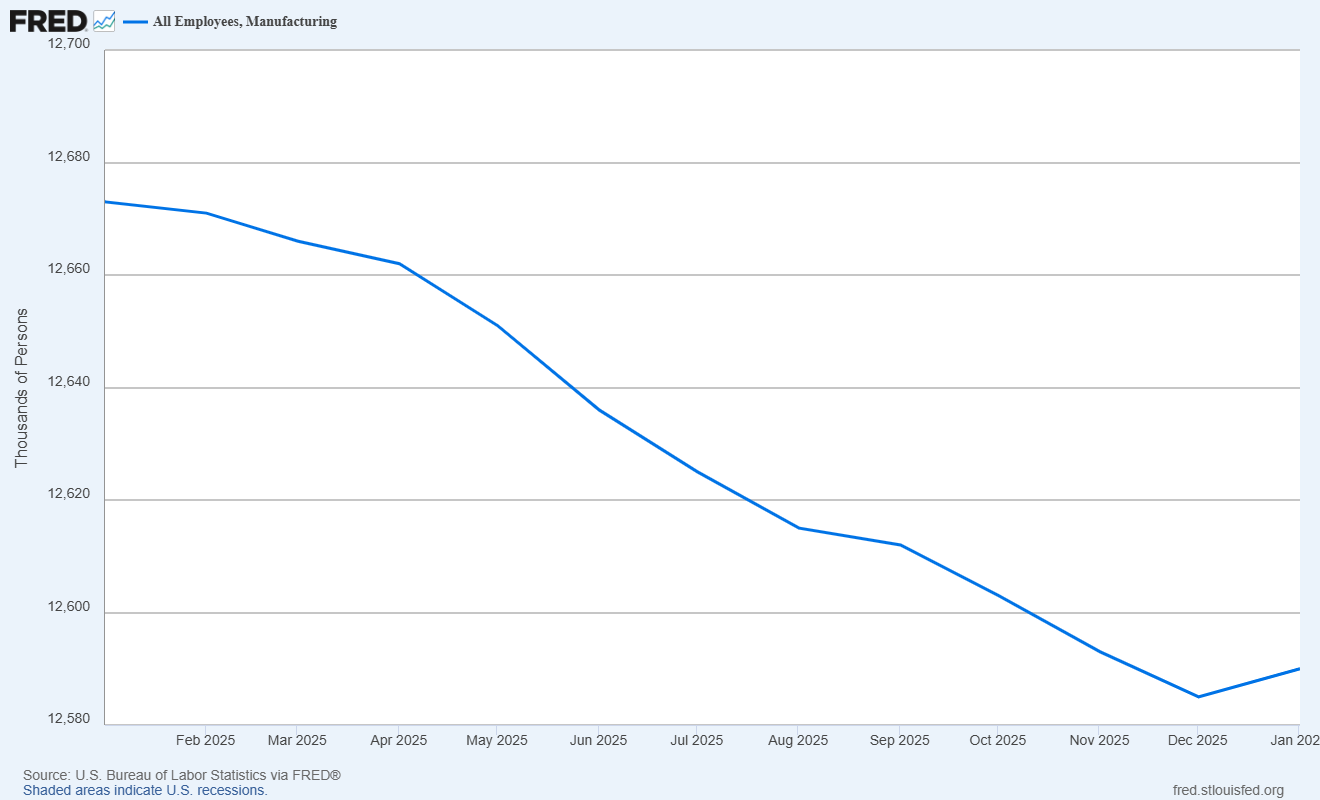
But wait, wasn’t there supposed to be a manufacturing boom? After all, this is something Trump cares a great deal about: Manly men doing manly work in factories, just like the good old days. That’s one of the main objectives of his tariff policy, to bring back manufacturing to America. How’s it going? Not so great: The number of manufacturing jobs has been going down all year, with just a tiny bump in January:
If you listen to Trump’s spokespeople and allies, we shouldn’t pay attention to any of this, because 2025 was just preparation for the glory to come:
Why, precisely, would that be? What in Trump’s policies will push the American economy to this spectacular “feast”?
The answer is: really nothing. There was a big tax cut bill, one that is giving rich people and corporations some more money, which in theory they could spend and invest. But if that has any effect on overall growth it will be minimal, and it’s unlikely to make any discernible difference in the average American’s life. So what else do they have?
First, there’s Trump’s tariffs. I’ve discussed this at length elsewhere so I won’t go into too much detail, except to say that what we’ve seen so far from the tariffs is what we’re likely to continue to see. Rather than being targeted at particular industries to whom we might want to give a boost in order to protect them from foreign competition, the tariffs will continue to be both sweeping (directed at all imports from many countries, whether what we’re importing is something we can make here or not) and unpredictable (raised or lowered depending on the vagaries of Trump’s whims). We will also be in a state of constant trade war with at least somebody, harming American companies that export goods. This means that we’ll get none of the benefits tariffs can offer if carefully designed, and all of the harms. As the Congressional Budget Office recently assessed, “The higher tariffs raise the cost of imported goods, temporarily increase inflation, reduce households’ purchasing power, and slow real investment.”
Next we have the immigration crackdown, which is already taking a toll on the economy, by deporting both undocumented and legal immigrants already here and by discouraging new arrivals. The crackdown is slowing the growth of the labor force, which makes it harder for employers to fill jobs. And like any workers, immigrants create economic activity with both their work and the money they spend. Immigrants pay more in taxes than they use in benefits, lowering deficits at the state and federal level. They start businesses at higher rates than native-born citizens. We’re sacrificing all of that benefit, and every day Trump is in office he will be working to make it worse.
Immigration and tariffs are the most visible parts of Trump’s damaging economic program, but we could list lots of others. His continued war on renewable energy will raise electricity costs. His eagerness to make climate change worse will worsen health and intensify disasters. His efforts to push people off their health insurance will lead to more sickness, missed work, and bankruptcies. His cuts to benefits like food stamps — which produce over $1.50 of economic activity for every dollar they cost — will drag the economy down even further. His gutting of the federal government will restrain innovation in science, technology, medicine, and many other areas.
Critically, none of this is going to change as long as he’s in office. His opponents might be able to restrain him here and there with lawsuits and smart politicking, but the basic contours of the Trump economic policy are going to continue.
That doesn’t necessarily mean we’re headed for an extended recession. The American economy is quite resilient; it can withstand a lot of disruption and attack. And for some reason, the stock market keeps growing no matter what happens (for now, anyway). But wherever the economy is at a particular moment, it’s worse than it would have been had we not had a president seemingly so determined to make the wrong decision at every possible turn.
Thank you for reading The Cross Section. This site has no paywall, so I depend on the generosity of readers to sustain the work I present here. If you find what you read valuable and would like it to continue, consider becoming a paid subscriber.