
Israeli Finance Minister Bezalel Smotrich and a woman hold up a map that shows the long-frozen E1 settlement scheme, which would split Israeli-occupied East Jerusalem from the occupied West Bank, on the day of a news conference, near the illegal Israeli settlement of Maale Adumim, in the Israeli-occupied West Bank, on August 14, 2025 [Ronen Zvulun/Reuters]
PYM, a grassroots, international pro-Palestinian movement, last year found that Maersk, Denmark’s publicly owned shipping company, facilitated trade from Israeli settlements.
The world’s biggest container group before being overtaken by MSC in 2022, Maersk is now reviewing its screening process to align with the UN Global Compact, which urges companies to adopt sustainable, socially responsible policies, and guidelines from the Organization for Economic Co-operation and Development (OECD) to the same effect.
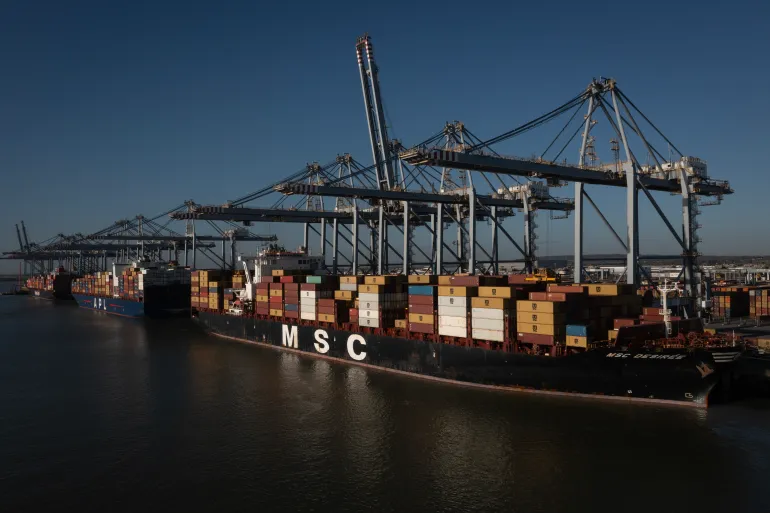
MSC told Al Jazeera in a statement that it “respects global legal frameworks and regulations wherever it operates” and applies this “to all shipments to and from Israel”.
Despite insurance companies raising premiums due to security risk as Israel launched its genocidal war on Gaza in October 2023, MSC announced that it would absorb the extra costs rather than impose war surcharges.
It also holds cooperation and vessel-sharing agreements with Israel’s publicly held cargo shipping company, ZIM.
The Spanish and Italian interior ministries were also contacted by Al Jazeera, but did not respond to requests for comment on the shipments.
The Israeli ministry did not respond to requests for comment.
Sustaining settlement economy
According to UN estimates, settlements in Area C – comprising more than 60 percent of the occupied West Bank that Israel controls – and occupied East Jerusalem contribute about $30bn to the Israeli economy each year.
As Israel enforces administrative and physical barriers that severely limit Palestinian businesses, the West Bank’s economy is understood to have suffered a cumulative loss of $170bn between 2000 and 2024.
Israel has recently accelerated efforts to build illegal settlements in the heart of the occupied West Bank, pressing a controversial project known as E1 that could effectively sever Palestinian land and further cut off East Jerusalem.
The plan includes about 3,500 apartments that would be situated next to the existing settlement of Maale Adumim.
Israel’s far-right finance minister, Bezalel Smotrich, said the project would effectively “bury” the idea of a sovereign Palestinian state.
In August, 21 countries, including Italy and Spain, condemned the plan as a “violation of international law” that risked “undermining security”.
Bills of lading obtained by Al Jazeera and PYM show that MSC delivered shipments on behalf of at least two companies, listing their address in Maale Adumim and the nearby Mishor Adumim industrial zone.
Maya, a wholesale supplier for supplement and candy companies, lists Mishor Adumim in the shipper address in 13 out of 14 shipments. Extal, a private company that develops aluminium solutions and holds partnerships with Israeli weapons manufacturers – including Israel Aerospace Industries (IAI) and Rafael Advanced Defense Systems – listed the Mishor Adumim industrial zone in all 38 bills of lading.
Extal is among 158 companies listed by the UN Human Rights Office (OHCHR) in its database of entities officially known to be operating from illegal Israeli settlements.
In at least three other cases, MSC delivered shipments on behalf of settlement-based companies listed in the OHCHR database.
This includes 17 shipments from Ahava Dead Sea Laboratories, an Israeli world-renowned cosmetic brand that has come under intense scrutiny for reportedly pillaging Palestinian natural resources.
A substantial portion of the settlement-based companies listed in the bills of lading were based in the Barkan Industrial Zone, one of the largest in the occupied West Bank. The area was established on confiscated private Palestinian agricultural land and, over the past 20 years, its expansion has led to the fragmentation and isolation of nearby Palestinian villages.