
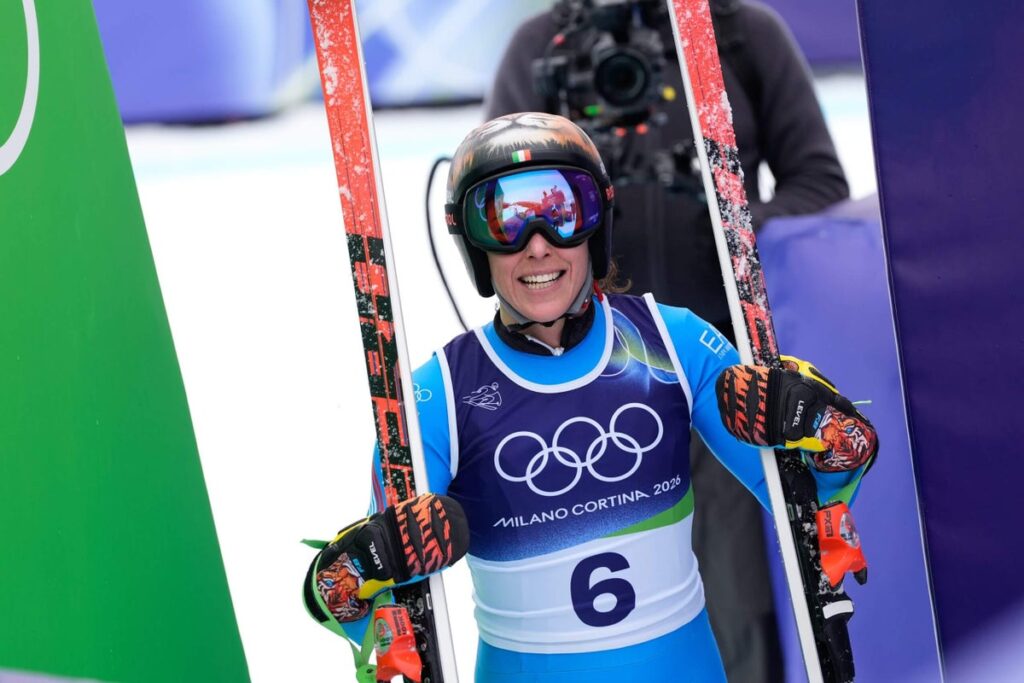
CORTINA D’AMPEZZO, Italy — A week ago, Federica Brignone pronounced herself just happy to be at the Winter Olympic Games and to be able to enjoy the once-in-a-career opportunity to compete on the biggest stage in her home country.
On Thursday, Brignone did a lot more than compete. Just 10 months after a crash at the Italian championships left her with a tear in her anterior cruciate ligament (ACL) and multiple fractures of her calf and tibial plateau, Brignone skied off with the gold medal in super-G.
On a gnarly, foggy, slippery day on the Olympia delle Tofane slope that felled 11 of the first 25 skiers, Brignone scored one for the older crowd. She stayed on her feet, barely, and became, at 35, the oldest woman to win an Alpine skiing medal.
Brignone completed the run in 1 minute, 23.41 seconds, 0.41 seconds better than France’s Romane Miradoli, who took silver. Austria’s Cornelia Huetter won bronze, 0.52 back.
“I was just trying to ski my best,” she said on the NBC broadcast. “I know I was an underdog today, I was an outsider. It has been really hard. I never told so much, but my injury was really hard every day, but I believed it. To be here, actually, my best thing was to be at the Olympics. So I was already happy.”
This one landed big. In recent years, Italy has failed to produce a standout in its favorite sport — soccer — and until Jannik Sinner came along in tennis, Brignone was at the top of the pyramid of Italian sports folk heroes. She has won 37 World Cup races and three Olympic medals, but never a gold.
On Thursday, Brignone took a wild ride down a nasty course that included a series of jumps into turns, a set-up that essentially asks skiers to switch directions in midair. Brignone looked like she was about to hit the snow at least twice. She nearly missed several gates.
Each time though, she recovered and got her shoulders, her hips and the tips of her skis pointed down the hill. She blazed across the finish line into a lead of 76 hundredths of a second at the time. She pumped her fists as the hometown grandstand that included Italy’s president, Sergio Mattarella, and Kirsty Coventry, the president of the International Olympic Committee, exploded for her.
But Brignone was only the sixth skier down the hill — or the sixth one who attempted to get down the hill. There were so many top speed skiers left, including her teammate Sofia Goggia and Alice Robinson of New Zealand, a protégé of Lindsey Vonn. Goggia and Robinson are leading the World Cup super-G standings this season.
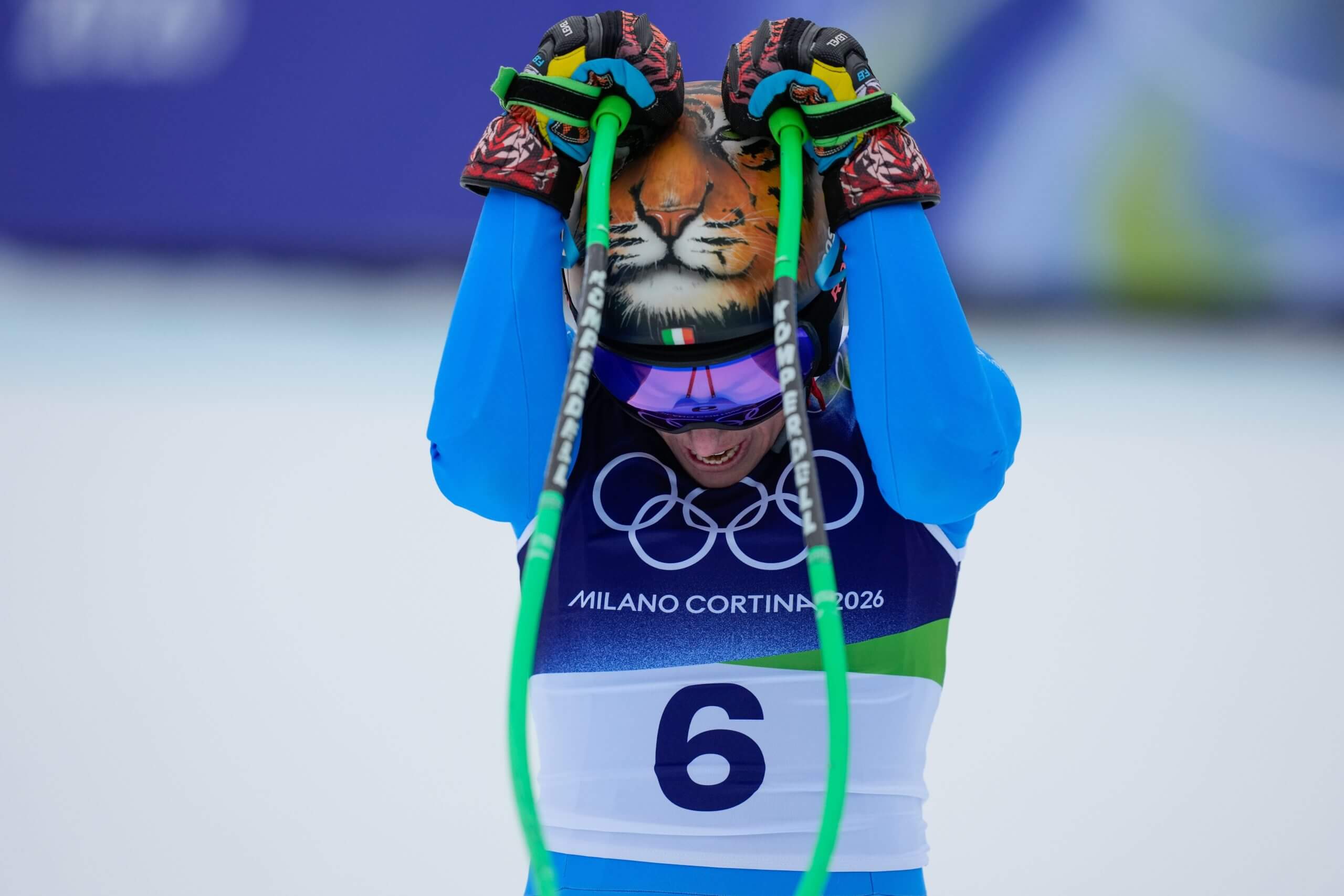
In her trademark tiger helmet, Brignone laid down easily the best run of the day in Thursday’s super-G, capping a remarkable comeback. (Agence Zoom / Getty Images)
Still, that vintage Brignone run looked like it was going to be good for a medal, and likely the top one.
One by one, they fell away, unable to match Brignone’s torrid pace as skier after skier tumbled into the snow or skied off course.
The Olympia delle Tofane’s victims included Breezy Johnson, the downhill gold medalist. About 20 seconds into the race, Johnson clipped a gate with her right shoulder and went skittering and twirling across the tracks. She flew into the safety nets, her back arching in the wrong direction. She somehow got up, seemingly without a serious injury, and eventually skied down the rest of the mountain.
Johnson said her coaches told her to stay in a tuck through the top of the course. She tried to stay low, but then she came over a first roll and was in the air and couldn’t get out of the way of the gate.
“Then you just try to kind of hold yourself together as best you can,” she said. “I took the net on, but luckily kind of scraped along it, so the helmet was a little, a little beat up.”
Johnson’s teammate, Mary Bocock, skiing in her first Olympic race, also wiped out violently in the upper half of the course, cascading across the snow before skidding to a stop. She, too, rose and skied the rest of the way down.
“I’m lucky, my airbag went off,” Bocock said.
Goggia didn’t crash but lost control and went off course. So did Ester Ledecka, the Czech skier/snowboarder who arrived in Cortina after competing in the parallel giant slalom snowboard competition earlier in the week across the country in Livigno. Ledecka won gold medals in 2018 in Alpine giant slalom and in snowboard parallel giant slalom. She also won gold in parallel giant slalom snowboarding again in 2022.
Robinson never found her groove. She ended up on the backs of her skis, putting on the brakes on multiple turns and never threatened for the podium.
Robinson said the course looked great during the inspection, but conditions changed as the air warmed and humidity settled, turning the snow soft and wet.
“It was really hard to create energy and to push, you had to just be really smooth the whole way, and I think people that were charging and trying to push the line too much,” she said, “it wasn’t working, so it was definitely a really challenging day.”
Super-G can always bring curveballs. It’s not like downhill, where racers get to do two official training runs ahead of the competition. In super-G, there’s an inspection, and then there’s a single-run race.
“Super-G is always tricky,” Robinson said. “You have to really understand the strategy and everything already on the inspection.”
Goggia is not having the sort of Olympics she hoped for. After lighting the Olympic cauldron in downtown Cortina last Friday night, she completed her medal set with a bronze in the downhill, but she crashed in the team combined event and skied out in super-G.
Another Italian hero, she’s said some odd things after each race. Goggia complained after the downhill about how long she and other skiers had to wait while Lindsey Vonn was being moved off the slope after crashing. During that 30-minute delay, the sun softened and slowed the course.
While that may have been true, Vonn had suffered what is likely a career-ending injury. Vonn was evacuated by helicopter after suffering multiple fractures in her left leg. She’s had three surgeries since Sunday.
Two days later, Goggia said she had trouble finding the same energy and inspiration in the team event. On Thursday, she was leading the field when she headed off course.
“It hurts a lot,” Goggia said.
Austria’s Huetter said the location of gates behind the rolling jumps made the course especially hard. “Blind gates,” she called them.
Brignone found her way.
“So incredible seeing Federica back on top of the podium,” Johnson said. “She’s been through so much with injury, and I think it’s a really cool full-circle moment for her. She’s one of the kindest people on the World Cup.”
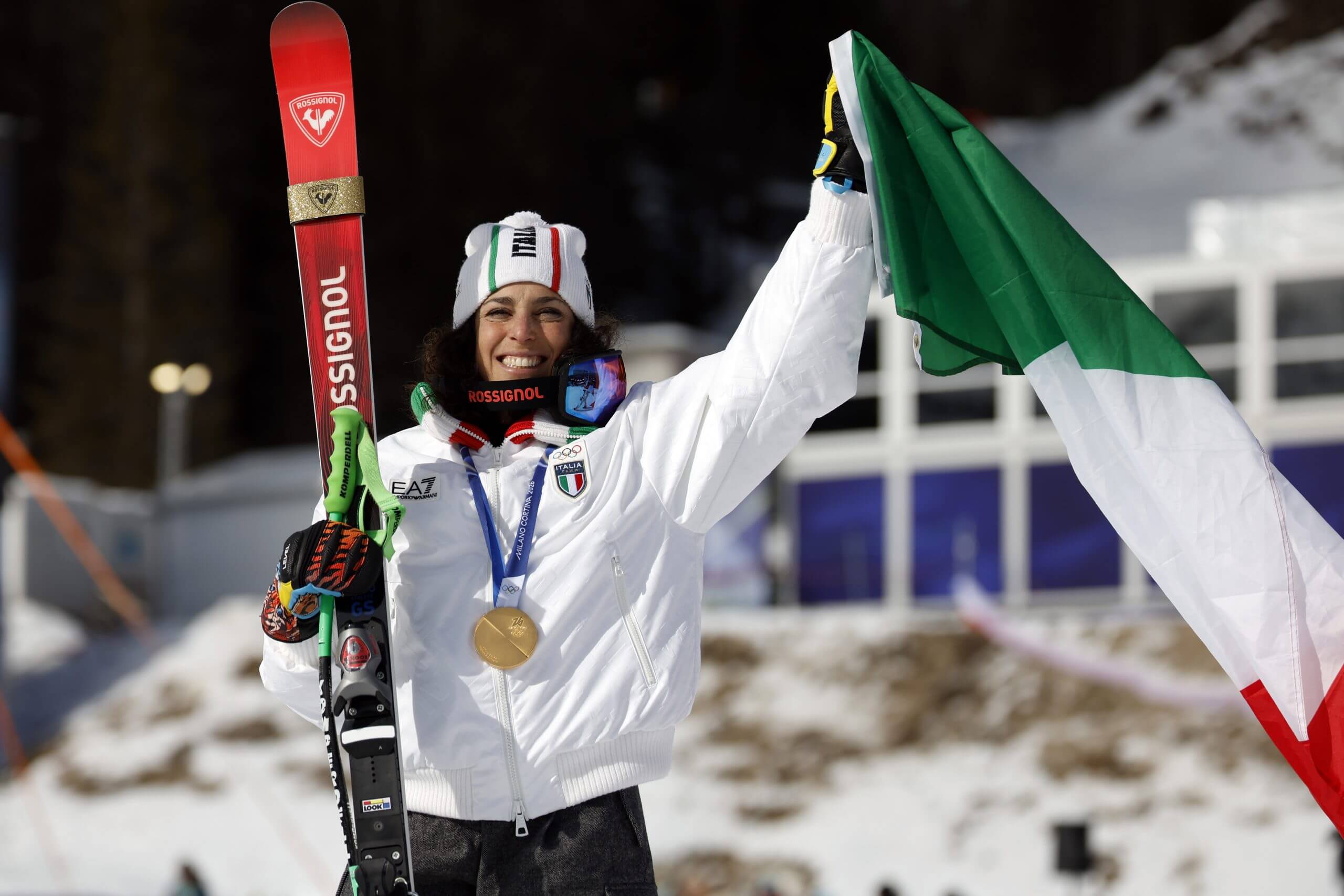
Brignone celebrates her win. (Christophe Pallot / Agence Zoom / Getty Images)
Last March, Brignone was celebrating a haul of crystal globes — the award given to the season-long World Cup champions in each discipline and overall. She won the downhill, giant slalom and overall titles last year and headed into the offseason with sights on another big year, capped by a home Olympics.
Plans changed in April, when Brignone had a bad crash during the Italian championships and suffered multiple fractures and a torn ACL in her left leg. It took two surgeries to fix, and she spent months recovering.
“It has been, like, a long way,” she said on NBC. “And every day now, with this slope, it was getting better and better with the confidence. With the downhill, I found myself better with the skiing, and this slope, because two weeks ago I was training here and it was really hard for me.”
She didn’t return to the World Cup circuit until Jan. 20, taking sixth in a giant slalom in Kronplatz, Italy. Eleven days later, she was 18th in a super-G in Crans-Montana, Switzerland.
That was all the top-level competition she had to warm up for these Games. She was then 10th in Sunday’s downhill.
Brignone also won silver in giant slalom and bronze in the combined event in 2022 in Beijing, along with giant slalom bronze in 2018 in Pyeongchang, South Korea.
Brignone also became the first Alpine gold medalist on home snow since Lasse Schusse won for Norway in Lillehammer in 1994.
“The problem is the pressure,” Brignone said.
For six years, people have been asking her about this competition. Ironically, her magic power came from the injury that made it difficult for her to walk, much less ski. That freed her of any pressure to perform. Her main emotion was gratitude for the chance to compete after everything she had been through. She didn’t bother training earlier in the week because she was in too much pain.
Still, after last week’s downhill training runs, she had the confidence that if she could make it to the starting hut, she could do something special, especially if she remained just happy to be here.
That part wasn’t so hard. As recently as November, she didn’t know whether she would be able to ski again.
Her plan as she burst through the gate was to stay consistent and “tactically intelligent and to let my skis go every moment,” she said, “I never thought of a result. … For me, it was impossible to be here with the gold medal.”
Then came the wait, which can sometimes be the hardest part of ski racing. But it was far better than where she had been over the past months, when she had to accept her injuries and whatever happened as a result of them.
“I’m a positive person, and I always strive to make something, to make it happen,” she said. “But sometimes when you try too hard, you want something too hard, you can’t achieve it. And today I was really calm.”