
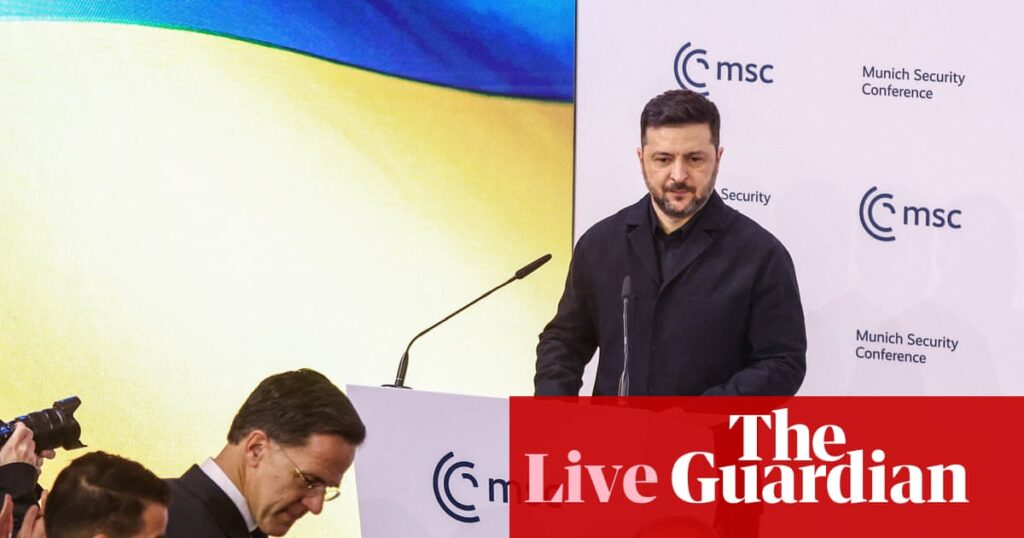
Zelenskyy says he wants to prompt leaders to “ask yourselves, are you ready not only for the challenges that Russian aggression brings, the challenges of modern war, but also for the constant effort to convince the world to fight for support to defend your country’s interests every single day as Ukraine must do.”
He then references continuing Russian ballistic and drone attacks on Ukraine.
As he talks about it, he has lots of visualisations and images shown on the screens behind him – including of some strikes that took place during his stay in Munich.
“I want you to understand the real scale of these attacks on Ukraine.
As you can see, in just one month this January, we had … to defend against 6000 attack drones, most of them were Shahid drones, and 150 plus Russian missiles of different types, and more than 5000 glide bombs.
And it’s like these every month. Imagine this over your own city. Shattered streets, destroyed homes, schools built underground.
And this is daily life in Ukraine because of Russia.”
He then talks about the devastating impact of these strikes on Ukraine’s energy infrastructure and praises the repair and rescue teams working on this emergency.
Key events
-
4m ago
‘We can stand up to Russia,’ Zelenskyy urges leaders
-
11m ago
‘None of our people chose to be heroes,’ Zelenskyy says
-
14m ago
Russia loses 156 soldiers per kilometer of Ukraine, Zelenskyy says, as he takes swipe at Hungary’s Orbán
-
19m ago
‘Our unity is best interceptor against Russia’s aggressive plans,’ Zelenskyy says
-
23m ago
Iranian regime ‘must be stopped immediately,’ Zelenskyy says
-
25m ago
Risk we face evolve and get worse as war goes on, Zelenskyy warns
-
29m ago
Zelenskyy shows impact of Russian strikes on Ukraine
-
1h ago
Rubio tells Europe US wants renewed alliance, but on Trump’s terms – analysis
-
1h ago
Starmer hits pro-European tones in urgent speech on unity in uncertain times – snap analysis
-
2h ago
Starmer says change in EU-UK relations is of ‘some urgency’ amid Ukraine war
-
2h ago
Von der Leyen, Starmer welcome Rubio’s ‘reassuring’ speech
-
2h ago
Starmer warns against ‘peddlers of easy answers’ on ‘extremes of left and right’
-
2h ago
Starmer says UK needs look to ‘move closer’ to EU single market
-
2h ago
Adversaries must know that in crisis, they could be confronted by combined nuclear strength, Macron says hinting at cooperation with France
-
2h ago
Starmer hints at more cooperation to boost Europe’s defence
-
2h ago
Starmer defends US alliance, but says Europe must take ‘primary responsibility’ for its defence to strengthen alliance, Starmer says
-
2h ago
Munich conference applauds Starmer’s break with Brexit years Britain
-
2h ago
‘Solidity of peace is softening,’ Starmer warns, as he points to ‘warning signs’ from Russia
-
2h ago
Europe needs to ‘recaliberate’ its security strategy to respond to challenges, von der Leyen says
-
2h ago
’10 years from Brexit, our futures are as bound as ever,’ von der Leyen says, as she calls for closer relations with UK
-
2h ago
Europe going through ‘awakening’ in response to changing global landscape, von der Leyen says
-
2h ago
Europe experiences ‘shock therapy’ on security as it wakes up from decades of lull, von der Leyen says
-
2h ago
Von der Leyen calls for ‘more independent’ Europe in response to global crises
-
3h ago
China hopes for settlement of Ukraine war, and Europe should be involved, Wang Yi says
-
3h ago
Rubio love bombs Europe in style, while issuing stark warnings on substance, and it seemed to work – snap analysis
-
3h ago
Talks ‘narrowed’ issues on Ukraine, but hardest questions remain unanswered for now, Rubio says
-
3h ago
End of transatlantic era ‘not our goal nor our wish,’ Rubio says
-
3h ago
US does not want allies to ‘rationalise broken status quo’ but face it and fix it, Rubio says
-
3h ago
US not interested in being ‘caretakers of west’s managed decline’, Rubio says in urgent call to reject ‘decline’
-
3h ago
UN, international bodies need to be urgently reformed as ‘we do not live in perfect world,’ Rubio says
-
3h ago
Rubio takes aim at deindustrialisation, mass migration as risks to Europe
-
3h ago
US ‘little direct and urgent in counsel,’ because ‘we care deeply,’ Rubio says
-
3h ago
Rubio talks about postwar delusion mistakes made ‘together’ by Europe and US
-
4h ago
Postwar triumph led to ‘dangerous delusion’ on end of history, Rubio says
-
4h ago
Starmer’s Munich speech alongside EU’s von der Leyen part of rapidly evolving post-Brexit relations – snap analysis
-
4h ago
Morning opening: What will the US say?
Please turn on JavaScript to use this feature
‘We can stand up to Russia,’ Zelenskyy urges leaders
Zelenskyy also calls out former officials and politicians who are now trying to shift responsibility for not acting to prevent the war.
He stresses that “we can stand up to Russia,” bringing up the example of a Ukrainian athlete disqualified from the Olympics for planning to wear a helmet showing the face of Ukrainian athletes killed in the war.
He repeats that Russia “must not be given any hope it can get away with this crime.”
He says Moscow was most serious about negotiations when Ukraine when it was hit by Ukrainian deep strikes inside its territory.
“The stronger we are, the more realistic peace becomes,” he says.
Zelenskyy says that Ukraine tried everything to prevent the war, but he didn’t get any serious help from the previous US administration to counter the Russian aggression.
“But the most practical advice General [Mark] Milley could give Ukraine at that time was simply dig trenches, and that is the answer my commander in chief brought back.
Just imagine, hundreds of thousands of Russian troops on your borders, massive military equipment, and all you hear is: dig trenches.
So if Russian troops enter Lithuania, God bless, just [as an] example, if or another country on Nato’ss eastern flank, what will the Allies hear then? Will they hear that help is on the way?
Hope so.”
But he says Europe needs to have its own ability to respond to any threat to send a clear signal as he backs call for more defence investment.
He also says that Ukraine has “the strongest army in Europe,” and “that’s why Europe needs Ukraine.”
“I think it’s simply not smart to keep this army outside Nato,” he says, “but at least let that be your decision, not Putin’s decision.”
Share‘None of our people chose to be heroes,’ Zelenskyy says
In a moving tribute to ordinary Ukrainians, Zelenskyy says “none of our people chose to be such heroes” as they worry about the war.
But he warns that Putin “is no longer interested in anything else” than the war, as “he cannot imagine life without power or after power.”
“Putin consults more with Tsar Peter and Empress Catherine about territorial gains than with any living person about real life. Can you imagine Putin without war?,” he asks.
He warns that Putin “may see himself as a tsar, but he is a slave to this war,” which is why Ukraine needs strong security guarantees.
The guarantees should answer the main question “how long there will be no war again,” as he says he hopes Trump and the US Congress hear that point clearly.
ShareRussia loses 156 soldiers per kilometer of Ukraine, Zelenskyy says, as he takes swipe at Hungary’s Orbán
Zelenskyy says that in both December and January, Ukrainian forces killed and badly wounded more than 30,000 to 35,000 Russian troops.
He says that at the moment, Russia pays with lives of 156 soldiers for every kilometer of Ukraine it secures.
“Putin is not concerned about this now, but there is a level at which he will start to care,” he says.
He says Ukraine aims to get to 50,000 kills a month to raise the price of continuing the war.
He says that Ukrainians are key to stop Russian aggression as they secure free and independent Poland, the Baltics, Moldova, and Romania.
In an angry swipe at Hungary’s Viktor Orbán, with whom he’s been publicly clashing in recent weeks, he says:
“Even one Viktor can think about how to grow his belly, not how to grow his army to stop Russian tanks from returning to the streets of Budapest.”
Share‘Our unity is best interceptor against Russia’s aggressive plans,’ Zelenskyy says
Zelenskyy goes back to drones, saying Ukraine has “more experience than anyone in the world” on how to defend about them.
He says:
“That is why while we invest in interceptors and protection, Russia invests in breaking unity between all of us, our unity with you, unity in Europe, unity in the Euro-Atlantic community, they want to break it.
Why? Because our unity is the best interceptor against Russia’s aggressive plans – the best one – and we still have it.”
He names several countries, thanking them for their help: Denmark, Germany, Czechia, the Nordics, the UK, France, the Netherlands, Italy, Poland, the US, Canada, Turkey and Japan.
But he says Russia also has its “accomplices”, including North Korea and Chinese companies that provide components for Russian weapons and missiles.
He also talks about the importance of stopping the Russian shadow fleet to further cut Moscow off funding for its war.
ShareIranian regime ‘must be stopped immediately,’ Zelenskyy says
Zelenskyy turns to the situation in Iran, as he picks up on demonstrations in Munich calling for a change of regime there (covered on the blog yesterday).
He says that Ukraine has no border with Iran or conflict with the Iranian regime, but points out that they continue to sell drones to Russia that kill Ukrainians.
“The Iranian regime has already done and can still do more harm than many other regimes could do in the century. … When they have time, they only kill more. They must be stopped immediately,” he says.
Updated at 06.18 EST
Risk we face evolve and get worse as war goes on, Zelenskyy warns
Zelenskyy also says the risks that Ukraine face continue to evolve, as he discusses how the Shahid-type drones have changed over the course of the war as they now have a jet engine and fly at different altitude, guided by an operator in real time.
“The longer the war continues, the more resources the aggressor receives, the more dangerous the consequences become, the more dangerous the evolution of weapons and of war itself is, and the evolution of Putin [himself],” he warns.
He expresses some frustration with how slow at times the response to the war had been, with Ukraine waiting “months” or “years” for much needed supplies.
“Everyone who seeks security and peace must understand this every day matters,” he says.
ShareZelenskyy shows impact of Russian strikes on Ukraine
Zelenskyy says he wants to prompt leaders to “ask yourselves, are you ready not only for the challenges that Russian aggression brings, the challenges of modern war, but also for the constant effort to convince the world to fight for support to defend your country’s interests every single day as Ukraine must do.”
He then references continuing Russian ballistic and drone attacks on Ukraine.
As he talks about it, he has lots of visualisations and images shown on the screens behind him – including of some strikes that took place during his stay in Munich.
“I want you to understand the real scale of these attacks on Ukraine.
As you can see, in just one month this January, we had … to defend against 6000 attack drones, most of them were Shahid drones, and 150 plus Russian missiles of different types, and more than 5000 glide bombs.
And it’s like these every month. Imagine this over your own city. Shattered streets, destroyed homes, schools built underground.
And this is daily life in Ukraine because of Russia.”
He then talks about the devastating impact of these strikes on Ukraine’s energy infrastructure and praises the repair and rescue teams working on this emergency.
Zelenskyy begins by thanks to all who “stand with us, not only in words … emotions, but in real actions.”
He then stresses the importance of the PURL, or the Prioritised Ukraine Requirements List, scheme that supplies Ukraine with US-made weapons to continue its fight against the Russian aggression.
He then says that one of the worst things that a leader can hear is that the air defence units are empty and cannot repel Russian attacks – and some of them come “at last moment.”
He thanks Germany, Norway, the Netherlands for their help in this area in particular.
Updated at 06.26 EST
Jakub Krupa
in Munich
Zelenskyy is here and ready to speak – and gets a standing ovation before he even says anything.
Coming up, we will hear from Ukraine’s president Volodymyr Zelenskyy, Nato’s secretary general Mark Rutte, European Parliament’s president Roberta Metsola and US senator Roger F. Wicker and their ideas on Ukraine shortly.
I will bring you all the key lines here, obviously.
ShareRubio tells Europe US wants renewed alliance, but on Trump’s terms – analysis
Patrick Wintour
Diplomatic editor
in Munich
The tone of Rubio’s speech earlier was greeted with relief by the delegates in the hall, although many pointed out Rubio was not offering a partnership of equals, but an alliance largely framed in Donald Trump’s terms.
US secretary of state Marco Rubio delivers a speech during the 62nd Munich Security Conference (MSC 2026) in Munich, Germany. Photograph: Anadolu/Getty Images
In offering the hand of friendship, in sharp contrast to the tone adopted by the US vice-president, JD Vance, at the same conference last year, Rubio made clear the US was not shifting on its fundamental approach.
Throughout the speech he showered praise on Europe’s history, but in so doing raised questions whether Europe had the capacity to join the US’s rebuilding of the world.
Jakub Krupa
You have a brief opportunity to grab a (soft!) drink of your choice and a quick sandwich before we go back to the main hall for the next panel on Ukraine, with Volodymyr Zelenskyy among the speakers in just a few minutes.
ShareStarmer hits pro-European tones in urgent speech on unity in uncertain times – snap analysis
Jakub Krupa
in Munich
This was a very pro-European speech by Starmer, at times even resembling Macron’s speech from yesterday – and similarly undercut by serious doubts as to the credibility of the vision he outlined given his precarious future.
Britain’s prime minister Keir Starmer gives a speech at the 62nd Munich Security Conference (MSC) in Munich, Germany. Photograph: Stefan Rousseau/AFP/Getty Images
His repeated references to “10 years on from Brexit” and “some urgency” in this reset (10:33, 10:56) were particularly interesting: could it be a sign of further rapprochement as we get closer to the actual 10th anniversary of the Brexit referendum in June?
Speaking alongside the European Commission’s president, a sign in itself, Starmer has made it pretty clear that his government is very interested in closer defence amid increasingly urgent threat from Russia (10:31, 10:42) and reinvigorating trade ties (10:46), including some sort of alignment with, but not a membership of, the EU single market. And there is some appetite for both of these things on the EU side, too.
But reopening these debates would bring back the usual questions about associated trade offs and political costs, which both are tricky for any UK government, even at the best of times. Just thinking about it give me flashbacks from covering the Brexit years.
There is also a domestic angle to all of that.
As my colleague Jessica Elgot noted last month, the battle over closer ties with Europe is not accidental here as it is likely to be a key dividing line that Labour seeks to draw with Reform.
We heard a bit of that in his comments warning against “the peddlers of easy answers” on “the extremes of left and right” (10:49).
Updated at 05.32 EST
Starmer gets asked about domestic politics in Britain now, and if he “narrowly just missed being toppled” in the last few weeks and how much credibility he has to talk about these long-term projects being in a difficult spot politically.
He says he rejects that, as he “ended the week much stronger than I started it.”
“My party and my government is completely united on the question of Ukraine and defence and security and the need for stronger relations with Europe, on defence, on security and on economy as well,” he says.
He says some of these issues have support across the parliament, except for Reform party politicians, which he says are “pro-Putin.”
“Imagine, if they were in government in the United Kingdom, the Coalition of the Willing could not exist with the UK’s participation in it; we would not be seen as a leader on the European or international stage,” he says.
He warns that under Reform, “we would be seen as a country that people couldn’t do business with.”
He says Labour supported the Conservative government’s line on Ukraine when it was in opposition, and he’s happy to see this continue after the change of government in 2024.
And that concludes the Q&A.
On Ukraine, the two leaders get asked about reported US pressure on Ukraine to move to a deal, even at the cost of concessions to Russia.
Von der Leyen says it’s important not to fall for Russian propaganda narrative on the war, which she says “is a huge failure” for Putin.
She says it’s important to put pressure on Putin to get him to take peace talks seriously.
Starmer also notes that “we are not dealing with two equal parties,” as “there is an aggressor, which is Russia, and there is Ukraine, which has been subject to attack.”