
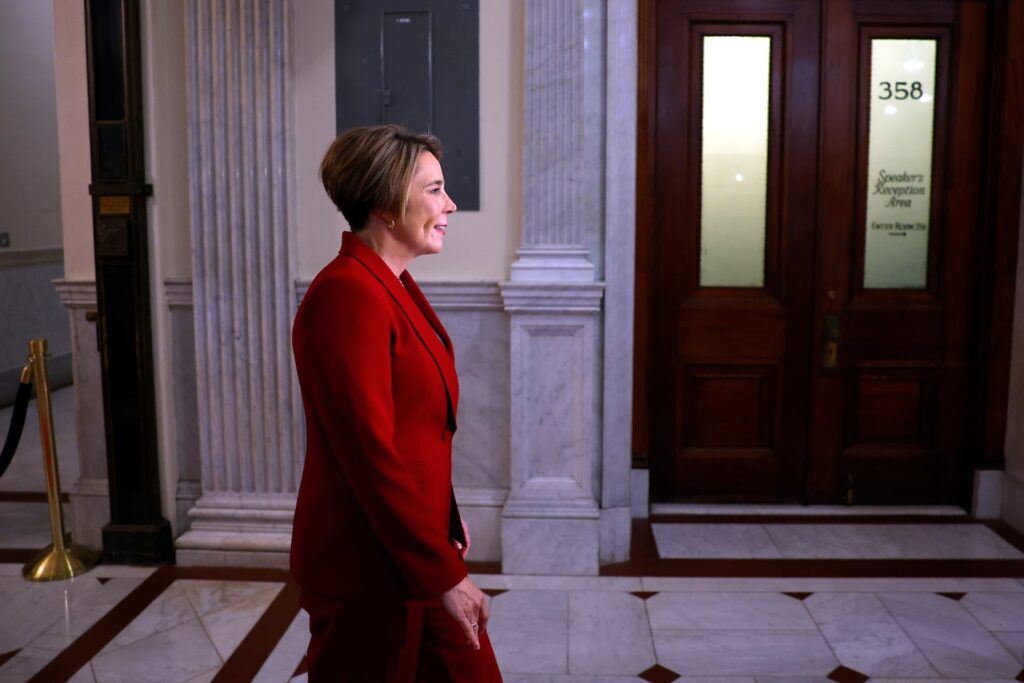
Healey and her aides have done little to pound the pavement on behalf of one of her administration’s major climate initiatives, the so-called ResilientMass Finance Strategy. Although the report was finished around Thanksgiving, it was not distributed to the media or unveiled at a showy announcement, as is common with big political initiatives, and was finally published online just Thursday evening, nearly three months later, after the Globe inquired about it.
“It’s remarkable why such a gigantic budget buster is not brought to the attention of the public sooner,” said Mary Connaughton, chief operating officer of the Pioneer Institute, a conservative leaning think tank that focuses on Massachusetts public policy.
Even some of the stakeholders who contributed to the effort privately said they fear the governor is shying away from talking about such a massive expense because it could be considered politically risky.
The Healey administration did not directly respond to questions about whether political calculations factored into dissemination of the findings. In a statement, a spokesperson for the governor noted she has both “focused on making life more affordable in Massachusetts, while also protecting our communities from the mounting impacts of climate change.”
Danielle Burney, a spokesperson for the Office of Energy and Environmental Affairs, noted her agency releases dozens of reports each year and shares them with relevant stakeholders.
“The report has also already informed important actions,” Burney said. ”We are grateful for the collaboration in our work and will continue to keep stakeholders and the public informed.”
It’s not so much the report was quelched as “it was kind of a quiet release by the administration,” said Kris Sarri, state director of the Nature Conservancy in Massachusetts. It was circulated among those who worked on it, which include specialists from the private sector, and raised at meetings of the Mass Municipal Association and the Metro Mayors Coalition — hardly mass market audiences.
Yet the suspicion among some that Healey is avoiding the topic was reinforced when the governor did not mention climate change at all during her annual State of the Commonwealth speech in January, despite the subject being a cornerstone of her political platform and subject of previous addresses.
Further, the governor’s new budget proposal calls for nearly $20 million in cuts to the main state agency overseeing her climate initiatives, the state Executive Office of Energy and Environmental Affairs, its lowest funding level in at least four years.
The political context for any politician considering big spending initiatives is pretty sobering. For example, a Suffolk University/Boston Globe poll in December found that one-third of 500 voters surveyed have considered moving out of Massachusetts because of the high cost of living here.
“There is no end in sight to fiscal challenges in Massachusetts, particularly as the state’s population growth wanes with people fleeing to more affordable states,” Connaughton said. “Kicking the can down the road for future administrations to deal with is not good long-term strategy.”
Indeed, the climate-spending findings come at the same time Healey is confronting a backlash over skyrocketing energy bills, driven in part by a number of green energy programs that are financed by fees on customers’ bills. She has proposed a temporary 10 percent reduction on winter gas and electric bills, yet the deep cold of much of the season has only served to keep the issue top of mind for residents.
For some involved in climate planning, Healey is doing herself — and the public — no favors by not publicizing the difficult choices the state will inevitably face.
“The problem doesn’t go away until we decide to address it,” said Brian Swett, chief climate officer for Boston.
“This is not discretionary, in the mindset of like, ‘Oh, we can wait 10 or 15 years to get started,’ ” Swett said. “We have already burned through all of the extra slack time we had on climate.”
The scope of work is massive. It includes elevating or protecting commuter rail tracks, highways, and roads in flood plains and hardening MBTA tunnels, buying out as many as 2,500 residential properties in danger of flooding, adding cooling measures to countless buildings, upgrading drinking water and waste systems, and beefing up culverts, drainages, and small bridges.
The report also recommends the state remove 200 to 300 dams, restore thousands of acres of wetlands, and conserve 685,000 acres of forest land.
For those not keeping count, that’s $130 billion or so — and likely far from the final bill.
“The administration has a huge challenge in socializing the scale of this,” said Bradley Campbell, president of the Conservation Law Foundation, a legal group that advocates for environmental causes.
Regardless of how well or little known the report is, officials at the state Office of Energy and Environmental Affairs say have already begun the hard work of implementing it. That includes filing a $3 billion bond bill known as the MassReady Act that would provide funds for some of the work.
Katherine Antos, the state’s undersecretary for decarbonization, said the thinking inside her agency was that rather than spending time saying “here’s another plan or strategy,” they would highlight the work they are already doing.
The MassReady Act would create a revolving fund to help communities and water districts access low-interest loans to pay for climate-related projects. The legislation would also make it easier to permit climate-resilience work, such as restoring marshes and replacing culverts, and would open up more grant funding in the state.
Still, the $3 billion is barely a down payment on the looming climate challenges facing the state, and some worry that unless political leaders engage a more public debate about the extent of the problem, it will not get fully addressed.
Swett, the Boston climate officer, said he hopes the state will entertain creative solutions, such as a tax on visitors flying into Logan Airport to fund climate resilience. It’s a tool that has been used in other cities, such as Amsterdam, to pay for city services.
Others argue businesses that stand to benefit from improvements such as coastal barriers and flood protections should pony up.
“This is not something that the public sector can take care of alone,” said Sarri. “The question is, what is the private sector willing to help actually pay for?”
Sabrina Shankman can be reached at sabrina.shankman@globe.com.