
 Ritratt: Newsbook Malta
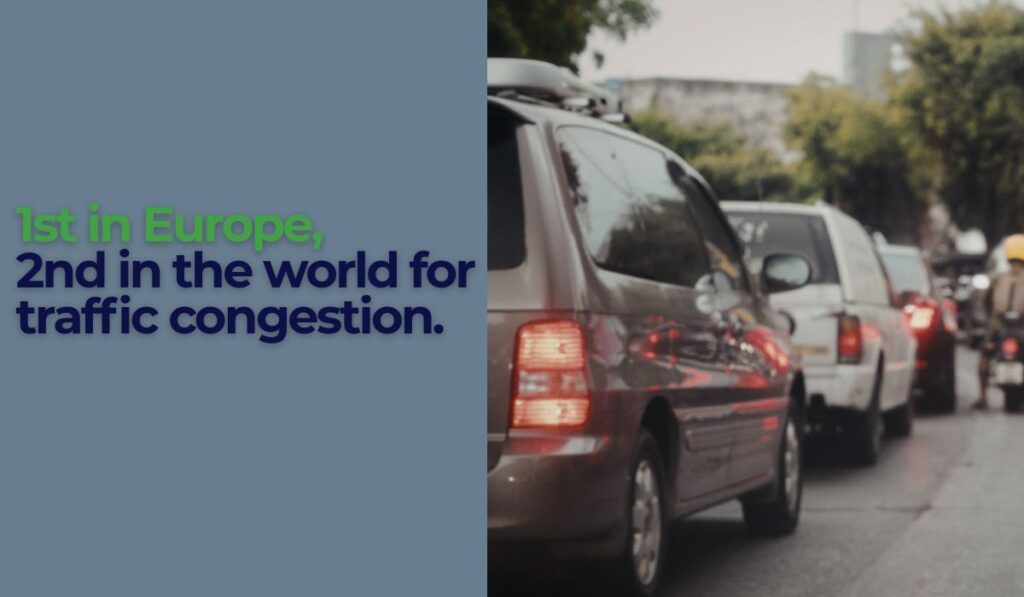
Malta has been ranked the world’s second most congested country, trailing only Colombia, according to the latest TomTom Traffic Index released last month.
The mapping technology specialist’s 15th annual study found that Malta recorded an average congestion level of 45.1% in 2025, meaning journeys across the island took nearly half as long again as they would under free-flow conditions. Colombia topped the rankings at 48.8%, while the Philippines placed third at 44.6%.
Drivers in the Valletta area lost 94 hours to peak-hour traffic over the course of 2025 – an increase of nearly four hours compared to the previous year – based on a standard 10-kilometre commute driven twice daily during rush hours. The figure translates to nearly four full days spent annually in congestion.
A 10km journey during morning peak took an average of 27 minutes and two seconds; in the evening, 27 minutes and 47 seconds. The average congestion level for the year stood at 50.5%, 1.9 percentage points higher than in 2024. At that rate, the average distance a driver could cover in 15 minutes was 6.7km, 0.2km less than the previous year.
The rankings position Malta first in Europe, and well above larger nations including India (37.4%), Singapore (36.8%), Japan (34.3%), and the United Kingdom (27%). The United States, despite housing several notoriously congested cities, ranked 54th globally with just 19% average congestion.
TomTom attributed Malta’s exceptionally high national ranking to the absence of high-speed motorway networks that typically offset urban congestion in larger countries. Unlike nations where rural highways lower overall averages, nearly all driving in Malta occurs on urban or arterial roads, meaning the concentrated congestion of Valletta and central regions defines the entire national score.
The congestion crisis comes despite Malta having invested heavily in road infrastructure expansion over the past decade. Infrastructure Malta, the government agency responsible for major projects, has overseen significant arterial road upgrades, including the Marsa Junction and Central Link developments.
However, critics argue these investments exemplify “induced demand” – the phenomenon whereby expanded road capacity simply encourages more driving, ultimately returning congestion to previous levels. Malta’s vehicle density supports this concern: as of September 2025, the island had 454,138 licensed vehicles for a population of approximately 574,000 – roughly 791 vehicles per 1,000 inhabitants, placing it amongst the highest motorisation rates in Europe and globally.
The National Statistics Office reports the vehicle fleet increases by approximately 36 vehicles daily, with passenger cars comprising 73.6% of the total. Malta’s vehicle density substantially exceeds the EU average of 560 per 1,000 inhabitants and rivals the United States.
Research from the University of Malta’s Institute for Climate Change and Sustainable Development has quantified the broader costs of this congestion. A landmark study estimated the external costs of traffic – including lost productivity, accidents, air pollution, noise, and climate impacts – at €274 million annually, roughly 4% of Malta’s GDP. Without significant intervention, researchers project these costs could reach €1.2 billion by 2050.
The psychological toll has also been documented. A 2023 study by the University of Malta’s Faculty for Social Wellbeing found that 47.7% of respondents “strongly agreed” that simply thinking about traffic increases their anxiety levels, whilst nearly 60% stated time spent in traffic negatively impacts their mood for the remainder of the day.
Despite the worsening statistics, successive governments have avoided implementing demand-management policies common in other congested European cities, such as congestion charging zones or significant restrictions on private vehicle access to urban cores.
The Robert Abela administration has instead emphasised road infrastructure expansion and introduced free public transport for residents – making Malta one of the first countries globally to do so.
Critics, however, argue that without politically challenging measures to actively discourage car use, Malta’s position near the top of global congestion rankings seems unlikely to shift.
The island’s compact geography and high population density create what transport researchers describe as a “structural trap” – limited space for road expansion combined with cultural attachment to private vehicle ownership that makes demand-reduction policies politically fraught.

