
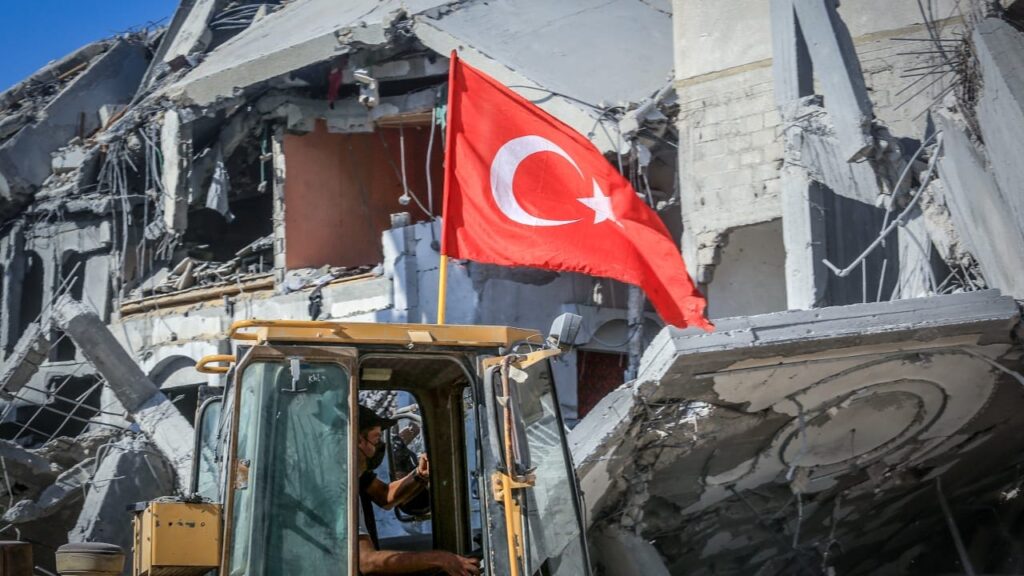
Turkey’s Diyanet Foundation has opened three mosques in Gaza, according to TRT, the Turkish state-run broadcaster. A video online showed members of the Turkish charity in blue vests helping to refurbish and open the mosques. The report says that the work is designed to enable suitable places for worship during Ramadan. This is part of Ankara’s efforts to increase its influence in Gaza.
According to the report, the organization opened the Abdullah Azzam Mosque in the Al-Sabra neighborhood of Gaza, the Al-Huda Mosque in Jabalia’s refugee camp, and the Al-Isra Mosque in the Sheikh Radwan neighborhood. These areas were heavily damaged in fighting during the war that began with the Hamas attack on Israel on October 7. Abdullah Yusuf Azzam was an Islamist jihadist of Palestinian and Jordanian background. It appears that the mosque was named for him, although it was not clear from the broadcast.
According to a paper at the Institute for National Security Studies at Tel Aviv University, “while al-Qaeda and Hamas have become household terms, far less familiar is the man behind the idea of al-Qaeda, the Palestinian sheikh Abdullah Yusuf Azzam, who also did much to support the establishment and entrenchment of Hamas.” A mosque with a similar name is also located in Nuseirat in central Gaza.
The Diyanet Foundation says on its website that it has conducted work on nine mosques in “Palestine” but doesn’t mention the three latest ones. The organization says it works to build mosques that are a foundation of “brotherhood.” It also notes “today, mosques are rising with the efforts of the Presidency of Religious Affairs and our foundation to deliver the Adhans to every corner of our country and every continent of the earth with the donations made by our beloved nation.” The work is clearly one backed by the government and part of Ankara’s mission to work with Islamic communities around the world.
Towards that end, Turkey is working to grow its influence in Gaza. One way it does this is via religious charities. The organization notes that the “Diyanet Foundation, which was established to support the activities of the Presidency of Religious Affairs, delivering religious services to a wider audience and raising the next generation who will take part in religious services, has become a significant civil society movement in our country today with 1,003 branches and a wide range of activities and international aid activities in 149 countries around the world, from education to culture, social and charitable services to supporting religious services.”
In another sign of Ankara’s growing involvement, Turkey’s Foreign Minister Hakan Fidan also met with Ali Shaath of the National Committee for Administration of Gaza. This is the technocratic Palestinian organization that is backed by the Board of Peace to transition governance in Gaza away from Hamas. In the past, Ankara has hosted Hamas leaders for meetings and backed Hamas. It is not clear if this represents a change.
Turkey’s state-run media said that “Hakan Fidan receives Ali Shaath in Turkish capital, diplomatic sources say.” It went on to say, “The NCAG, formed after the October ceasefire in Gaza, is a Palestinian governance body under recent peace efforts to oversee Gaza’s civil administration and reconstruction, with Turkey offering diplomatic backing and humanitarian support to help stabilise and rebuild the besieged enclave.”
Turkey’s TRT also noted that “the National Committee for the Administration of the Gaza Strip said on Saturday that preparations for handing over the institutions of the sector pave the way for its management during the transitional phase, while Palestinian President Mahmoud Abbas called for the removal of obstacles to the second he National Committee for the Administration of Gaza considered that the statements issued from within the sector regarding the readiness to hand over all public institutions pave the way for enabling the committee to fully assume its responsibilities in managing the transitional phase.”
The meeting with Shaath and the support for mosques in Gaza are part of the multi-pronged efforts by Ankara to increase is influence and also maintain its current level of influence in Gaza.