
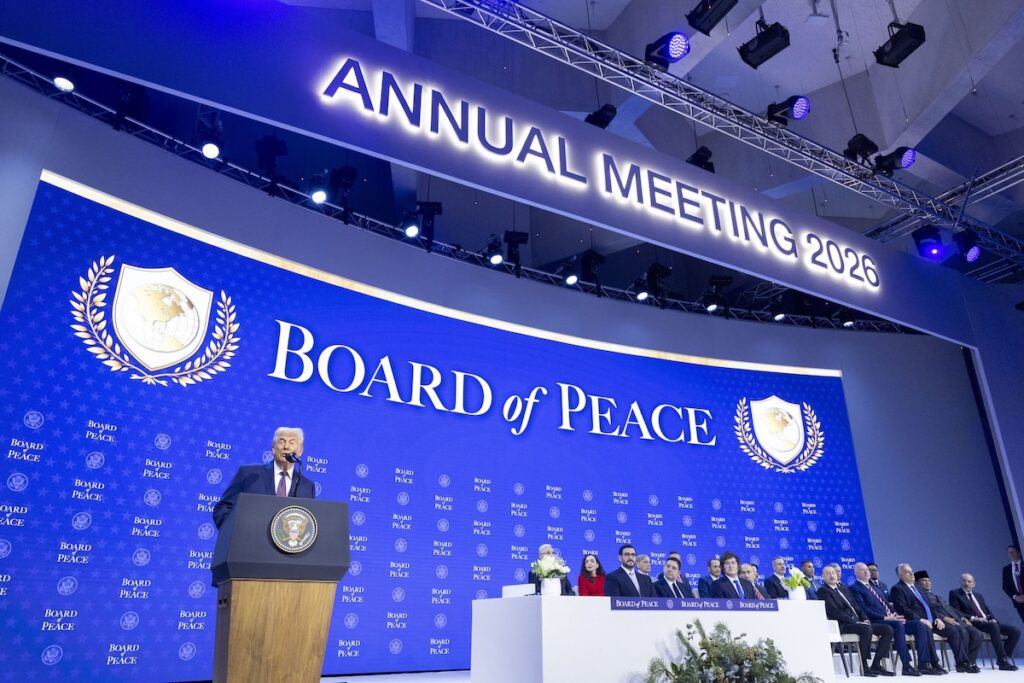
On Tuesday, Foreign Minister Antonio Tajani will testify before the Senate’s Foreign Affairs and Defence committees in joint session on Italy’s participation as an observer in the U.S.-backed Gaza Board of Peace. Rome’s line: remain engaged in Gaza’s reconstruction and regional stabilisation without breaching constitutional limits, using observer status to retain influence while managing domestic backlash.
Why it matters: Italy is moving to join — as an observer — the U.S.-backed Board of Peace for Gaza, signalling a pragmatic doctrine: stay inside decisive processes shaping Gaza’s post‑war order and the wider regional balance while navigating constitutional constraints at home.
Driving the news: Tajani is set to brief Parliament after a political push by Prime Minister Giorgia Meloni’s government to formalize Italy’s participation through a parliamentary vote of guidance.
- A government summit took place this afternoon at Palazzo Chigi, attended by Meloni and her deputy prime ministers, ahead of Tajani’s communications to lawmakers.
- Tajani will appear before the Senate’s Foreign Affairs and Defence committees in joint session after opposition parties demanded clarification on Italy’s role.
- Rome plans to attend the first Board meeting in Washington as an observer — the only formula deemed compatible with Italy’s constitutional framework.
State of play: Italy’s leadership argues the country cannot afford to be absent from Gaza’s reconstruction framework.
- “We cannot stay out of Gaza’s reconstruction,” Tajani told Corriere della Sera, framing observer status as both a constitutional necessity and a strategic choice to stabilise the Middle East.
- Rome sees participation as a way to influence post‑Hamas governance and reconstruction decisions without formally joining the governing structure.
- Officials also point to the presence of the European Commission and other European actors to rebut claims of excessive alignment with Washington.
The big picture: Meloni’s decision reflects a broader foreign‑policy doctrine: Italy should be present wherever major geopolitical decisions are made.
- Observer status, according to the government, offers three advantages:
- Access to discussions on Gaza’s future.
- Protection from constitutional challenges at home.
- Alignment with the U.S. while remaining anchored in the European framework.
Between the lines: The debate exposes a deeper tension in Italian foreign policy — balancing Atlanticism with European coordination and domestic legal limits.
- Opposition leaders accuse the government of subordinating Italy to Washington and legitimising a U.S.-driven plan for Gaza.
- The government counters that absence would mean forfeiting influence over a regional transition with direct implications for migration, energy security, and Mediterranean stability.
Zoom in: Strategic rationale. Participation is framed not as ideological alignment but as strategic realism.
- As noted by columnist Roberto Arditti on Formiche, our sister website, being inside the Board — even as an observer — strengthens Italy’s credibility and signals a more political, pragmatic Europe willing to engage in security and reconstruction decisions rather than relying solely on multilateral diplomacy.
What to watch: Who will represent Italy in Washington remains unresolved.
- Tajani is the most likely envoy, though Meloni herself could attend depending on the level of participation by other European leaders.
- Italian diplomacy is closely watching Berlin and other capitals to calibrate the political weight of its delegation.
Bottom line: Italy is betting that presence without full membership is better than principled absence — a middle path designed to keep Rome relevant in shaping Gaza’s future while avoiding constitutional and political pitfalls at home.