

America’s abandonment of the “endangerment finding” undergirding national climate policy is not the most important thing that happened last week. That decision was an act of gross stupidity, but it was also perfectly predictable given the people making it, and since America’s not doing anything good on climate anyway it won’t have deep immediate effect. (As is often the case, humorist Alexandra Petri had the best response). What will matter more, I think, for America and for policy going forward, is the news that we’re likely to see another El Niño soon; take this as your first warning that not only the temperature but the politics of the planet are likely to change dramatically, and soon.
We’re still in a La Niña phase in the Pacific right now—the cooler part of the cycle that meant that 2025’s global temperature was “only” the second or third highest ever, trailing 2023, the last big El Niño year. But that hot phase seems to be returning, and somewhat faster than expected. In the last few weeks, big Kelvin waves have been moving eastward across the Pacific, driving warmer water before them; these can sometimes peter out, but strong westerly wind bursts across the region—counter to the usually dominant trade winds—seem to indicate this one is for real; the best guess of the various forecasters is that sometime between June and September the world will enter an El Niño cycle.
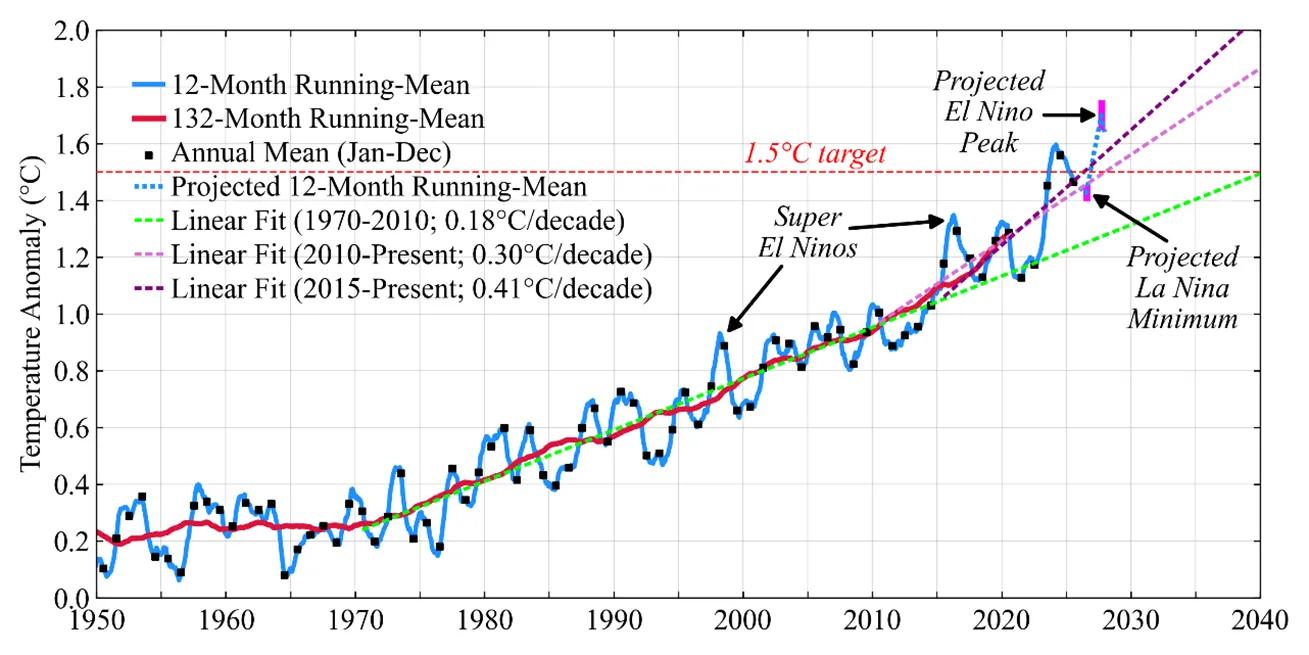
When that happens, prepare for bedlam. Each El Niño event in recent decades has gotten steadily worse, because each one drives the temperature to a new record. That’s because each is super-imposed on a higher baseline temperature that comes with the steady warming of the planet. As James Hansen and his team pointed out in a paper last week, the expected low temperature at the close of the La Niña this spring is expected to be about 1.4 degrees Celsius above pre-industrial temperatures, which is higher than the maximum from the last El Niños. We are ever further into the great overheating.
We get fires and floods all the time now, but we get lots more of them when the temperature tilts sharply up. As Eric Niiler reported in the Times, the Pacific warm current “brings the potential for extreme rainfall, powerful storms and drought across some areas of the globe.”
So let me make a few predictions about what this next El Niño will mean, assuming it appears.
-
The idea that “global warming is over” as a political issue will quickly disappear. It’s mostly in this country that it’s taken hold, but our mediasphere is strong enough that the notion seeps in around the world. Here, for instance, is the truly shameful editorial in the new Bezosified Washington Post, saluting the end of the endangerment findings because regulating greenhouse gas emissions carries only “modest benefits.” Big new global temperature records will remind the world the peril we’re actually in, and even in our rotten domestic politics it will lift those governors—maybe particularly J.B. Pritzker and Gavin Newsom—who have solid claims to significant climate progress.
If you want a sense of how close we’re dancing to the brink, check out this new study from some of the heavy hitters in climate research, documenting the approach (or in too many cases the passing) of various tipping points in the earth’s climate system.
Prof William Ripple, at Oregon State University, who led the analysis, said: “The [great Atlantic currents are] already showing signs of weakening, and this could increase the risk of Amazon dieback. Carbon released by an Amazon dieback would further amplify global warming and interact with other feedback loops. We need to act quickly on our rapidly dwindling opportunities to prevent dangerous and unmanageable climate outcomes.”
-
The impact of this new warming surge will be especially profound because this El Niño will probably provide the final proof that global warming is actually accelerating sickeningly from its previously merely alarming pace. Hansen and his team have an important new paper making this case. They have long believed that the planet is more sensitive to greenhouse gases than other researchers—basically, they’ve held, based in part on models of ancient climates, that doubling the amount of co2 in the atmosphere will increase temperatures 4 degrees Celsius, not the three or so that is closer to the existing consensus. They’ve made a bold set of temperature predictions that the temperature will rise to 1.7 degrees Celsius above pre-industrial temperatures in this El Niño cycle, and that that will mean we’re due to hit a two-degree Celsius rise, long viewed as the mark to avoid, by the 2030s, about fifteen years ahead of standard predictions.
They think that global warming began to accelerate viciously about 2015, and that it will become evident to everyone in the next few years, and they even engaged in a bit of good-natured trash-talking aimed at other climatologists who they said were beginning to arrive at a “befuddled recognition that something was wrong with the models, which did not reproduce the rapid warming of the past several years.” Here’s their guess of the political impact, with which I agree:
Realistic understanding of the climate situation, and public recognition of that, is the essential first step toward successfully addressing climate change. Progress in climate science during the next 5-10 years is needed for the development of effective energy and climate policy because the pressure for policy action will grow along with climate impacts as global temperature approaches +2°C.
The current flippant attitude – 1.5°C isn’t so bad, we can deal with 3°C – of people who should know better will dissolve, if we can improve understanding of the danger of passing the point of no return.
I will note that Hansen remains a bit apart from other climate researchers, but that they are starting to converge a little on his numbers. (An interesting Washington Post article on parts of the debate can be found here). Here’s reliable climate scientist Zeke Hausfather’s predictions for the next two years—he’s got extremely wide error bars, but Hansen’s predictions fit within them. And Hausfather underscores the seriousness of the numbers
The fun part about making these short term forecasts is that we won’t have to wait that long to see how well they play out. The less fun part is that we are all forecasting a future rate of warming well above the ~0.2C per decade that has characterized the post-1970 period.
-
In fact, I’ll make one more speculative prediction myself. The heating is going to be so big and so obvious that it will lead, for the first time, to a real global discussion of solar geoengineering as a response. I think that is tragic and also increasingly likely, because the cost of letting the temperature continue to rise will be so large that the side-effects that could come from pouring sulfur into the atmosphere will start to seem more more evenly matched with the weather carnage on display. It’s probably time for those who care about the planet to start figuring out what their response to this debate will look like. There are some good reasons to fight it tooth and nail, but it’s also the moment to start insisting that if it’s ever going to be even considered it be accompanied by an iron-clad commitment to drive down fossil fuel emissions to zero. If we’re going to bet the future of the planet, the reason can’t be to make sure Exxon’s business model remains intact.
James Hansen, by the way, remains a fascinating part of this story. I’ve been talking with him for almost forty years (my profile of him, from the 1980s for Outside magazine, is apparently so old it can’t be found digitally). I volunteer on the board of the nonprofit that supports his research (contributions to fund it can be sent here). I would say: if you’d bet against him over the years, you’d have gone broke.
One way of summing up this moment is to say that the endangerment finding, and the politics of climate, are puny in the face of physics. We’re going to see that physics in action again in the next 24 months, and it will drive many changes. Some of them will be political.
Our job is to make sure that we use that sad opening to force as much change as we can.
In other energy and climate news:
+From DeSmog Blog and Rolling Stone, an important investigation into the trillions of gallons of toxic wastewater that the fossil fuel industry is gifting the future. From Justin Nobel
A cache of government documents dating back nearly a century casts serious doubt on the safety of the oil and gas industry’s most common method for disposing of its annual trillion gallons of toxic wastewater: injecting it deep underground.
Despite knowing by the early 1970s that injection wells were at best a makeshift solution, the U.S. Environmental Protection Agency (EPA) never followed its own determination that they should be “a temporary means of disposal,” used only until “a more environmentally acceptable means of disposal [becomes] available.”
The documents include scientific research, internal communications, and talks given at a December 1971 industry and government symposium. And they come from multiple federal agencies, including the EPA, the U.S. Department of Energy, and the U.S. Geological Survey (USGS).
The documents show there may be little scientific merit to industry and government claims that injection wells are a safe means of disposal — putting drinking water and other mineral resources in communities across the country at risk of contamination, and jeopardizing local economies and public health.
+Good news from Africa, which is emerging as the fastest growing solar market on earth. Allan Olingo chronicles the surge:
Historically, South Africa dominated solar imports in Africa, at one point accounting for roughly half of all panels shipped to the continent. The latest data show its share has slipped below a third as demand surged elsewhere. Last year, 20 African nations set new annual records for solar imports, as 25 countries imported a total of at least 100 megawatts of capacity.
+Know your toadies. Excellent account of Interior Secretary Doug Burgum in the American Prospect. Hannah Story Brown and Toni Augilar Rosenthal write:
In March, Burgum told oil and gas executives that he sees them as “the customer.” In August, his Interior Department claimed that renewable projects are “environmentally damaging,” and repeatedly insisted that coal—a highly polluting fuel that is far, far more expensive to use to generate electricity than renewables—is the miracle solution to the country’s affordability crisis.
Again borrowing Trump’s favored communication style of strangely capitalized tweets accompanying AI-generated images, Burgum introduced a lump of coal named Coalie as the new “spokesperson” of “Beautiful, Clean Coal” for the Office of Surface Mining Reclamation and Enforcement. He has played a central role in opening new public lands to coal mining and preventing coal plants from closing, passing on the costs to communities in the form of more expensive electricity bills and increased air pollution. While the administration pushes coal, it has also made it easier for miners to be sickened and killed by black lung disease, and harder for afflicted miners to access health care.
Perhaps worst of all, Burgum has led Interior in a historic sabotage of renewable-energy development, including by requiring that all solar and wind projects be personally approved by Burgum himself, and rescinding the designated study areas for offshore wind. These orders were followed by cancellations or stop-work orders on a slate of wind energy projects. He has also propagated baseless claims and conspiracies about wind farms, including that they inexplicably present a profound national-security risk. In doing so, Burgum has threatened thousands of jobs nationwide, undermined the long-term stability of the nation’s power grid, wasted billions of dollars in delays and red tape, and contributed to skyrocketing electric bills nationwide.
+The 21 million people who live in Sao Paulo—making it the biggest city in the Americas—are battling both prolonged drought and occasional violent flood, even before the El Niño gets underway. Fabiano Maisonnave reports:
Water in the region’s largest reservoir network is hovering at 32%, the lowest since the region endured its worst water crisis in 2014 and 2015, and is due to dip lower as the dry season approaches. Meanwhile, the Brazilian city has been battered in recent weeks by intense storms that have killed four people, including an elderly couple whose car was swept away by rushing water.
“What’s behind all of this is climate change, derived not only from global warming and greenhouse gas emissions, but also from land use change,” said Marcelo Seluchi, a meteorologist from Brazil’s National Center for Monitoring and Early Warning of Natural Disasters, also known as Cemaden.
The federal agency’s data shows that precipitation levels have been falling since the 1960s in much of Brazil, coinciding with widespread deforestation in the central area and in the Amazon. “A forested area evaporates four times more water than pasture,” said Seluchi. “This moisture is a fundamental input for causing rain, along with that which comes from the ocean.”
On the other hand, rising temperatures allow the atmosphere to hold more moisture. That saturated air releases far greater amounts of water in a short time when it rains, producing intense downpours and flash flooding, he said.
+Bob Howarth, the pioneering Cornell chemist largely responsible for our understanding of the threat of methane in this country, has an important new paper explaining the failure of Kathy Hochul’s New York State energy efforts, an effort he’s gotten to watch up close as a member of a key Empire State advisory panel.
New York is far from being a climate leader, with a little less than one third of our electricity from renewable sources. Eighteen states are doing better, with renewables producing more than half the power in twelve, including Vermont, Maine, and California. Globally, seventeen countries produce more of their electricity from renewables than does NY, including Germany, the UK, Australia, and China
+If you’re enjoying the Olympics (all hail Johannes Klaebo, greatest winter Olympian of all time, with his total of nine gold medals so far), you may also notice the backdrop of dead trees. As in the western U.S., Italy’s Dolomites have been suffering a plague of bark beetles as temperatures rise. The website MountainsForEverybody has details
A 2024 Annals of Forest Science study reports that milder winters and longer warm seasons now allow 3-4 beetle generations annually, up from 1-2 historically, fueled by climate change.
+Hmm. A new aluminum smelter is going up in Oklahoma, not West Virginia, because wind energy produces cheaper electricity than coal. Maria Gallucci:
For clean energy advocates, the decision to build in Oklahoma and not the Bluegrass State felt like an indictment of Kentucky’s power system. Coal-fired power plants supplied 67% of the state’s electricity generation in 2024, and gas plants generated another 26%. Hydroelectric dams provided most of the rest, though dozens of solar projects are in development, including ones atop old mining sites.
“Kentucky needs to learn from this and understand that our infrastructure, too, is an economic development tool,” said Elisa Owen, a Louisville-based senior energy organizer with the Sierra Club’s Beyond Coal Campaign. “We cannot remain invested in 19th-century energy if we want to attract 21st-century business. It’s just as simple as that.”
Meanwhile, the Financial Times reports that the same shift is underway in China, where aluminum smelters are relocating from coal country to the renewables-southwest.
China’s aluminium industry has embarked on a green long march, moving millions of tonnes of production from the northern coal country, its stronghold for seven decades, to pockets of the south and west rich in renewable energy.
The country’s output of electrolytic aluminium, the sector’s main product, reached 43.8mn tonnes in 2024, accounting for about 60 per cent of the world’s total production, according to local industry data. However, following a spree of relocations in recent years, 13mn tonnes of that capacity — about 30 per cent — now comes from new smelters in areas with clean energy and low-development costs in Yunnan, Sichuan, Xinjiang and Inner Mongolia.
The years-long multibillion-dollar relocation project is helping decarbonise one of the world’s dirtiest industries. Analysts believe the aluminium sector’s success will serve as a blueprint for Beijing to direct more aggressive production caps and capacity swapping in other industries.
In fact, the economics of coal are so stupid that the Trump administration now is resorting to using the Pentagon to start buying up supplies for its use.
The anticipated order would direct the Defense Department to enter into agreements with coal plants to purchase electricity.
Lauren Herzer Risi, director of the Environmental Security Program at the Stimson Center, a Washington, D.C. think tank that analyzes issues related to global peace, noted that the order runs counter to the agency’s recommendations, which favor on-site microgrids with distributed energy solutions rather than centralized external power production.
Research by the National Laboratory of the Rockies, formerly the National Renewable Energy Laboratory, found that solar power combined with battery storage can enhance energy security at military bases, at “little to no added cost,” in the event of power outages.
+Veteran readers of this newsletter know that I like blimps. And obviously I’m a big fan of windpower. So now a Chinese company has invented what is essentially a combination blimp and wind turbine, designed to catch those steady higher-altitude breezes.
The enormous S2000 Stratosphere Airborne Wind Energy System (SAWES) flew at an altitude of 2,000 metres in southwest China’s Sichuan Province, generating electricity and successfully connecting to the power grid – a world first for a high-altitude wind power device.
The aircraft-like structure functions as an “airborne power station” and combines an airship platform with wind turbines to capture stronger, more stable winds high above the ground.
I trust that you, like me, would enjoy looking at a picture of this machine

On the other end of the size spectrum, Boston’s housing authority is figuring out how to install window-based heat pumps in city-owned apartments.
It’s a new type of heat pump that’s compact, hangs over a windowsill and plugs into a standard 120 volt outlet — no HVAC technician or electrician required.
The units aren’t widely available to the public yet, but the Boston Housing Authority is piloting them in the Hassan Apartments, a 100-unit complex in Mattapan for seniors and disabled adults. The 50-year-old building is one of many older structures across the Northeast with an energy-gobbling heating system and no air conditioning — factors that make it a prime candidate for a climate retrofit.
“It’s really exciting for us because we feel like it could be the tip of an iceberg of converting many thousands of units,” said Kenzie Bok, administrator of the Boston Housing Authority.
+Doyne Farmer—whose analysis of learning curves helped people understand the sudden surge in renewable energy even as it was in its infancy—is proposing a new method for simulating the world’s economy. Damian Carrington reports that he’s driven by his concern about climate change
“It’s an area where the failure of economic models is seen most dramatically,” he says. “I think the models we have are completely inadequate and even misleading. For example, the track record for these models in saying what renewable energy was going to do is genuinely terrible. They consistently predicted that it would be very slow to roll out and the cost would come down very slowly.” In reality, costs have plunged and the rollout has been rapid.
Driven by this, Farmer’s team’s first step towards a complexity model of the entire world economy is tackling the energy sector. The model encompasses all 30,000 companies and their 160,000 oil rigs, power stations and other assets, based on a rich, 25-year-long dataset of how they have operated.
“We’re literally modelling the decision-making of all the energy companies in the world,” he says, each represented by a separate digital agent in the model. “We can simulate the whole energy system of the world to see how much energy each company delivers and at what price.”
The model is still in development, but should be much better at laying out the best path to a green energy future than today’s economic models. That could be transformative – a data-led study by Farmer and colleagues in 2022 found that a rapid transition to clean energy could save the world trillions of dollars.
+Energy influencer Bad Bunny did an excellent job of reminding the world that Puerto Rico’s electric has never recovered from a series of hurricanes (and management scandals). The folks at the Solutions Project have a new video out about one solution, community solar microgrids.
When lights go out across the island, Casa Pueblo’s solar microgrids keep running. Instead of relying on a crumbling centralized grid that leaves 3.2 million people in the dark for an average of 27 hours a year, these systems bring renewable power generation directly to communities.
The results speak for themselves: 80% reduction in electricity bills, zero power outages, and neighbors supporting neighbors during emergencies. From local businesses staying open during blackouts to families finally having peace of mind during hurricane season, this is what energy independence looks like.
Last month, Casa Pueblo demonstrated how their interconnected solar microgrids can transform Puerto Rico’s landscape. In front of special guests and community members, electrical engineer and researcher Maximiliano Ferrari gave a live demonstration of the orchestrator, an innovative technology that breaks with the current model of unidirectional transmission and allows multidirectional dynamics of energy exchange between communities. This demonstration proved that microgrids can support each other in times of emergency or massive blackouts to ensure that community energy needs are met.
“We are proposing to scale up and evolve from independent solar installations, which number more than 175,000 throughout the country, to energy communities of homes with and without solar panels. We already know that individual systems offer a good quality of life. With the microgrid ecosystem, we would have a good coexistence,” said Casa Pueblo’s executive director, Arturo Massol Deyá.
+Wildfires raging in Patagonia claimed some of the world’s oldest trees. Meanwhile Jeva Lange reports that wildfire is spreading in the eastern United States as temperatures rise, and that researchers are worried.
Though the Eastern U.S. is finally exiting a three-week block of sub-freezing temperatures, the hot, dry days of summer are still far from most people’s minds. But the wildland-urban interface — that is, the high-fire-risk communities that abut tracts of undeveloped land — is more extensive in the East than in the West, with up to 72% of the land in some states qualifying as WUI. The region is also much more densely populated, meaning practically every wildfire that ignites has the potential to threaten human property and life.
It’s this density combined with the prevalent WUI that most significantly distinguishes Eastern fires from those in the comparatively rural West. One fire manager warned Smithwick that a worst-case-scenario wildfire could run across the entirety of New Jersey in just 48 hours.
+Cynthia Kaufman, the author of the just-published Solidarity Economics, has a nifty essay on how to manage the political transition to cleaner energy—it’s well worth reading, and not just for the Californians its mostly aimed at.
Navigating the bumps and difficult spots in the transition requires us to be very thoughtful about how our work sits at the intersection of affordability, sustainability, and democracy. It requires that we maintain as much solidarity as possible among those who are fighting for a world that works for us all. And it requires that we be proactive in dealing with the political machinations of an industry that will stop at nothing to protect its ability to profit.
Solidarity means we are all in this together, we look for solutions that serve a multiplicity of needs, and use our intersectional lenses to make sure no one is left behind. We need to always be sure that we propose solutions that don’t benefit one part of society while causing another to suffer.
+Good possible news from Indonesia, where a surge in EVs means that the government may not need to turn over millions of acres of forest for biofuels plantations. David Fickling has the story:
The switch in Southeast Asia has been less celebrated, but is becoming breathtakingly rapid. EVs in Thailand are already cheaper than the fossil-powered equivalent, and made up about a fifth of the market last year. In Singapore, they accounted for a Chinese-style 45%, and 32% in Vietnam.
The pivot in Indonesia, the fourth-most populous country with 285 million people, has been even more dramatic. In 2020, less than one in every 350 cars sold was electric. In December, that number stood at more than one in three.
A recognition of the transformation underway could give the nation cleaner air, a less-ravaged environment, stronger fiscal and current accounts, and more jobs — all while reducing the risk of catastrophic climate disasters, like the floods that claimed the lives of 1,201 people in Sumatra last month. It’s a good bargain.