
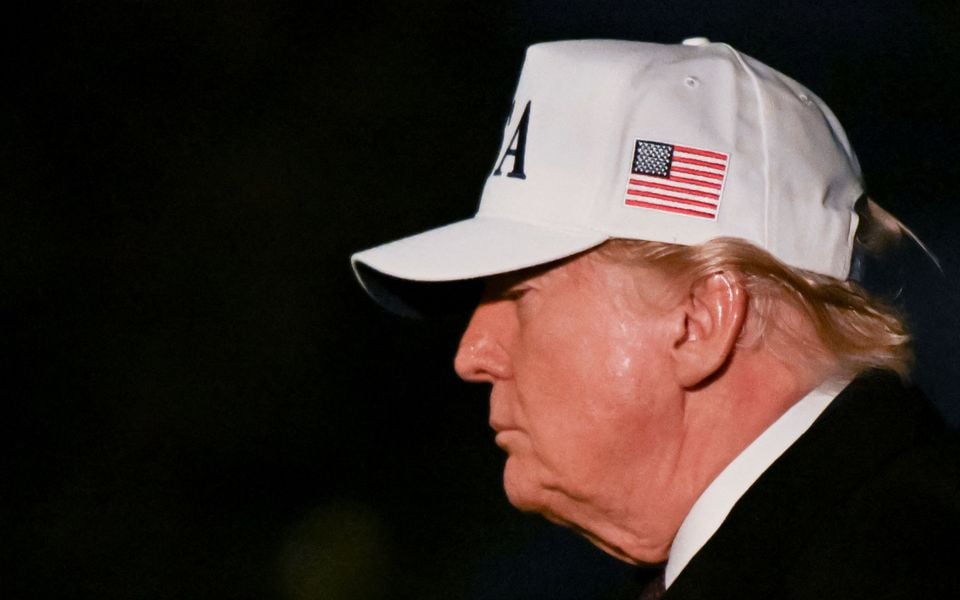
US President Donald Trump walks after arriving on the South Lawn aboard Marine One, at the White House in Washington, D., US, on January 11, 2026. [Annabelle Gordon/Reuters]
Donald Trump’s shaking the bond between the United States and Europe highlights a fundamental difference between the two sides: The Americans see the Europeans as foreigners, while the Europeans turned out to have believed that they had a close kinship with their great ally.
Before the first Trump term, there was a sense in Europe that the member-states of NATO and the European Union were part of a single body, with the United States as the head and spine of a geopolitical giant who promoted their mutual interests and guaranteed their security. But right from the start of his first term, Trump hammered away at the message that the Europeans were “ripping off” the United States and that this had to change. He didn’t manage much then, and Joe Biden’s presidency appeared to be a restoration of close ties. Trump’s return, though, is leading to a definite rift.
And while Trump, his vice president, J.D. Vance, cabinet members and aides seem to delight in imposing American might on the Europeans, the Europeans stand dazed before the revelation that the “giant” on which they relied for their security and prosperity has been stricken by a disease against which it has no antibodies, because it comes from within the body. That’s why the Europeans are surprised, dismayed, and very slow in setting aside their differences and uniting to face the dangers of the time.
The European citizens have realized the need for major decisions for their collective security. The latest Eurobarometer (conducted in Autumn 2025 and released on Wednesday) found that 89 percent of respondents believe member-states “should be more united to face current global challenges,” and 86 percent “want the EU to have a stronger voice at the international level.” Also, seven out of 10 are “highly worried” about “active conflicts and wars near the EU (72 percent), terrorism (67 percent), natural disasters made worse by climate change (66 percent), and cyberattacks from non-EU countries (66 percent).” A few months earlier, in June 2025, the Pew Research Center had found a precipitous drop in Europeans’ (and others’) positive perceptions of the United States. Sweden, for example, recorded a 79-percent unfavorable rating and just 19 percent positive view (from 44 percent and 47 percent, respectively, in 2024), while in Germany there was a 16-percent drop of the positive rating of the United States (from 49 percent to 33 percent). And all this before Trump demanded that Denmark hand over Greenland to the United States, before he threatened the EU with further tariffs.
US Secretary of State Marco Rubio’s comments on Friday to reporters a day before his appearance at the Munich Security Conference were both a statement of the obvious and a challenge to the Europeans. “The world is changing very fast right in front of us,” he said. “We live in a new era in geopolitics, and it’s going to require all of us to sort or re-examine what that looks like and what our role is going to be.” The world is changing at the rate that it is mainly because this president is translating his personal habits and obsessions into America’s policies, disrupting geopolitical balances and social achievements of many decades, undermining the struggle against climate change and encouraging the enemies of democracy in the EU.
Last year, at the same forum, Vance had set out this reality in a direct and contemptuous way. Now the Europeans appear to be getting the message, that they will either be vassals or will stand up, united.