
![[OC] 25 years of my earnings adjusted for inflation show raises that didn’t increase purchasing power and a late inflection point](https://www.byteseu.com/wp-content/uploads/2026/02/eyk9i0l11wjg1-1536x656.png "[OC] 25 years of my earnings adjusted for inflation show raises that didn’t increase purchasing power and a late inflection point")
First time posting. A friend suggested this sub might appreciate this, so I’m sharing.
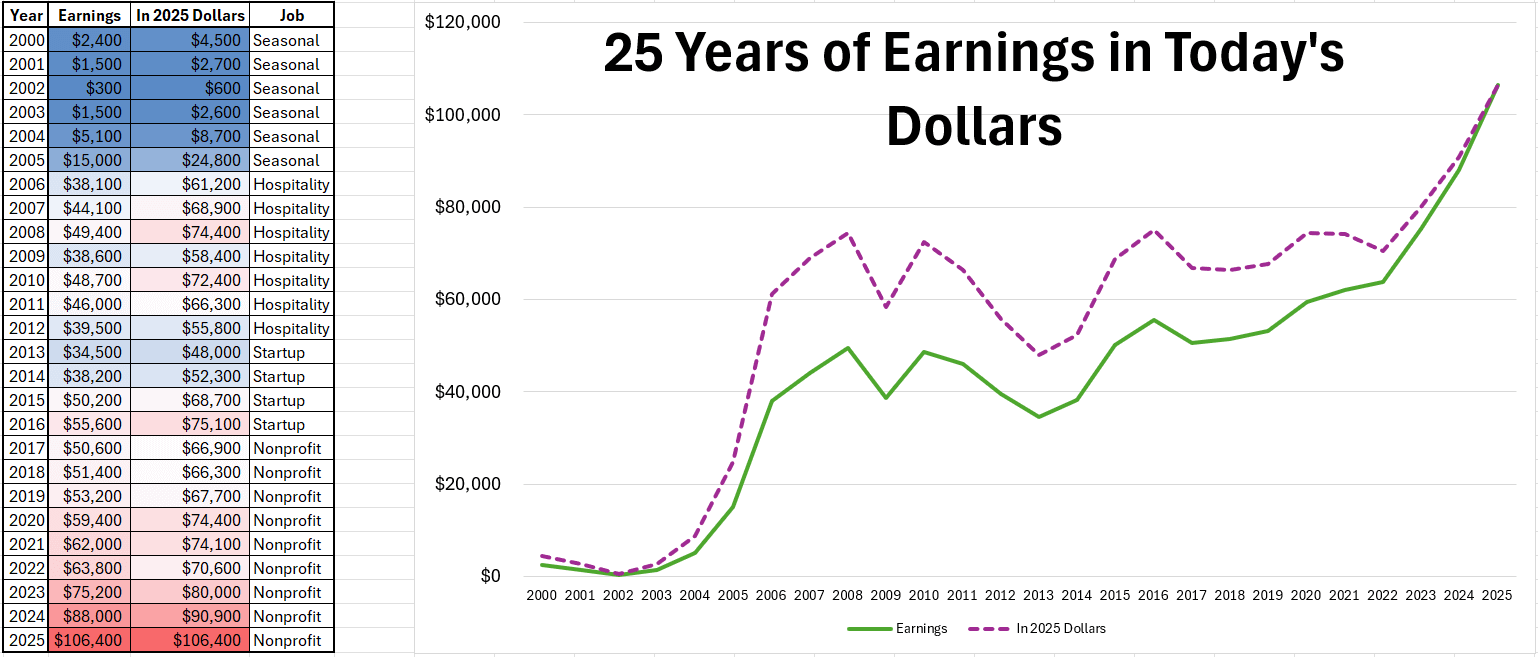
This chart shows 25 years of my earnings adjusted to current-year dollars using U.S. CPI. Figures are rounded, and job labels generalized to preserve anonymity, but the data and trends are accurate.
A few patterns stood out once everything was converted to real dollars:
- Despite multiple raises and promotions, my inflation-adjusted earnings returned to roughly the same ~$74k level (in today’s dollars) five separate times between 2008 and 2021.
- Nominal income growth masked long stretches of real wage stagnation.
- The most recent upward break represents the first sustained move above a ceiling I had previously hit multiple times.
- For additional context, my current salary (~$106k) has purchasing power roughly equivalent to about $66k in 2000, which helped explain why milestone salaries can feel less transformative than expected.
The inflection point coincides with completing a master’s degree and a leadership-focused professional credential. The effect was not immediate, but it aligns with the first sustained break above prior real-income peaks.
Sharing as a single data point rather than a universal claim. Adjusting long time horizons for inflation was clarifying for me, and I hadn’t seen many personal examples visualized over multiple decades.
Happy to clarify methodology if helpful.
Posted by RemarkableElk4306
9 Comments
A major stagnation from GFC until COVID is clearly visible
I’m curious, I’m 10 years younger and sounding like I’m on a similar path.
What was your masters in? What field/role did it assist your career? Did you have to move employers to see the breakout?
https://preview.redd.it/1ki7xij36wjg1.png?width=1149&format=png&auto=webp&s=3e719175be911f113a4ae6e81c57c5c436a360e1
I’ve had a very similar experience in the past decade working in tech. Purchasing power actually decreasing despite a promotion. All at the same company. (I haven’t been able to job hop)
Honest subjective question: Did you feel like in 2016-2017 you were doing well financially? Raise and low cost of items? Was this a good time in your life? Did you buy a new/used car, washer/dryer, other large purchases?
Wow, I’ve tracked my income over time and at minimum have 3% raises/year. I got a new role in 2018, with a 30% raise and have had 3 market adjustments on top of my yearly raises, which were additional 3-5% and I’m hardly staying above inflation.
This is pretty eye opening. I don’t make a massive amount, but definitely more than average- I really feel for those who are making less and have employers that don’t or can’t at least do the minimum of keeping up with inflation.
Inflation adjusted earnings since a job change:
2018: 99k (partial year with ~30% raise)
2019: 106k (3% raise)
2020: 108k (3% raise)
2021: 109k (6% raise)
2022: 102k (3%)
2023: 111k (9%)
2024: 106k (2.5%)
2025: 110k (6%)
I don’t see the raises that you are talking about. The only comparison seems like 2008 vs 2016, you were earning $6k more but like… 8 years is a long time, and it was at a different company in what appears to be a different role. I don’t think that counts as a “raise”.
If your point is that your wages were effectively stagnant from 2008-2019 I would like to point out that… they were? 11 years later you grossed 10% more. That’s not exactly a surprising finding that the real earnings were eaten up by inflation
This fits my personal experience too. Adjusting for inflation I make less now than I did in 2016
What source are you using for relative value of a dollar pegged to 2025?
My trajectory is almost the same