
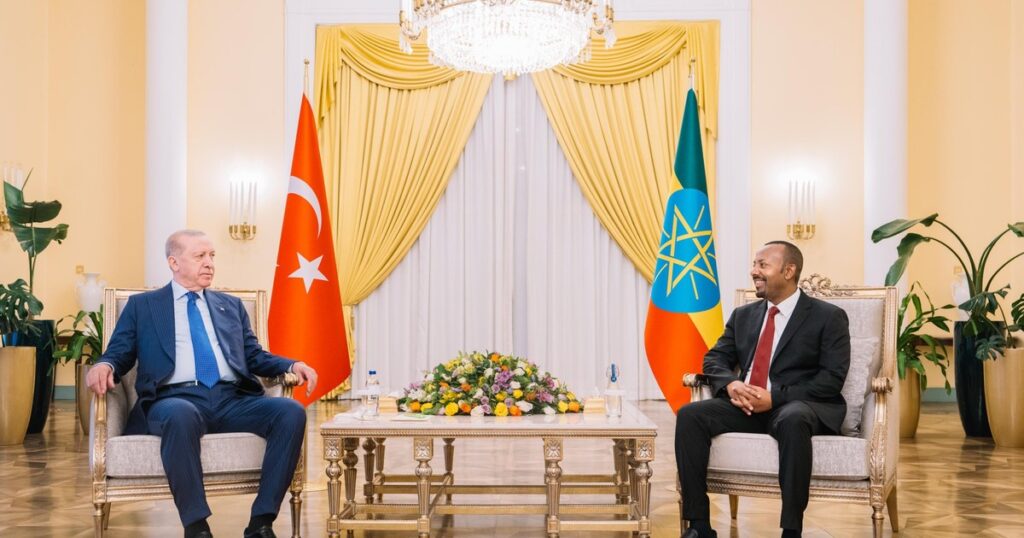
The Turkish leader on Tuesday touched down in Ethiopia on an official visit, just a few weeks after receiving Bola Ahmed Tinubu, the president of Nigeria.
Following the meetings between both parties, Nigeria signed a series of trade and security agreements with Turkey aimed at boosting bilateral trade to $5 billion and strengthening cooperation on defence.
Initial reports showed that both countries inked nine memoranda of understanding covering trade, energy, defence, media, education, and agricultural standards.

Perhaps, Turkey’s president intends to replicate such agreements with the East African country of Ethiopia, as he reached the office of Ethiopia’s Prime Minister, Abiy Ahmed.
President Recep Tayyip Erdogan and his delegation received an official and elaborate welcome ceremony in Ethiopia.
“Held substantive discussions with President @RTErdogan of the Republic of Türkiye. Our talks reinforced the enduring friendship and robust cooperation that underpin Ethiopia-Türkiye relations,” the Prime Minister of Ethiopia stated.
“We exchanged views on strategic areas of collaboration and reaffirmed our mutual commitment to advancing partnerships that serve the interests of both nations. I am confident that our continued engagement will further strengthen the ties that unite our countries,” he added.
Turkey’s recent engagement in Africa
Outside of Turkey’s MoUs with Nigeria, which aims to expand bilateral trade from about $2 billion to $5 billion, the West Asian country also has some agreements with Egypt.
During President Recep Tayyip Erdoğan’s official visit to Cairo and negotiations with President Abdel Fattah el-Sisi, Turkey’s state-owned armaments producer, Mechanical and Chemical Industry Corporation (MKE), and Egypt’s Ministry of Defence struck a deal.
According to Middle East Eye, the agreement includes ammunition exports and the creation of local production facilities in Egypt, placing the North African country as a possible regional manufacturing hub for military gear.
Concerning its agreement with Nigeria, both nations further consented to cooperation in areas including energy development, higher education, and the Halal Quality Infrastructure, a framework established to facilitate Nigerian agricultural products in meeting international certification standards and accessing new markets.