
Hailed as a “new gateway to European justice”, the redesign of the main portal to access EU case law, InfoCuria, has drawn the ire of legal scholars from around Europe.
“It’s a disaster,” one law professor wrote to EUobserver.
A letter seen by EUobserver, dated 9 February, and signed by law practitioners and academics states that the new search tool “has made it very difficult, if not almost impossible, to conduct our research effectively.”
The letter was addressed to Marc van der Woude, president of General Court of the European Union and Koenraad Lenaerts, president of the Court of Justice of the European Union (CJEU).
“Searching for relevant cases is neither easy nor necessarily effective: the results yielded by the search engine are not always accurate, filters are very difficult to use, and searching by legislation is almost impossible,” the letter states.
“These factors, especially when combined together, make our job difficult: scholars, practitioners, judiciaries and clients expect our writings and advice to be accurate. The new search engine does not allow us to guarantee, with absolute certainty, that this is the case,” it continues.
Meanwhile, on LinkedIn, a post by University of Namur associate professor Luc Desaunnettes-Barbero about the shortcomings of the redesigned search interface garnered sympathy from fellow legal professionals.
“It feels like a redesign made by people that don’t actually use the website,” one commenter wrote.
On the surface, this might appear to be a common case of people not liking to adapt to new technology, but this would belie the depth of the issues created by the new platform.
Inadvertent inventory of missing features
The CJEU’s own FAQ page, published partially in response to user complaints, effectively serves as an inventory of missing features.
It lists eight search criteria that are “currently absent as stand-alone criteria,” including case number, case name, language of the case, formation of the court, judge rapporteur, and advocate general.
For a legal search engine, these are among the most basic parameters any researcher, lawyer, or judge would use daily, a law professional confirmed.
All of them were available on the previous InfoCuria search.
In place of these missing filters, the FAQ proposes workarounds that border on the absurd. To search for cases by language, for example, users are told to type out the entire phrase “Language of the case: English” —with quotation marks — into the general text search bar.
But the bigger problem emerges when a researcher tries to do something that should be straightforward: finding all preliminary references originating from a specific member state.
The FAQ’s suggested method is to combine the language-of-the-case text search with a procedure-type filter.
This works, the court notes, only for countries with a unique language.
For all others, the search simply returns results from every country that shares that language.
Thus, a researcher looking for preliminary references from Austrian courts will get every German-language reference, including those from Germany.
Someone trying to isolate Belgian references faces an even worse situation: cases from Belgium can be in French, Dutch, or German, each shared with multiple other member states.
The FAQ lists the countries affected by this limitation: Belgium, Germany, Greece, France, Ireland, Cyprus, Luxembourg, Malta, the Netherlands, and Austria. That is 10 out of 27 member states for which the suggested workaround does not work.
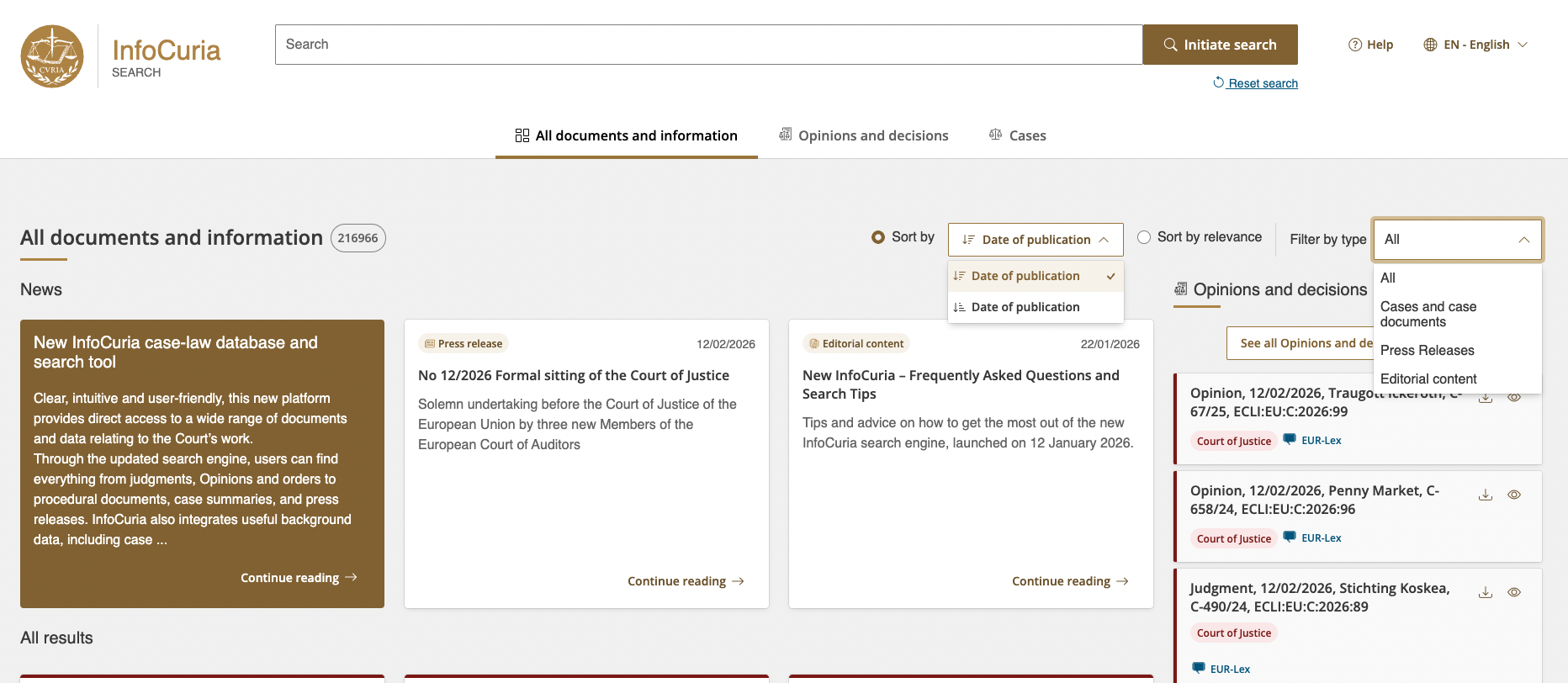 Screenshot InfoCuria website (Source: CJEU website)
Searching for a specific judge rapporteur or advocate general is no better.
The suggested method — typing a surname in quotes — cannot distinguish between cases where a member of the court served as judge and those where they served as advocate general.
It also pulls in results from academic writings that happen to mention the person’s name. The FAQ’s proposed solution is to sort results by “relevance.”
To search for legislation cited in judgments, users must now input CELEX numbers, which is the EU’s internal document-numbering system. The old platform allowed legislation searches without them.
The FAQ helpfully links to an infographic explaining how to construct CELEX numbers, a task that requires familiarity with an intricate coding syntax. A more intuitive system, the court says, is coming in a future version.
That future version, with its promised multi-criteria advanced search form, is foreseen for spring 2026. The CJEU launched its new search engine in January knowing that core functionality would not be available for months.
The CJEU responded to questions about why the platform went live with missing functionalities, saying that “the old platform, in place for over 15 years, had a number of problems stemming from its age. It used obsolete technology, has suffered a number of technical errors, was becoming increasingly more risky and difficult to maintain, and no longer complied with minimum accessibility standards. It is this combination of factors which led the court to decide to release the new version.”
More than an ‘inconvenience’
The shortcomings are more than a simple inconvenience. As Desaunettes-Barbero wrote, it’s more than “just a poorly-designed product, and that is already serious enough. This is an open-access platform that is supposed to facilitate access to the law. As things stand, the redesign is undermining an essential tool, which in practice ends up benefiting private, paywalled legal publishers. That goes squarely against the very objective of accessibility.”
Professor Alberto Alemanno agrees. “The most immediate consequces of this failed system is to de-democratise access to public data fuelling an industry of commercial actors that won’t miss this chance to double down on their services. It’s tragic.”
Desaunettes-Barbero later adds that researchers are most likely not the ones to be most affected, as most have access to paid databases, and can search there when InfoCuria becomes too frustrating or time-consuming.
However, as he later wrote, “what worries me more is the impact on citizens who want to access a judgment directly – and who, by definition, are not subscribed to any commercial platform. For them, finding a specific decision has become considerably harder, which raises a genuine concern regarding access to justice and access to the law. That said, let’s be honest: it’s relatively rare for the average citizen to directly look up a court decision. But for the few who do — often at important moments — the tool should work reliably.”
The CJEU said “We are grateful for the constructive feedback we have received from our users and continue to make every effort to respond.”