
Published on
February 18, 2026
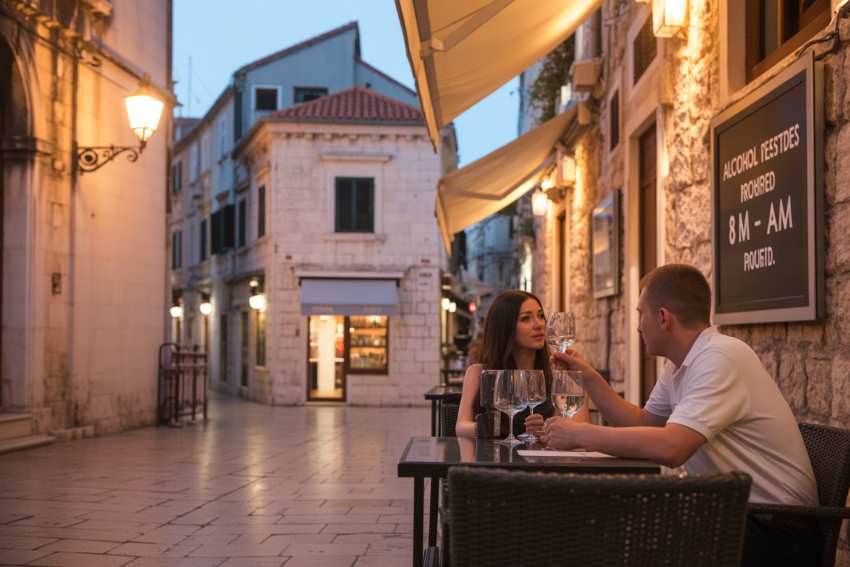
Image generated with Ai
Local authorities are implementing a more controlled approach to holiday management, resulting in a significant transformation along the Adriatic’s sun-drenched coast. In the historic city of Split, a groundbreaking legislative change has been proposed to reduce the disruption caused by nighttime revelry. Mayor Tomislav Šuta has announced new regulations that will limit the retail availability of alcoholic beverages. Beginning with the upcoming summer season, the sale of alcohol in supermarkets and specialised liquor outlets will be prohibited between the hours of 8 p.m. and 6 a.m.
This measure is being introduced in direct response to growing concerns about the preservation of local life. The urban landscape of Split, particularly its UNESCO-protected core, has been under increasing pressure from concentrated nightlife activities. The municipal leadership has emphasised that these scenes of public intoxication frequently occur when alcohol is purchased cheaply at retail locations and consumed on the street. As a result, the new legislative framework prioritises residents’ safety and tranquility. While the retail ban is in effect, the hospitality industry remains unaffected; visitors can continue to enjoy drinks in the regulated environments of bars, restaurants, and licensed clubs. The goal is not to eliminate all forms of entertainment but to shift social drinking to venues specifically designed for such activities.
Strengthening the National Strategy Against Overtourism
The proactive stance taken by Split is not an isolated event but part of a broader, nationwide movement to refine the Croatian tourism brand. Similar restrictions are currently being evaluated by the governing bodies of other prominent coastal destinations, including Novalja and Makarska. A systematic departure from the “party destination” identity is being facilitated by these local governments. For many years, certain Adriatic hubs were marketed as playgrounds for non-stop celebrations, but a new narrative is being crafted—one that highlights Croatia’s deep cultural roots, its breathtaking natural landscapes, and its suitability for families.
This transition is supported by the Ministry of Tourism and Sport, which has recently overseen the enactment of the new Tourism Act. Under this national legislation, local municipalities are granted greater autonomy to manage their own visitor capacities and environmental impacts. The overarching objective is to foster a sustainable model where the quality of the visitor experience is balanced with the well-being of the permanent population. Through this lens, the new alcohol laws are viewed as essential tools for destination management rather than mere punitive measures.
Lessons from Hvar: Noise and Conduct Regulations
The roadmap for these changes was arguably laid out by the island of Hvar, a location once synonymous with high-octane nightlife. In the previous year, the local council of Hvar Town introduced stringent noise level limitations to restore peace to the historic center. The decibel levels of outdoor music and entertainment were capped at 85 dB—a volume comparable to that of a busy indoor restaurant. For those establishments found to be in violation of these limits, significant financial penalties exceeding €1,300 have been established.
Furthermore, a culture of accountability for individual behavior has been fostered through the implementation of “on-the-spot” fines. Since 2017, the act of consuming alcohol in public spaces has been penalized with fines of up to €700. These regulations extend to other forms of antisocial behavior, such as improper attire in urban centers or public disturbances. By the Hvar Tourist Board, it has been noted that while the island remains a lively and welcoming destination, the era of unmonitored excess is being replaced by a more refined atmosphere. These efforts are intended to ensure that the delicate stone architecture and the serene Mediterranean charm of the islands are respected by every guest who walks their streets.
Advertisement
Advertisement
The Future of the Croatian Travel Experience
As these laws take effect, the Croatian coastline is being repositioned as a top European destination for high-value, conscious travel. The implementation of these regulations reflects the maturation of the country’s tourism industry. The local travel industry believes that these measures are intended to encourage responsible behaviour, ensuring that the Adriatic remains a popular destination for future generations.
For travellers, this means a shift in expectations, as well as a more authentic immersion in the local way of life. The emphasis is shifting away from late-night street parties and towards the rich tapestry of Croatian history, from the Roman ruins of Diocletian’s Palace to the vibrant culinary scenes found in the country’s many hidden plazas. As the sun sets over the Dalmatian coast, the sound of waves and the quiet hum of polite conversation return as the primary soundtrack to Croatian summer. These strategic regulations help to restore the balance between a thriving economy and a livable community.
