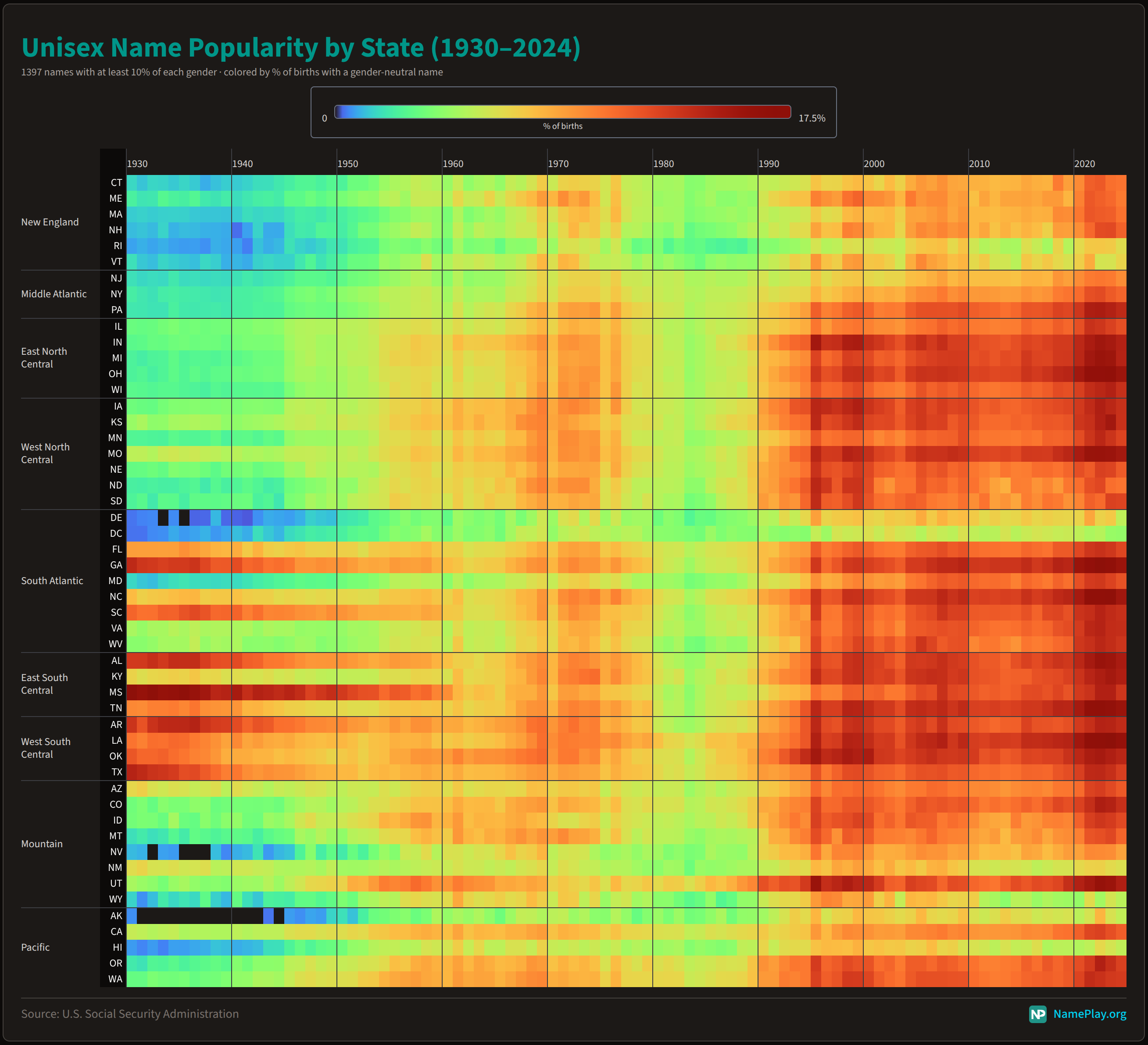
interactive: https://nameplay.org/blog/where-unisex-names-are-most-popular . Interactive version lets you change neutrality threshold (10% – 40%) and shows tooltip with top name in each state + year.
Posted by Chronicallybored

![[OC] unisex name popularity by US state, 1930-2024](https://www.byteseu.com/wp-content/uploads/2026/02/4alrk8zdt5kg1-1536x1399.png "[OC] unisex name popularity by US state, 1930-2024")
interactive: https://nameplay.org/blog/where-unisex-names-are-most-popular . Interactive version lets you change neutrality threshold (10% – 40%) and shows tooltip with top name in each state + year.
Posted by Chronicallybored
7 Comments
[link to interactive version](https://nameplay.org/blog/where-unisex-names-are-most-popular)
data source: name data is from [Social Security Administration](https://www.ssa.gov/oact/babynames/limits.html). births by state are pieced together from a handful of sources: CDC WONDER (2007-2024), CDC natality microdata files (1969-2006), NBER (1947-1967), NHGIS (1930-1950), with some linear interpolation where gaps existed (esp. for AK/HI pre-statehood).
tools: d3.js (heatmap color scale calculations), Svelte (interactivity), SvelteKit (data loading), floating-ui (tooltip), python + polars (data processing)
This isn’t beautiful: it’s an eye exam.
Wow!
So it looks like we see the 80’s as the peak of boy names and girl names being different, then the rise of the Dakotas and Rileys
And I think it shows the boomers born in the south with names like Billie, Jo, and Bobbi?
All the same names in DC so they don’t discriminate against women is my assumption.
Edit: I wrongly assumed green meant more gender neutral names. Bad me for assuming. Bad visual design choice. Seems like DC is actually pretty split.
are these unisex names as defined today or during that year?
e.g. did Jennifer go from boys, to unisex, to girls or is it considered a girl’s name for all years?
I’m not wild about the severity of the color changes in a fairly narrow range. It seems to make the variation far more pronounced than it really is.
I understand why you put Hawaii and Alaska in the Pacific region, but they are not a good fit. I think they should go into a category of their own: “non-contiguous”. Notice how poorly their color codes match the others in the Pacific category.