
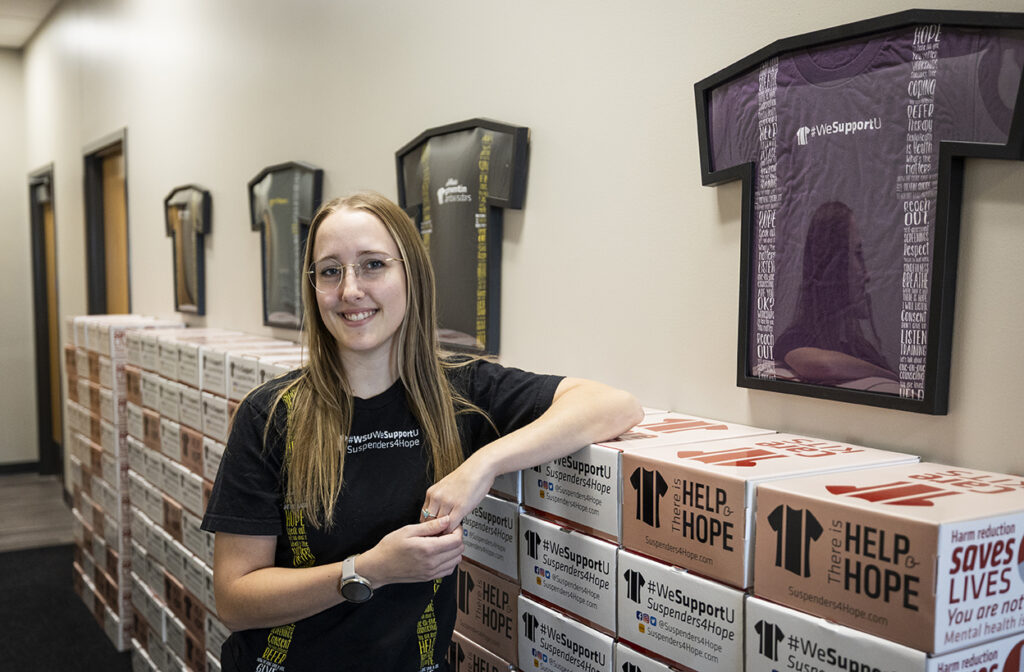
As a teenager, a significant portion of Layna Adams’ life was oriented around a single goal: graduating from college. Neither of her parents had a bachelor’s degree, and her brother had left community college with a certificate in computer programming. “My parents always wanted me to go to college,” Adams says. “They wanted me not to go through the struggles they did.”
At her small high school in Udall, Kansas, Adams racked up achievements she thought would help get her into a degree program. She was class president. She participated in athletics. She excelled in the classroom and out. By the time Adams graduated in 2019 as valedictorian of her class, she had accepted an offer to attend Wichita State University.
Within a year of beginning her studies, however, Adams was struggling. As with other schools, the COVID-19 pandemic had forced Wichita State to move classes online. For a young student like Adams, it was an isolating and disorienting time. Her singular focus on getting into college hadn’t prepared her for the experience of navigating it.
“I knew I wanted to go to college, but I didn’t know what to do after I got there,” she says. She also wasn’t finding her studies fulfilling. She had arrived at Wichita State with plans to pursue a degree in sports management, but in the midst of the pandemic, a latent interest in psychology began to surface. “I’ve always had an interest in trying to understand people,” she says. “I was like, ‘Let me see if changing my major will help me want to stay in school.’”
Adams transferred to Emporia State University, and in its psychology program she found the academic fit she had been looking for. After graduating in 2022, she decided to continue her education and pursued a master’s degree, working part-time on top of a graduate assistantship to afford tuition.
Over time, Adams developed an interest in community mental health and public perceptions around disorders such as addiction, as well as a passion for educating the next generation of mental health professionals. She was especially interested in working with people from rural communities and helping address the lessening yet still present stigmas around mental health. But when she applied to doctoral programs she found herself faced with an uncomfortable — and costly — choice: move out of state to continue her education, or stay in Kansas and postpone the doctorate.
“It’s recommended that you apply to 12 to 15 schools, hoping that you get interviews with two or three. And I did get two interviews, but both were out-of-state schools,” Adams says. With the out-of-state options cost prohibitive, Adams resigned herself to an alternative path. But in June 2025, Adams was invited to meet with Wichita State assistant professor Thomas Skinner. She thought the meeting was going to be about how to improve her application. Instead, he offered her a place in Wichita State’s clinical psychology doctoral program. “I was shocked,” Adams says.
The reason for the abrupt — and belated — invitation was that new funding earmarked exclusively for Kansas students pursuing degrees in behavioral health had been made available through the Kansas Behavioral Health Center of Excellence. A state-funded consortium of universities, health care providers and government agencies, the Center of Excellence was established in 2023 to help address the statewide workforce shortage in the fields of mental and behavioral health. (Behavioral health is an umbrella term that includes mental health, as well as the treatment of disorders such as substance abuse.)
Its goal is to bring together previously siloed organizations to recruit existing behavioral health professionals to Kansas and help incentivize young people to enter the field. “We want some (workers) to be store-bought, and we want some to be homegrown,” says Kyle Kessler, the executive director of the Association of Community Mental Health Centers of Kansas, a nonprofit organization that lobbies on behalf of the state’s licensed community mental health centers and the entity that spearheaded the Center of Excellence’s creation.
The center’s efforts are currently focused on Wichita and south-central Kansas. Although the worker shortage is statewide, the geographic emphasis was necessary in order to pilot a new model, Kessler says. Wichita is a place with high potential and high need: The city has a high concentration of service providers and university training programs and will also soon be home to a new state mental health hospital, expected to open in 2027.
Michelle Ponce, the associate director of the Association of Community Mental Health Centers, says the severity of the worker shortage was enough for service providers and university leaders to support the idea of a Behavioral Health Center of Excellence, but it took time for partners to grasp what it might mean for them. It helped that the center wasn’t imposing a specific set of strategies. Instead, Ponce and Kessler began by inviting organizations to share with them their biggest needs, then demonstrated how the center’s efforts could help meet them.
“I don’t think it ever would have worked if we walked in and said, ‘This is what you need to be doing,’” Ponce says. “They’re the experts.”
In early meetings, they did insist on some ground rules, however. “One of the first was, ‘Hey, if there is any turf here, if you don’t feel comfortable with someone in this room, this might not be the group for you because we are going to throw out every idea we can to see if we can address the workforce shortage in the state,’” Kessler recalls.
According to Kessler, Kansas has a shortage of nearly every type of behavioral health professional: psychiatrists, psychologists, therapists, social workers, counselors, nurse practitioners, you name it. “The two areas where we have the biggest gaps in workforce are the medical side and the clinical side, which are the only two sides,” he says.
The figures are especially stark for child psychiatry. To serve a population the size of Kansas’, the state should have roughly 150 child and adolescent psychiatrists working across its 105 counties. In actuality, it has 60, and all but 10 of those are located in or near Kansas City, Missouri. “So two thirds of our population lives outside the Kansas City area, but just 17% of child and adolescent psychiatrists live close enough to serve that population. That’s a crisis,” says Matthew Byerly, the associate dean of research at the University of Kansas Medical Center-Wichita.
The crisis has not gone unnoticed. A 2023 report from Mental Health America ranked every state in terms of prevalence of mental illness and access to care. Kansas came in last.
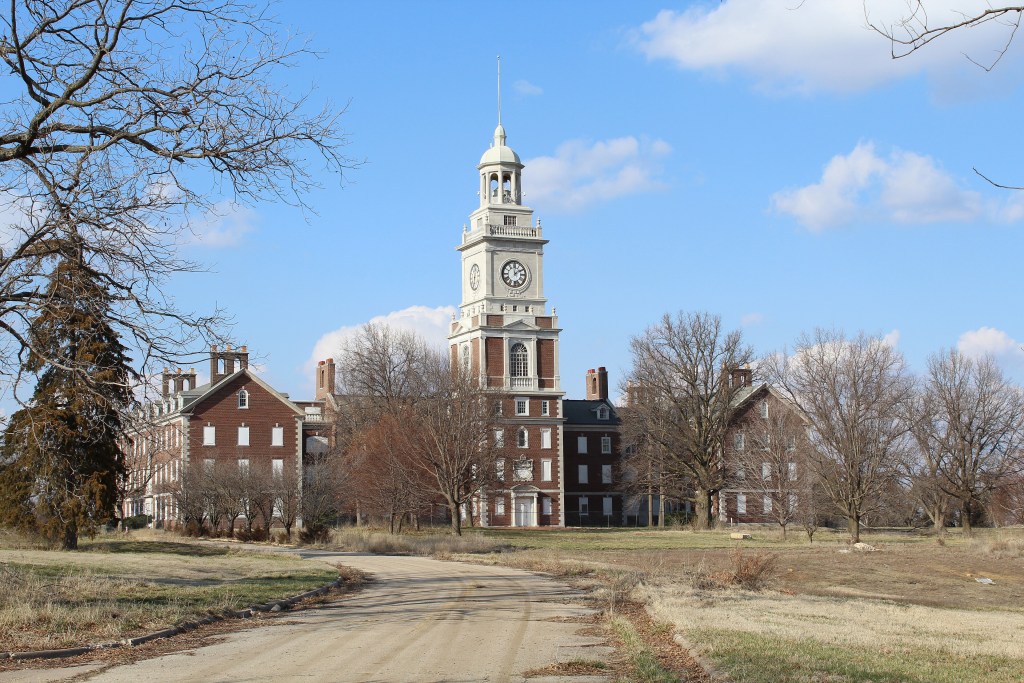 Once a symbol of the “hill that healed a nation,” the Menninger Tower, pictured here during better times in 2013, sits abandoned and has been wrecked by vandals.
Origins of a crisis: Menninger’s seismic departure
In 2024, Kansas jumped in the rankings to a more modest 22nd, a leap experts say was made possible by changes enacted prior to the pandemic. But the hole the state dug for itself over the years was deep enough that there’s still a lot to fix.
To understand how Kansas found itself in what Kessler describes as a workforce crisis, it’s necessary to go back to 2003, when the Menninger Foundation, a nationally known institution with its own mental health clinic and school of psychiatry closed its campus in Topeka that for almost a century had been its home.
Founded in 1919 by Dr. Charles Menninger and his sons Karl and William, the Menninger Foundation was influential in advocating for the humane treatment of individuals with psychiatric disorders. The clinic attracted students and practitioners from around the world and became a pipeline for institutions across the state.
When the Menninger Foundation announced that it was leaving Topeka for Houston, where it would join the Baylor College of Medicine and the Methodist Health Care System, Kansas lost not just a magnet for individuals who were interested in psychology or psychiatry but also that pipeline, which helped staff state hospitals. “When the Menninger Clinic moved away in the early 2000s, that was a body shot to our state,” Kessler explains.
Jessica Provines, the assistant vice president for wellness and chief psychologist at Wichita State, was in graduate school at the time. “Things just started falling apart,” she says of that period. “All of my peers were leaving for private practice. We would bring new folks on, and they would stay one or two years. As soon as they were licensed, they would leave.”
Menninger’s decision to relocate was part of a larger shift in the mental health landscape. The entire health care system was moving to what is known as “managed care.” Under that system — which if you’ve ever heard the term “in-network” you’re familiar with — mental health services were much more likely to be denied by insurance companies.
“It started to make it more and more difficult for behavioral health providers to be solvent,” Provines says. Congress eventually passed a series of mental health parity laws that prohibit insurers from treating mental health benefits differently than medical or surgical benefits. But they couldn’t undo the damage.
On two separate occasions, Provines was the only licensed clinician at Wichita State’s Student Wellness Center. “I saw multiple agencies lose their psychology internship training programs. And I just felt this fear that our training program was going to close,” she says. “I felt trapped. I felt like if I left, the training program would close, and that would have devastating impacts for our community and their access to behavioral health.”
Twenty years later, the loss of those training programs has left entire communities — entire regions — without access to behavioral health services. Workforce shortages translate into longer wait times to meet with doctors or access treatment and untenable workloads for the mental health workers Kansas does have.
Shortages also have a price tag: A 2017 report from the Treatment Advocacy Center estimated that in the U.S., police spend 21% of their time and 10% of their budgets responding to individuals experiencing a mental health crisis, sometimes with disastrous results. The same organization estimates that roughly a quarter of police shootings involve a person with mental illness. Even when police are not involved, an absence of mental health services can be fatal, since untreated mental illness is highly correlated with death by suicide.
“The last thing I want is to be dramatic about it,” Kessler says, “but those are the stakes.”
With the Kansas Behavioral Health Center of Excellence, Kessler’s idea was to try to replicate, in part, what Menninger was. Instead of a single brick-and-mortar campus, the center operates as a diffuse collection of allied organizations, including Wichita-area service providers, such as Comcare and the Substance Abuse Centers of Kansas; institutions, including WSU, the KU School of Medicine and Friends University; and public agencies, notably the Kansas Department of Aging and Disability Services. Each entity has a certain amount of autonomy even as members work collectively to solve the workforce shortage.
In 2024, the center received an initial $5.8 million from the Kansas Legislature. That money has gone to establishing new fellowships at universities, expanding the number of paid placements for students who need clinical hours, providing retention bonuses for faculty in nursing programs and helping the KU School of Medicine-Wichita restart a child and adolescent psychiatry program, among other initiatives. As Layna Adams’ experience illustrates, a paid position can mean the difference between a student continuing their education or not.
By not targeting only training programs or service providers, the Center of Excellence has been able to function as a sort of matchmaker, identifying partners that can meet existing needs. Service providers, for instance, need skilled practitioners while students need financial support, as well as training sites for practicums and supervision. By helping service providers expand the number of paid placements that they can offer students, the center meets two objectives simultaneously.
The center is also focusing on behavioral health innovation, whether it’s helping expand telehealth to increase access to mental health care or cautiously leveraging artificial intelligence to reduce the administrative burden on practitioners.
In general, advocates describe the center’s efforts as a novel approach to a complex problem. “We all knew we were having similar problems and that we weren’t going to be able to solve it alone,” Provines says. “I was excited — and relieved — to join such an unprecedented group and put our minds together to draft a plan for how we can fix this issue.”
Fractures in bipartisan consensus
Despite receiving funding only for fiscal year 2025, the Center of Excellence can claim some notable achievements. The KU Medical Center-Wichita already has three graduates in its child and adolescent psychiatry program, all of whom have accepted positions in Kansas. Wichita State has converted 100% of its applied training and prevention ambassador positions to paid positions. And the university has used its funding to grow enrollment in high-demand focus areas.
“We went from one person in our addictions counseling program to 13 last year, to 18 additional this year, directly because of the scholarship funding that the Center of Excellence allowed us to have,” says Jody Fiorini, the interim director of WSU’s WISE Clinic.
Kansas lawmakers have signaled continued support for the center’s efforts, awarding the Center of Excellence an additional $2 million for fiscal year 2026, for a total allocation of $7.7 million. Ponce says the center is asking that the Legislature maintain the center’s current level of funding for the next fiscal year, and she expects it will, given the bipartisan support the topic of mental health has received from legislators in recent years.
“We do plan to be in front of the budget committees, thanking them for their previous support, talking about how that funding has been utilized, what we’ve been able to accomplish and reminding them that most of those initiatives are multiyear projects,” Ponce says.
Mental health advocates applaud the creation of the Center of Excellence and applaud the Legislature’s willingness to fund holistic strategies to address the pipeline issue.
“There is absolutely a workforce shortage, so it’s definitely something that we support,” says Isaac Johnson, a school social worker who currently works for the Kansas chapter of the National Alliance on Mental Illness (NAMI). Johnson’s organization is not a part of the Behavioral Health Center of Excellence but has been supportive of the consortium’s focus on training the next generation of psychiatrists, therapists, social workers and nurses.
Johnson points out, however, that while mental health has emerged as a bipartisan issue in Kansas, policies such as the state’s recent ban on gender-affirming health care for minors, known as Senate Bill 63 before it became law over Gov. Laura Kelly’s veto, have the potential to work at cross-purposes of the Center of Excellence’s work and negatively impact the mental health of transgender teens and their families.
The measure’s supporters oppose medical interventions, including surgeries and medicines, that allow for gender transitions. Yet studies have shown that access to gender-affirming care can significantly reduce anxiety, depression and risk of suicide and improve overall well-being. Johnson, who is transgender, recently moved to New York in part because of the ban.
“I left Kansas because my partner moved, first and foremost,” says Johnson, who maintains his role as the Kansas operations manager for the NAMI. “But I was also very discouraged by SB 63 as a trans school social worker. I figured that my existence alone would make me prone to lawsuits, regardless of whether or not I talked about transitioning with students. So Kansas has lost at least one mental health professional who specializes in working with kids because of SB 63.”
It’s unclear the degree to which such policies will impact the state’s ability to recruit and retain mental health workers, though one study out of UCLA found that nearly 1 in 2 transgender adults had moved or had considered moving based on whether or not a state supported gender-affirming care.
Kansas is currently one of 27 states with bans on gender-affirming care for youth, though the issue may soon be decided at the federal level. Republicans in the U.S. House of Representatives recently passed a bill that would criminalize gender-affirming care for minors nationwide and impose penalties including prison time for medical providers who offer certain treatments.
The Center of Excellence’s strategies face other hurdles as well. The long-term nature of investments in training programs means that behavioral health workers feeling the crunch of the worker shortage may experience burnout at faster rates than the state can produce workers to share the burden. It also remains to be seen how the center and its partners will go about addressing access to mental health care in frontier parts of the state. There are policy barriers as well, such as the Legislature’s choice not to expand Medicaid eligibility and disparities between existing licensure requirements and adequate access to the training and supervision needed to meet those requirements.
Provines, the Wichita State psychologist, agrees that the topic of mental health has bipartisan support in Kansas. But there are also “very strong headwinds in the policy landscape that could derail progress.
“If we see a lack of investment, or if we stop too soon, that could have devastating consequences. But if we continue to make these smart investments and recognize that growing the pipeline is good for all Kansans, we could go from being one of the poorest performing states in terms of our access to behavioral health care to really being a model where other states come to learn from us and see how we all came together through an interdisciplinary, collaborative approach to solve a collective issue.”
An evolving landscape
How and where to invest will be a continually evolving question, particularly after the state mental hospital opens in Wichita next year. Among the people positioned to answer the question is Layna Adams. This winter she’ll join her doctoral advisor, Thomas Skinner, in conducting research on the costs of losing mental health workers.
One of the focuses will be on the “why” of mental health care shortages. “Why are mental health organizations in the state of Kansas failing to retain workers, or universities in the state of Kansas failing to retain faculty to train those workers?” Skinner says.
Specifically, Adams will be helping Skinner look at the economic impact of faculty advisors leaving a university midway through a research project.
“We’re having students sometimes delayed by two years because their faculty mentor is leaving,” Skinner explains. “We want to get a full accounting of that and see economically what the cost of that is.”
If they can quantify what failing to retain these faculty advisors costs the state, Skinner says, it can help justify an increase in starting salaries and provide higher quality, more consistent and quicker training to future mental health professionals.
Like Adams, Skinner is a beneficiary of the Center of Excellence; his position at Wichita State is 100% funded through the center and is dedicated to conducting research to better understand the needs of behavioral health degree programs. He says it’s been encouraging to see the state take proactive steps to address the pipeline problem that was created when the Menninger Clinic closed.
“It’s one of those things where in six years we’re gonna be like, ‘Oh wow, this was a really, really good investment,’” he says. “I think it’s going to make a huge difference. It’s making a difference already.”
This <a target=”_blank” href=”https://klcjournal.com/effort-targets-shortage-of-mental-health-workers-in-kansas/”>article</a> first appeared on <a target=”_blank” href=”https://klcjournal.com”>KLC Journal</a> and is republished here under a <a target=”_blank” href=”https://creativecommons.org/licenses/by-nd/4.0/”>Creative Commons Attribution-NoDerivatives 4.0 International License</a>.<img src=”https://i0.wp.com/klcjournal.com/wp-content/uploads/2024/03/cropped-Journal_Apple_Icon-03-square.png?resize=150%2C150&ssl=1″ style=”width:1em;height:1em;margin-left:10px;”>
<img id=”republication-tracker-tool-source” src=”https://klcjournal.com/?republication-pixel=true&post=19124&ga4=G-D0ZLBQ9V11″ style=”width:1px;height:1px;”><script> PARSELY = { autotrack: false, onload: function() { PARSELY.beacon.trackPageView({ url: “https://klcjournal.com/effort-targets-shortage-of-mental-health-workers-in-kansas/”, urlref: window.location.href }); } } </script> <script id=”parsely-cfg” src=”//cdn.parsely.com/keys/klcjournal.com/p.js”></script>