
Welcome wandering souls to this new episode of Board Game Pizza, the cyclical thread on board games and RPGs.
Whether you are an experienced player or a novice or someone who knows nothing about this world, you are welcome.
I would like this thread to be used to make small reviews, ask for opinions or advice, even clarifications on an unclear part of the rules or why not, look for companions for a DnD campaign or to play some online board games.
Don’t be afraid to ask, the expert players are here to help and if I can, in my small way I will try to help too.
GAME OF THE MONTH
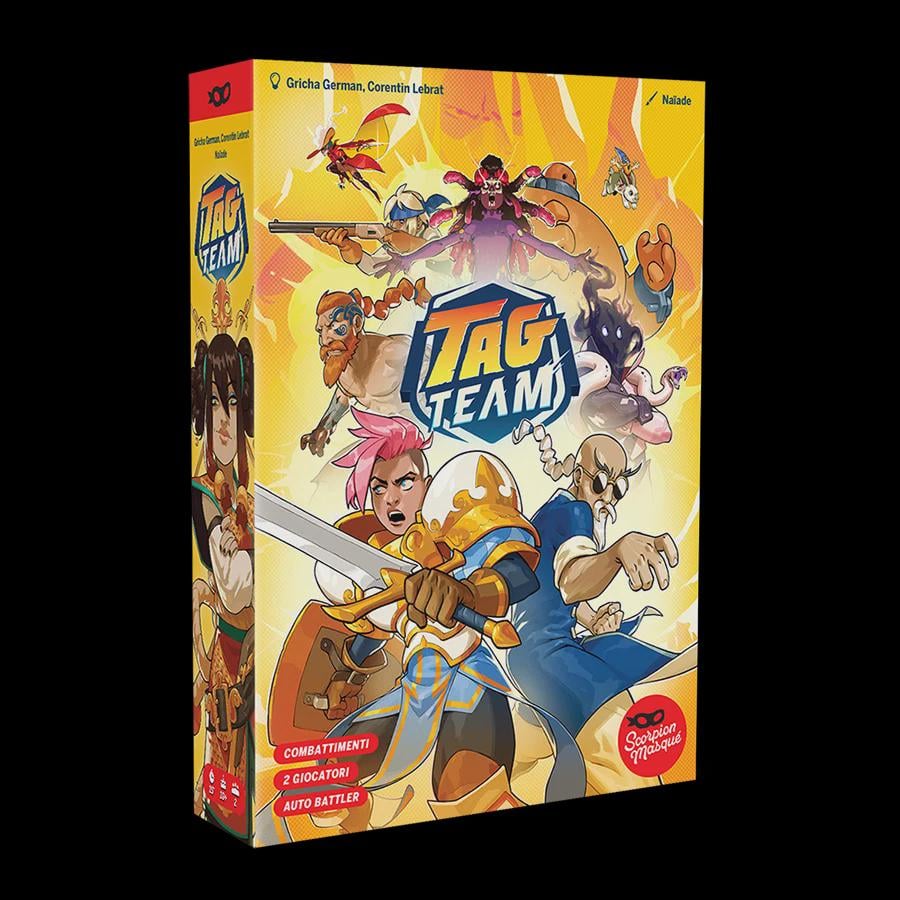
I tried Tag Team expecting a quick fighting game-themed filler, but after a few games I realized that behind the short duration there is a surprisingly interesting system. It’s a pure duel for two players that mixes deckbuilding, programming and automatic combat, and the thing that struck me most is how these three souls coexist during the game. The preparation is immediate: I choose two fighters from those available and combine their decks, which represent moves, attacks, defenses and special abilities. The initial choice is not trivial at all, because the style of play is already decided here. Some couples focus on offensive pressure, others on time management or defensive responses. Right from the selection of characters I felt that fighting game feeling where you look for the combination that best reflects you.
The most particular part comes when the actual fight begins. The system is auto battler: I don’t play the cards from my hand, but I reveal them sequentially from the deck, applying the effects one after the other. At first it may seem almost passive, but in reality all the tension comes from the fact that the deck was built by me and that the order in which the cards come out determines combos, defenses and waste. It’s a kind of indirect programming: I don’t control the single shot, I control the flow of the fight.
What gave me the most satisfaction is the moment between one round and another. This is where deckbuilding comes in: I can add new cards to the deck to improve the strategy, but I can’t rearrange the ones already present. This detail completely changes the feeling of the game. I’m not just powering up the deck, I’m planning the future pace of the game. Each card inserted is a temporal choice: will it arrive immediately or too late? Do I risk slowing down a combo? Am I creating a devastating chain or an unmanageable mess? This makes every decision concrete and visible in subsequent rounds, and often gave me that feeling of having won or lost due to choices made two rounds earlier. At the table the game works very well because it alternates different moments. There’s suspense during the card reveal, almost like watching a match unfold on its own, with little emotional spikes when the right card comes out at the right time or when an unexpected defense negates an important attack. Then comes the more thoughtful construction phase, where the pace slows down and we think about how to adapt to the opponent. This alternation keeps the game alive despite the short duration, which is usually around ten to fifteen minutes.
The best thing about Tag Team, for me, is the sense of rhythm. It is not a classic deckbuilding where the engine grows slowly, nor a simple one-shot fighting game. Here everything revolves around the timing and synergy between the two fighters, and when the deck turns as I had imagined there is a remarkable satisfaction, almost like having executed a perfect combo in a video game. On the contrary, when the deck gets jammed or the cards arrive out of time, the defeat is clear and often deserved.
As for flaws, it can be a bit chaotic in the first few games, because until you know the icons and effects well it’s difficult to really evaluate how strong a card or combination is. Furthermore, being only for two and very fast, it is best played several times in a row, almost in continuous rematch mode.
In summary, Tag Team gave me the impression of a compact but intelligent duel, in which deck construction is inseparable from the flow of combat. It’s quick to explain, quick to play and, above all, it gives the table that feeling of direct confrontation and successful combos that the theme promises. It’s not just filler: it’s a small tactical system that rewards those who learn to read the rhythm of their own deck and that of their opponent.
Board Game Pizza – Il circolo dei giochi di r/italy
byu/nerdvana89 initaly
Posted by nerdvana89