
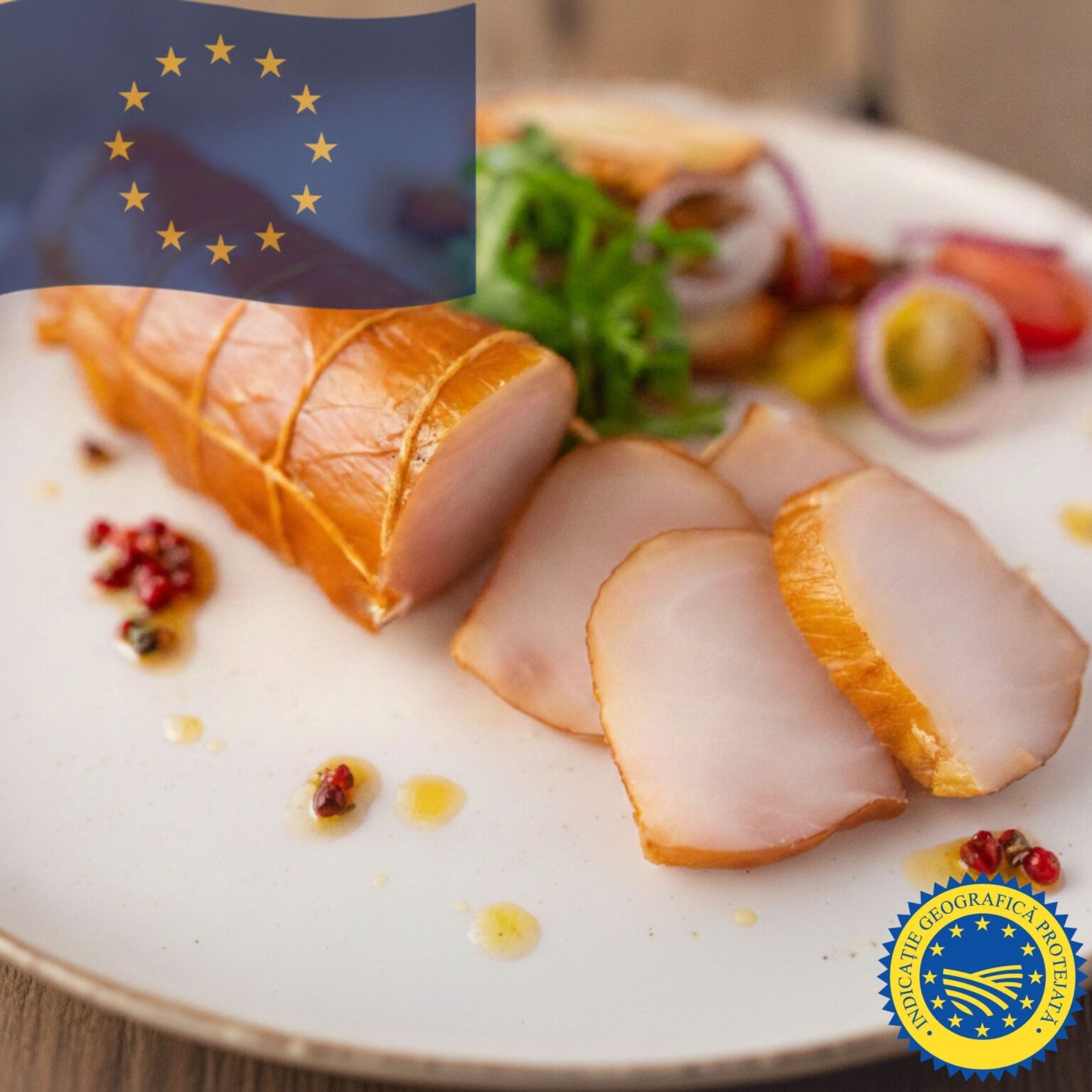
The European Commission on Wednesday approved the addition of ‘Batog de sturion’ from Romania to its register of Protected Geographical Indications (PGI), marking the country’s 16th product recognised at European level. The PGI certification confirms the product’s strong link to its geographical origin and production methods in Tulcea County, reinforcing Romania’s growing portfolio of protected agri-food products within the European Union.
A traditional product from Tulcea County
‘Batog de sturion’ is made from the dorsal fillet of aquaculture sturgeon raised in Tulcea County, a region that includes the Danube Delta and the mouth of the Danube River flowing into the Black Sea. The Danube Delta covers nearly 88% of Tulcea County’s area, spanning approximately 580,000 hectares.
The product is obtained from hand-filleted and skinned sturgeon back muscle, known for its compact structure that allows for easy slicing. The manufacturing process includes salting with a mixture of rock salt and sugar, drying to achieve a minimum residual moisture content of 35%, and smoking with hardwood to enhance flavour and colour.

The result is a sweet-salty delicacy with a fleshy texture specific to sturgeon species, offering a refined taste often compared to poultry meat, alongside a delicate yet firm consistency characteristic of the dorsal muscle.
Sustainability through aquaculture
According to Romania’s Ministry of Agriculture and Rural Development (MADR), sustainability plays a key role in the product’s recognition. Since 2006, Romania has enforced a strict ban on sturgeon fishing in natural habitats, including in the Danube Delta region, to protect wild populations.

The PGI-certified ‘Batog de sturion’ uses exclusively aquaculture sturgeon. These fish are raised in controlled, contaminant-free environments, where their diet resembles that of wild sturgeons and conditions are conducive to growth and reproduction. This approach supports conservation efforts while ensuring the specific organoleptic qualities required for the product.
PGI status and local impact
A Protected Geographical Indication (PGI) highlights the connection between a product and its geographical origin, where a certain quality, reputation or characteristic is essentially attributable to that region. At least one stage of production, processing or preparation must take place within the designated area.

The application for registration was submitted by the RO-PESCADOR Association from Tulcea. The product gained public visibility in September 2022 during the Rowmania – Ivan Patzaichin Festival, dedicated to the sustainable development of the Danube Delta area, where it received an award that contributed to its growing reputation.
Romania’s expanding EU portfolio
With the addition of ‘Batog de sturion’, Romania now has 16 products registered at European level. Of these, 12 are protected under PGI, including well-known products such as Topoloveni plum jam, Salami from Sibiu, Pita de Pecica bread, Telemea cheese from Sibiu, and Dobrogean pie.

One product holds Protected Designation of Origin (PDO) status – Telemea de Ibănești – while two are registered as Traditional Speciality Guaranteed (TSG).
In addition, 13 Romanian products are currently under verification by the European Commission: four seeking PGI status and nine applying for TSG registration. Among those identified for potential European protection are Telemea from Vaideeni, Bran kneaded cheese, Copălău garlic, Pericei onion, Transylvanian ham, and Voinesti apples, notes Agerpres newsagency.
The latest approval further consolidates Romania’s efforts to position its regional specialities on the European quality map, while reinforcing sustainability and local economic development in the Danube Delta region.