
![[OC] The share of people who identify as religious has fallen across many Western countries](https://www.byteseu.com/wp-content/uploads/2026/02/ge53yavpafkg1-1229x1536.png "[OC] The share of people who identify as religious has fallen across many Western countries")
Debates over whether religion is booming or dying are common. What does the data say?
Most countries lack long-term data on religious identity, but results from the Pew Research Center offer insights into changes over the decade from 2010 to 2020. (Unfortunately, 2020 is the most recent year for which we have comparable global data.)
At a global level, there was barely any change. The share of people identifying with any religion dropped by just one percentage point, from 77% to 76%.
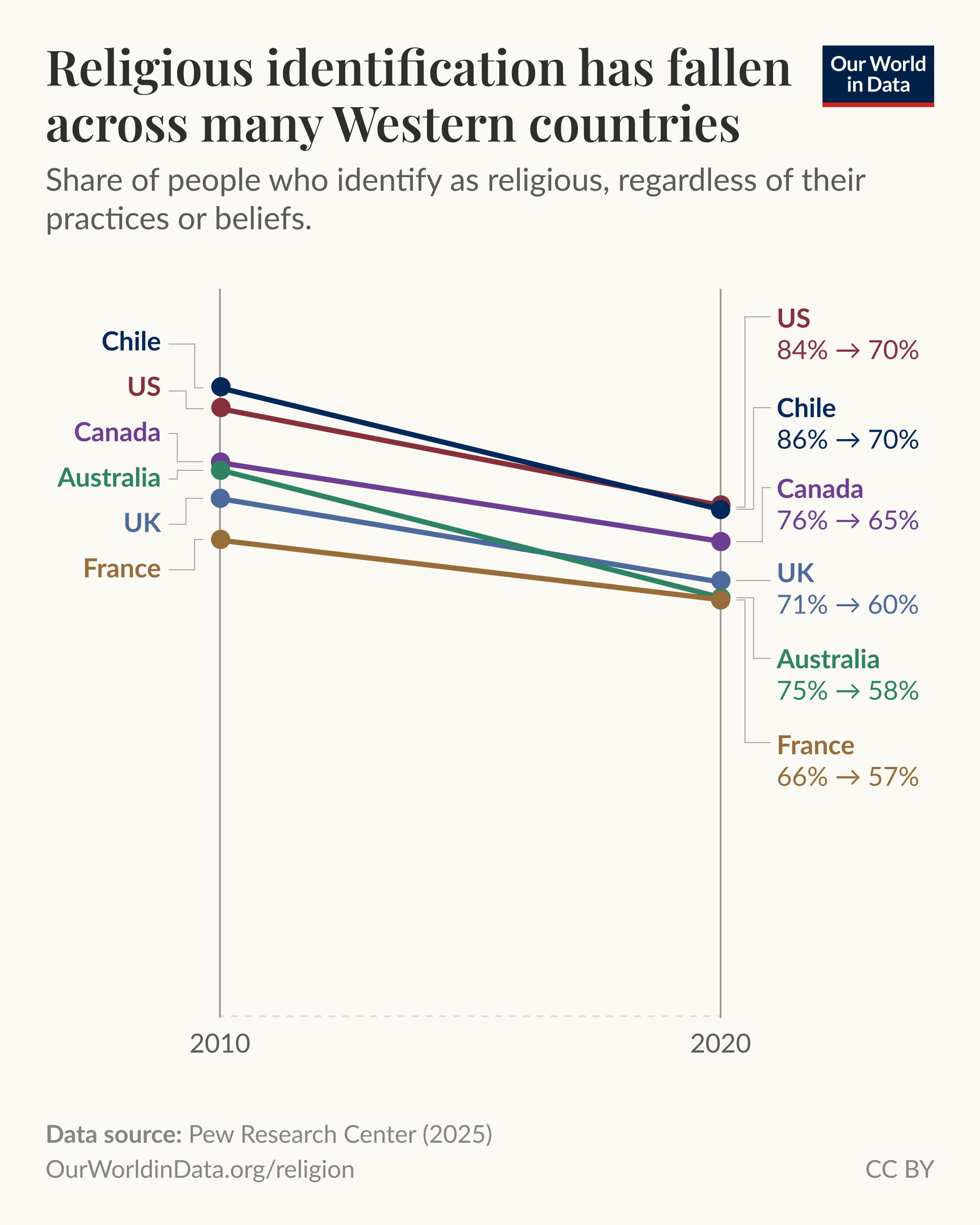
But religious affiliation did drop significantly across many countries in Europe, the Americas, and Oceania. You can see this drop for a selection of countries in the chart.
In Australia, rates dropped from 75% to 58%. In the United States and Chile, the percentage has decreased from roughly 85% to 70%.
So while religious affiliation is stable in many parts of the world, this data shows religion is becoming less prominent in others.
Note that this data is based on self-identification with any religion; it doesn’t tell us about changes in practices or rituals, such as prayer or attending services.
Posted by ourworldindata
23 Comments
**Data source:** Pew Research Center (2025)
**Tools used:** Started with our custom viz tool, [the OWID-Grapher](https://github.com/owid/owid-grapher), and finished in Figma.
still dont understand how anyone in the modern day can be religious, but i guess good that its in decline
Also just because someone identifies with a religion doesn’t mean they are actually religious. Many people just put a religion on forms or surveys just because they grew up with it.
if you find the amount of christians that no longer identify as christian disturbing look at the enourmous amount that claim to be christian but preach nothing but hate
the christian church is one of the wealthiest entitys on our planet yet the church mainly takes from its members
the scandals around priest that are pedos are also his own issue
believe might be a positive in this world, but churches are without exception a net negative, mainly because their rules and guidelines are massivly outdated
I find 70% in the US to be probably too high. It definitely doesn’t feel anywhere close to that and I live in the southeast too.
It hasn’t sunk far enough to end war for the imaginary friend in the sky
Canada here. Major religions were complicit in the Residential School System which was a component of the genocide done to Indigenous peoples when Canada was colonized.
Really not a good look.
A nearby Catholic Church has a giant sign outside about stripping women’s access to safe reproductive care.
I was raised Catholic. Part of me misses the feeling of community. However I have no interest in being part of something with a history of killing children, or is currently trying to take away healthcare to my family. Fuck that.
I’d argue amongst “western” people that number is even lower. It’s further skewed by immigrants from places such as India and the Middle East who are religious that has made the percentage higher than it otherwise would be.
There’s no way that 60% of the UK is religious. I’d be surprised if it was over 30%. These are checks on a form because someone’s Gran goes to church every Christmas.
Good, but still too many modern human fell into those ancient scams.
I suspect the youth of America are seeing the religious rally around a child rapist and obviois corrupt fraud with no capacity for basic empathy… and saying yeah nah.
The enourmois hypocracy has never been so obviois and glaring.
Surely we see a more rapid decline in the next few years in the US.
spect the youth of America are seeing the religious rally around a child rapist and obviois corrupt fraud with no capacity for basic empathy… and saying yeah nah.
The enourmois hypocracy has never been so obviois and glaring.
Surely we see a more rapid decline in the next few years in the US.
Putting minority religions aside – for every ten people who identify as Christian because they were christened as children and vaguely believe in God, there is only 1 person who actually attends church on Sundays and prays regularly etc.
The real figure for the UK is definitely not higher than 10% (for Christians at least).
Imaginary friends less popular now that we have TikTok
Makes me proud to be a secular Aussie bogan.
We have a census this year and I’m hoping my fellow Australian heathens can get that number under 50%
Does any other news agency report the figure as ‘religous fallacy is falling’ or “independence of belief is rising’’ to put it in the positive light? Or do all points of politics prefer that everyone is religous so that they’re easier to control?
Pew poll is probably not the best way to get this data for a lot of countries.
For example, Australia records this data in the census and has records going back to 1971.
The data represented here is inaccurate, out of date and doesn’t reflect the census data on religious affiliation in Australia (38.9% stated no religious affiliation in 2021 census, with 93% of total population responding).
That’s still way too high.
Refreshing to see this, spending 7 minutes on a Facebook comment thread had almost convinced me the opposite was true. I’d be interested to see how things had changed over the last few years.
Aussie here. France is beating us.
We need more atheists!
Capturing the people that affiliate themselves with an organized religion is of limited value. For example I don’t consider myself religious at all but I think it quite likely that some entity created the universe that humans either don’t understand or haven’t discovered. So for this research I’d be non religious yet one could argue im quite religious based on belief.
The problem is how you address the needs previously assessed by religion. Some people doesn’t go from religion to reason and ethics but to another type of religion.
40% of Lithuanians who identify as Catholic do not even believe in Jesus.