
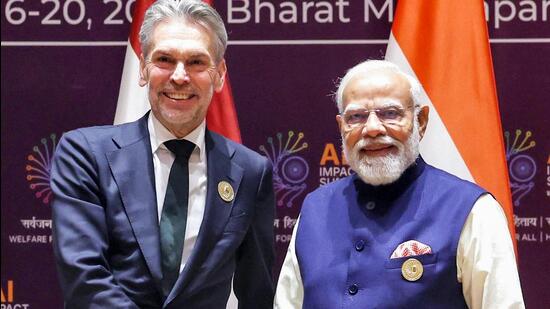
Countries around the world should come together to form a bloc to develop norms for responsible artificial intelligence (AI), at a time when China and the US are pursuing their own AI strategies, Dutch Prime Minister Dick Schoof said on Thursday, while highlighting potential collaboration between the Netherlands and India.
Prime Minister Narendra Modi meets Dutch Prime Minister Dick Schoof (ANI)
“The fact that the US and China are not at this conference clearly shows that other countries do see the [advantage] of working together and also working together with India to see how we can manage AI in a way that we believe [in],” Schoof told a news conference on the margins of the AI Impact Summit, referring to the US and China not participating in the event at the level of leaders or ministers.
The AI summit is being hosted in the Global South for the first time, with world leaders such as French President Emmanuel Macron, Spanish Prime Minister Pedro Sanchez, and UN chief Antonio Guterres gathering in New Delhi to discuss how to handle a technology that has spurred both investments and deep concern.
Schoof noted that China and the US are competing with each other in AI and have presented their own strategies for the technology, and said it is important for countries around the world to forge their own path to reduce dependence.
“It’s important that other countries take their own position because it’s not good to be dependent in the current geopolitical times. It’s an issue that’s very important in Europe. We have a very intensive relationship with the US, but at the same time we want more autonomy in Europe and [to] rebuild Europe, stronger as an economy, but also as a strong military force, especially for the threats from Russia,” Schoof said.
“It’s important that countries step up together and make sure that we create our own AI and not be too dependent.”
Schoof referred to Canadian Prime Minister Mike Carney’s speech at the World Economic Forum in Davos last month, when Carney had called for the world’s “middle powers” to come together to build greater resilience and stability amid the churn caused by the policies of the US, and said the middle powers could also unite to shape norms for responsible AI.
He said India, with a population of 1.4 billion, couldn’t be counted as a middle power and added: “But I think we can really unite together and make our own bloc [for AI] so to speak.”
Both Europe and the Netherlands have good relations with India, especially in the field of technology and innovation, and both sides also have the “same attitude towards AI.” Schoof said, “We want to use all the opportunities it has, but at the same time, we care about values and privacy. We want to have safeguards as well. In that respect, we can really work together to make sure that AI is available for everyone and also [there is] responsible use of AI to take full advantage of AI.”
Schoof pointed to the disruptions caused by the digital revolution a few decades ago and said he expects AI to have a similar impact. The digital revolution changed the workforce tremendously but also created new jobs. “My expectation is that AI is going to [go] in the same direction. It’s going to change the workforce, especially in public services, maybe also [lead to] layoffs, but at the same time, AI has a lot of opportunities and other businesses can be placed in a position to create a new workforce,” he said.