
Over 50 years after Franco’s death, the crimes of the Spanish Civil War and the dictatorship are being deliberately forgotten. Chris Bambery explains
Alicante, or Alacant in Catalonian, is only the second city in Spain, after Guernika in the Basque Country, to be declared a ‘lugar de memoria democrática’, or a Site of Democratic Memory. The city was given the title in 2025 in recognition of the key events that took place here during the Spanish Civil War of 1936-1939.
In Catalonia and the Basque Country, there are memorial plaques in every town, city and village marking events in the war or the repression afterwards.
On my first visit to Alicante, I have found out that if you want to avoid key sites associated with the war and the subsequent repression of General Francisco Franco’s dictatorship, it is hard work. There’s no guide available at the tourist office.
I’ll come back to that because more than half a century after general Francisco Franco’s death 1975, Spain still struggles with the toxic legacy of his 36 years of fascist dictatorship.
Alicante was not on the front line in the war. It was in Republican hands from the outbreak to the very bitter end. But it still suffered at the hands of fascism.
For instance, some 500 were killed in over 70 attacks by Italian and Francoist forces. Italian fascist bombers carried out the 25 May 1938 attack on the city’s central market, which killed 300 people.
By March 1939 the Spanish Republic still controlled between a quarter and a third of the country, including the capital, Madrid, and Valencia. On 5 March the commander of the Army of the Centre, Segismundo Casado, seized control of Madrid. He was acting against the Republican prime minister, Juan Negrín, who he saw as being a pawn of the Communist Party.
Negrín wasn’t a Communist, but he agreed with them on the need to create a conventional army to fight a conventional war, and then on maintaining the fight until a European war would break out, when it was hoped Britain and France would ally with the Republic.
Casado believed that if Negrín and the Communists were removed, he could negotiate a peace deal with Franco, soldier to soldier.
Casado took control of Madrid and most other towns and cities. Negrín and the Communist Party leadership decided not to resist and flew off into exile.
Casado discovered Franco was not interested in a peace deal. He wanted not just victory but the opportunity to unleash violent retribution of all who made up his ‘anti-Spain’; Socialists, Communists, anarchists, Basque and Catalan nationalists, trade unionists and freemasons.
On 28 March Casado’s forces surrendered Madrid to Franco. He himself fled to the Mediterranean coast to be picked up by a Royal Navy warship. He ended up in exile in England.
Republican forces were told to make their way to those ports remaining in their hands. Fifteen thousand made their way to Alicante. Britain and France, having recognised Franco’s government refused to evacuate them and the refugees alongside them.
A Welsh captain of the steamer the Stanbrook, Archibald Dickson, defied orders and entered Alicante port, avoiding a Francoist destroyer. His vessel was and just 1300 tons with a crew of 24. Dickson took aboard 1800 refugees, dangerously overloading the ship and set sail for Oran, in French Algeria.
After a voyage of 24 hours, it arrived only for the French authorities in Oran to refuse to let the men ashore. They were only let off the ship after three weeks because it was a health hazard. Most were then interned.
Back in Alicante some 15,000 Republican troops and refugees awaited ships that never came huddled in the port.
On 29 March Italian troops, part of the 80,000 strong force sent by Mussolini, took hold of Santa Barbara castle overlooking the port. That night, there were bitter debates over whether to accept surrender or to commit suicide. Everyone knew what would lie ahead in Franco’s camps.
One officer recalled two anarchists taking out their revolvers and then shooting each other in the head.
The next morning Italian troops entered Alicante. They handed over the prisoners to Franco’s troops. Women and children were sent to city’s cinema. The men were taken to a bare field outside the city where there was no shelter, food or medical care. From there they would be sent to Franco’s concentration camps for court martial, torture, execution or to sentenced to decades in prison.
From then until 1975 you could not talk of what had happened to Republicans in the civil war and afterwards. Terror enforced silence. In the wake of Franco’s death there was an amnesty for all the fascist executioners and torturers, while the newly democratic ex-fascists and the Socialist Party and Communist Party agreed a pact of amnesia: they didn’t just abjure vengeance but agreed to sweep all that had happened under the carpet.
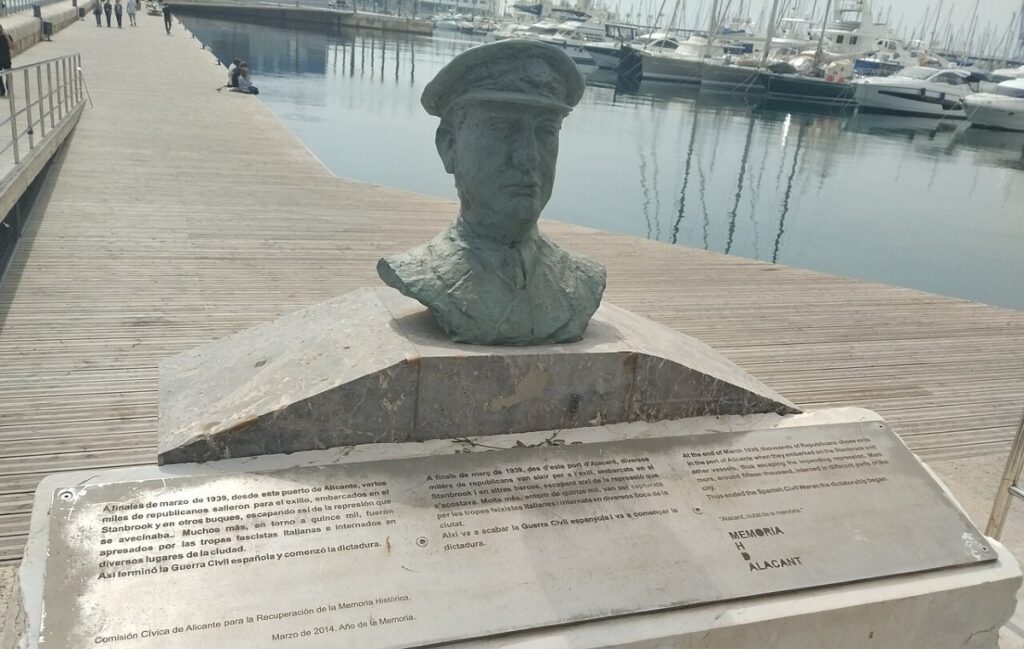
There is a bust of Captain Dickson on the ‘Muelle de Levante’ in Alicante port and there is a small commemoration held on the 28 March each year. There is also a plaque to him and his crew at the Pierhead Building, overlooking Cardiff Bay. Their names are also on the Tower Hill memorial to the dead of the Merchant Navy during World War 11 because, tragically, the Stanbrook was torpedoed and sunk with all hands by a German U-boat in November 1939.
That is in a prominent position, but the memorial to the 724 people who were shot in Alicante province between 1939 and 1945, after Franco’s victory, is in the municipal cemetery. It also marks the 300 victims of the central marker bombing, who are buried here. It was erected in 2011 paid for by the left parties, trade unions and civil groups,
To get there you have to get the 04 bus to Cimitiero on the edge of the city. There are no signs to help you find it. Luckily, Google Maps did the trick.
Also buried there is the Communist poet Miguel Hernández. He was captured trying to flee to Portugal in 1939 and sentenced to death. This was commuted to 30 years in prison. In 1942 he died in Alicante jail of tuberculosis.
There is also a monument to him where Alicante jail stood, now the Palace of Justice, on Calle Santa Maria Mazzarelo. But it simply says “Miguel Hernández, Poet” and there is no further information.
The men who surrendered at Alicante port were marched to various holding camps and jails before being moved onto concentration camps to face a military tribunal, torture, execution or decades in prison. There is a memorial at the concentration camp, Campo de Los Almendros. It was an open field with no shelter, no food or medical care. Today it’s not signposted and there is no information board.
The women and children were taken to the former state cinema on Avenida de la Constitución. It still stands but there is nothing to mark what took place there in 1939.
Until recently you could tour various air raid shelters built by the Republicans during the war, as I have done in Barcelona and Gerona, but not today in Alicante. The city council, run by a right-wing alliance of the Popular Party and Vox, ended the tours and say they will not re-commence until the guide’s description is approved by them. At the best that would involve the claim both sides were as bad as the other. The problem is that the Republicans did not bomb towns and cities, Franco and the Italians did.
In 2022 the Socialist government passed a the ‘Ley de la memoria democrática’, or law of democratic memory designed to address the legacy of the Spanish Civil War. The biggest issue is the huge number of unmarked graves where Franco’s victims were dumped. Spain is second only to Cambodia in having the greatest numbers of these.
Relatives’ groups want those buried there exhumed but in areas controlled by the right there is no funding available. It has been cut back too by the central government so outside Catalonia and the Basque Country volunteer groups have to raise money themselves. In Alicante, Spain’s second Site of Democratic Memory I had to do my own research and go by bus or on foot to the sights I have mentioned. Not so much democratic memory, more amnesia.
The ongoing genocide in Gaza, Starmer’s austerity and the danger of a resurgent far right demonstrate the urgent need for socialist organisation and ideas. Counterfire has been central to the Palestine revolt and we are committed to building mass, united movements of resistance. Become a member today and join the fightback.