
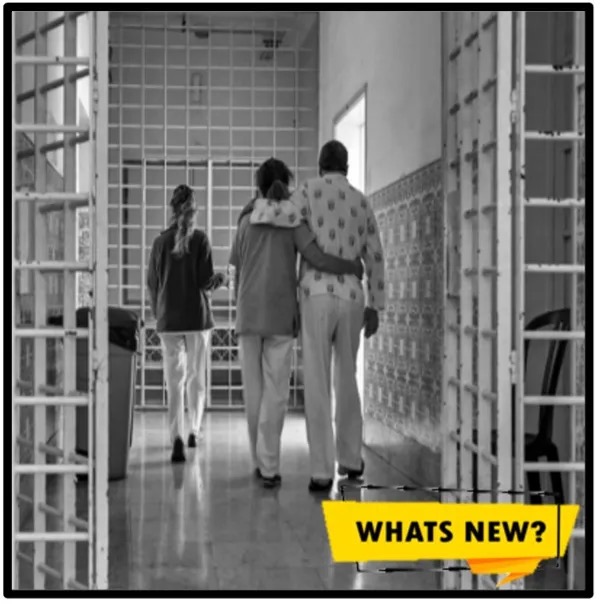
Compiled by Barry R. Ashpole. Following are selected articles, reports, etc., from the latest (January) posting on the End-of-Life Care Behind Bars website. Access the monthly postings at: https://bit.ly/47sVCRU
Barriers and facilitators in providing palliative and end-of-life care in prison settings: A qualitative study of professional stakeholders’ views and experiences in six western countries
JOURNAL OF CORRECTIONAL HEALTH CARE | Online – 20 January 2026 – Numerous barriers still exist in relation to assessing and managing risk, the aging profile of people in prison, staff boundaries and training, prison environments, and the bureaucratic management of compassionate release or parole for those approaching end-of-life in prison. The article makes the following recommendations: 1) In response to aging populations in prisons, it is important that prisons learn from one another about how best to improve their existing facilities or build new wings to accommodate specialist equipment that mirrors hospital wards; 2) Given the rising need for specialist palliative care (PC) within prisons, in-reach staff need timely access to people in prison and systems to store and administer controlled drugs; prison healthcare staff also need basic training in PC; 3) When people are diagnosed with life-limiting disease, protocols should be implemented that prompt advance care planning, referrals to specialist PC, consideration for early release on compassionate grounds, more flexible visitation, and a review of restraints. These protocols will promote dignity, human rights, and access to equivalent care; 4) Buddy systems and peer support are valuable informal resources but they provide limited access to personal care. Consideration should be given to employing and training buddies to deliver personal care in teams that do not compromise safety and dignity. Full text: https://bit.ly/49GbdP6
Palliative care in prison and the push for change
ABOUT TIME (Australia) | Online – 11 January 2026 – End-of-life care … is a healthcare process that aims to improve the quality of life and reduce the suffering of those who are terminally ill. Being incarcerated can make this stage of life even more complicated. Age can take on a different meaning in the prison system, with people being considered “old” at the age of 50. People in prison are experiencing age-related health conditions earlier than those in the community. Between 2009 and 2019, the proportion of older Australians in prisons … grew by over 78% to more than 9,500 people. Currently, to access specialist healthcare, those in minimum-security prisons are required to be transferred to maximum-security facilities. This can influence people’s decision to accept, decline or delay receiving treatment, as those in minimum-security prisons will potentially lose the comfort and familiarity of their cell and job. Once people in prison access the healthcare they need, there are still many systemic barriers that can negatively impact the delivery of care. Full text (scroll down to p.10): https://bit.ly/4qnaN7A
Resurrecting a prison doula program
INTERNATIONAL END OF LIFE DOULA ASSOCIATION | Online – Undated (Accessed 7 January 2026) – The men have just finished an exercise in pairs discussing the legacies of their lives as they take turns being the doula and then the dying patient. It is the evening of a second, long day of working together, nearing 8:00 pm. In the exercise, the men had spread out across the chapel in pairs. I could see the emotion: both pain and tenderness – the occasional, tentative hand on a shoulder, as a partner struggled with what they were saying and feeling. Touching openly like this between men is not part of the prison culture, and it’s frowned on by the correction officers that oversee their lives. Breaking through this unwritten code of behavior is risky, it makes them vulnerable. It’s much more usual for men here to be aggressive and predatory toward each other. That’s why what has been happening in this chapel over the first two of three days of learning to be doulas is that much more special. Full text:https://bit.ly/4jsiyWV
In Central California Women’s Facility, no one has to die alone
CENTRAL CALIFORNIA WOMEN’S FACILITY (U.S.) | Online – 26 January 2026 – Ensuring that no one at Central California Women’s Facility (CCWF) will die alone is one of the missions of the Comfort Care program at the institution. In 1998, Judith Barnett and Jeanne Pacheco had an idea for a program that would help provide comfort and assistance to individuals housed in CCWF’s Skilled Nursing Facility (SNF), including those nearing the end of their lives. Both Barnett and Pacheco were sentenced to life without the possibility of parole, so the thought of dying in prison was very real to them. The pair approached CCWF’s then-warden Celestine “Teena” Farmon about the prospect of incarcerated people providing outreach to individuals who lived in SNF, especially those who were in hospice. According to Barnett, Farmon relayed that Nancy Hinds, founder of Hinds Hospice, had contacted CCWF about starting a program around that same time. Full text: https://bit.ly/461jhc8
Lethal care: The Louisiana State Penitentiary model of medical violence
SOCIAL SCIENCES (U.S.) | Online – 21 January 2026 – Angola’s hospice ward and treatment of dying prisoners have … been the subject of several documentary films, including Serving Life (Cohen, 2011), The Farm: Angola, USA (Garbus et al. 1998), and Angola Prison Hospice: Opening the Door (Barens, 2011), as well as the photo-documentary Grace Before Dying (Waselchuk & Powell, 2011). These various media largely engender humanizing narratives by focusing on sensational aspects and rehabilitative ideals found in Angola’s hospice, such as the social bonds that form between inmate orderlies and patients, the basic needs met through palliative care, the visitations from family members, the participation in ornate funeral rituals, and the recognition that life behind bars is both valuable and grievable. In other words, Angola’s end-of-life care practices are operationalized as providing humane care to the dying and rehabilitation to inmate orderlies. According to testimonies and depositions offered by Angola’s hospice patients … hospice introduces its own set of routinized misery and harm. Angola’s medical staff often exposes hospice patients to harmful conditions by forcing them to rely on overworked inmate orderlies as caretakers because the ward is severely understaffed. Full text (scroll down to Sections 6 & 7): https://bit.ly/4jYJfCN
Telemedicine: The game changer in future prison healthcare setting
FUTURE HEALTHCARE IN ASIA (Malaysia) | Online – 8 January 2026 – This chapter explores telemedicine as an opportunity to overcome the barriers to quality health services in Malaysian prisons. The authors went through Ministry of Health and Prison Department reports, as well as WHO and UN Office on Drugs & Crime resources on prison healthcare. Additionally, they share their real-life experience from working in prison settings to discuss the pros and cons of implementing telemedicine. Telemedicine can enable healthcare providers to diagnose, monitor, and treat patients remotely. By making an alternate provision for prisoners’ transportation to external medical facilities, telemedicine minimises security risks, reduces costs, and enhances safety. The implementation of telemedicine in prison healthcare is not without challenges, including concerns about patient privacy, infrastructure requirements, regulatory limitations, and the need for specialised staff training. Abstract: https://bit.ly/4qdTPZa
HMP Edinburgh recognised for commitment to bereavement support
SCOTTISH PRISON SERVICE (U.K.) | Online – 2 February 2026 – HMP Edinburgh has become the first prison in the U.K. to receive special recognition for the support it provides to people struggling with bereavement. The prison has been awarded a Bereavement Charter Mark for the compassionate way in which it helps individuals to process grief. A prison sentence is challenging for individuals and their families in many ways but being separated makes it particularly hard to work through bereavement and loss. But the support available is not solely for individuals in custody, it encompasses the whole prison community, including staff. Working collaboratively with National Health Service Psychology and specialist organisations ‘At a loss,’ ‘Good life, Good Death, Good Grief,’ ‘Care for the Family’ and ‘CRUSE Scotland,’ the establishment’s Chaplaincy team have led efforts to develop existing practice to ensure people receive the space, time and support they need. Full text: https://bit.ly/46evHgU
How has this resource benefited you. Let us know: https://bit.ly/4cdWVFD
____________________________________________________________________________________
Barry R. Ashpole, Ontario, CANADA Biosketch: https://bit.ly/3XMTRs4
Source for lead Photo: Council of Europe https://bit.ly/48MqHC1