That’s somewhat surprising given the stereotype that people have shorter attention spans. I am guessing that filmmakers have given up on trying to appeal to more casual fans.
nxwtypx on
I attribute this to the decline of physical media. In the VHS era you had two hours to get it done.
Meanteenbirder on
I think this might actually be a symptom of there being more films from smaller studios. These guys aim to show the peak of what they can do, which often equates to a longer runtime.
almostsweet on
They’ve got to fit all those agendas in.
Vingt-Quatre on
It costs 20 CAD$ to go to a movie nowadays. Bring your partner, buy popcorn and 2 sodas and you’re around 70 CAD$. A teenager would have to work 5 hours to make enough money to afford a date at the movies. So, at this price, movie goers are expecting more. It’s not easy to make better movies but it’s super easy to make longer movies.
slip-slop-slap on
Who the hell wants an over 2 hour movie? I like something short and sharp 90-100 mins pls
TBSchemer on
The real reason is that movies are now being made to be streamed at home instead of being watched in theaters.
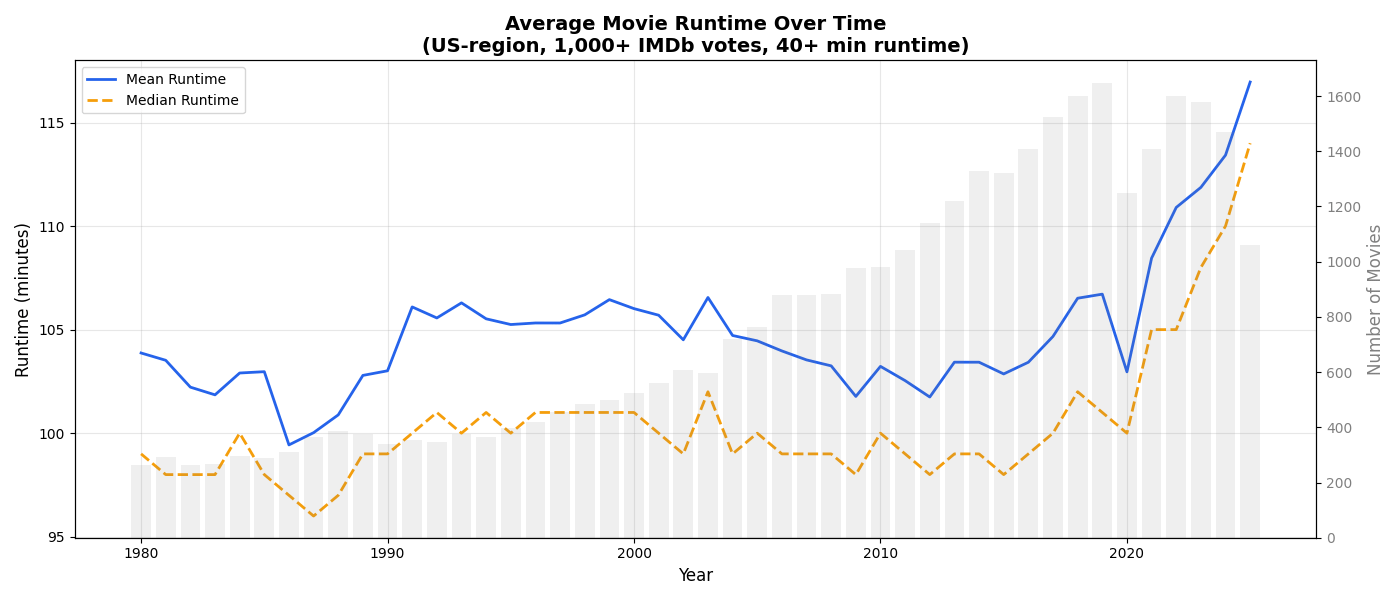
Notice this trend started during the pandemic.
When you’re watching a movie at home, you can pause, you can resume another day. Short attention spans and small bladders aren’t as much of a problem.
biz_cazh on
There could be some bias in the past few years due to the vote cutoff, ie, longer movies are more likely to reach that threshold faster. Does it look the same if you lower to 100 votes?
bl__ake on
The new Wuthering Heights could’ve been an email 🙁
bruno7123 on
I remember noticing the trend as a teenager, I remember saying that eventually we’ll hit a breaking point between runtime and people’s bladders. And a movie will be so long that intermissions will come back.
Sayon7 on
I do not like longer movies. I don’t have the time to sit through a 3 hour movie. It takes me an hour to drive to a theater. I don’t enjoy spending over 5 hours to go watch’s movie. I think two hours is perfect except in rare situations. Also working full time watch for two hours as opposed to three hour movies make night time routines rushed and unpleasant.
userhwon on
Misleading chart.
The scale on the left is mean and median and it’s a few more minutes per movie.
But the scale on the right is number of movies, and it’s quadrupled.
Also, how did they count? Because if they just looked at the listing data, that includes end titles, which have grown a lot themselves.
Rocket5700 on
As they should! Mr. Scorsese you will always have me seated for 3+ hours!
Rocktamus1 on
I can tell you why easily. The lack of 90 minute comedies. Or romantic comedies that come out and made a lot of their money back on DVD sales. Those all go right to streaming now.
lordhelmetann on
I wish this list went back longer because it’s probably just going back up to what it was like in the 50s-60s. There are so many epics that are 3-4 hours back then, mixed with 1.5 hour ones. Probably evens out.
Eh-Meee on
I wish they would get better instead of longer.
CookieN8tor13 on
Film is cheaper if even used.
FightOnForUsc on
If this includes Netflix and prime movies and not just ones in the theaters then I’m going with it being because of streaming. People can take breaks and stop and start as they please.
tungsten_panda on
This is interesting considering it’s getting more rare for a good movie to be released
AlphaSatsuma on
Interesting and looks good, but I would swap the y axes over to make it easier to read the key information (movies getting longer, not number of movies)
ToddBradley on
I just watched the Godfather movies from the early 70s. They’re so long they wouldn’t even fit on this graph. And movies are getting yet longer?
AtomicBLB on
Probably because they keep having to recite what is happening 10x and a bunch of BS for the sake of drawing a larger crowd. Such as unnecessary romances.
I can barely watch many movies made in the last 8-10 years because of how bland and unremarkable they are. Or with how the writing contradicts itself scene to scene. I especially hate the repetitive dialog though.
pokeyporcupine on
Im cool with this but for the love of God please add intermissions.
MWSin on
And shots are getting shorter. The average shot length is now a third of what it was 40 years ago. Longer movies and shorter shots mean more cuts. A lot more cuts.
That’s not to say that long shots are necessarily better, but so much of the work that used to happen on set between the actors and directors and cinematographers is now happening in the editing room and working around the performance, rather than with it. And it shows.
Geolib1453 on
Interesting how this is happening though at the same time as our attention spans becoming lower at that same period post-2020 like you would think it would also decline to match our decline in attention but its very much the opposite
randy_justice on
I always say “if it’s longer than 2.5 hours, make it a TV show instead”
JefferyGoldberg on
115 min is your top metric? So a movie under 2 hours? Bro, do you even watch movies?

![Movies Are Getting Longer [OC]](https://www.byteseu.com/wp-content/uploads/2026/02/ouu0okn0lkkg1-1024x439.png "Movies Are Getting Longer [OC]")
29 Comments
Huh, I have been noticing that recently. I wonder what’s driving the shift.
Data Source: [https://datasets.imdbws.com/](https://datasets.imdbws.com/)
Created with Python/matplotlib
That’s somewhat surprising given the stereotype that people have shorter attention spans. I am guessing that filmmakers have given up on trying to appeal to more casual fans.
I attribute this to the decline of physical media. In the VHS era you had two hours to get it done.
I think this might actually be a symptom of there being more films from smaller studios. These guys aim to show the peak of what they can do, which often equates to a longer runtime.
They’ve got to fit all those agendas in.
It costs 20 CAD$ to go to a movie nowadays. Bring your partner, buy popcorn and 2 sodas and you’re around 70 CAD$. A teenager would have to work 5 hours to make enough money to afford a date at the movies. So, at this price, movie goers are expecting more. It’s not easy to make better movies but it’s super easy to make longer movies.
Who the hell wants an over 2 hour movie? I like something short and sharp 90-100 mins pls
The real reason is that movies are now being made to be streamed at home instead of being watched in theaters.
Notice this trend started during the pandemic.
When you’re watching a movie at home, you can pause, you can resume another day. Short attention spans and small bladders aren’t as much of a problem.
There could be some bias in the past few years due to the vote cutoff, ie, longer movies are more likely to reach that threshold faster. Does it look the same if you lower to 100 votes?
The new Wuthering Heights could’ve been an email 🙁
I remember noticing the trend as a teenager, I remember saying that eventually we’ll hit a breaking point between runtime and people’s bladders. And a movie will be so long that intermissions will come back.
I do not like longer movies. I don’t have the time to sit through a 3 hour movie. It takes me an hour to drive to a theater. I don’t enjoy spending over 5 hours to go watch’s movie. I think two hours is perfect except in rare situations. Also working full time watch for two hours as opposed to three hour movies make night time routines rushed and unpleasant.
Misleading chart.
The scale on the left is mean and median and it’s a few more minutes per movie.
But the scale on the right is number of movies, and it’s quadrupled.
Also, how did they count? Because if they just looked at the listing data, that includes end titles, which have grown a lot themselves.
As they should! Mr. Scorsese you will always have me seated for 3+ hours!
I can tell you why easily. The lack of 90 minute comedies. Or romantic comedies that come out and made a lot of their money back on DVD sales. Those all go right to streaming now.
I wish this list went back longer because it’s probably just going back up to what it was like in the 50s-60s. There are so many epics that are 3-4 hours back then, mixed with 1.5 hour ones. Probably evens out.
I wish they would get better instead of longer.
Film is cheaper if even used.
If this includes Netflix and prime movies and not just ones in the theaters then I’m going with it being because of streaming. People can take breaks and stop and start as they please.
This is interesting considering it’s getting more rare for a good movie to be released
Interesting and looks good, but I would swap the y axes over to make it easier to read the key information (movies getting longer, not number of movies)
I just watched the Godfather movies from the early 70s. They’re so long they wouldn’t even fit on this graph. And movies are getting yet longer?
Probably because they keep having to recite what is happening 10x and a bunch of BS for the sake of drawing a larger crowd. Such as unnecessary romances.
I can barely watch many movies made in the last 8-10 years because of how bland and unremarkable they are. Or with how the writing contradicts itself scene to scene. I especially hate the repetitive dialog though.
Im cool with this but for the love of God please add intermissions.
And shots are getting shorter. The average shot length is now a third of what it was 40 years ago. Longer movies and shorter shots mean more cuts. A lot more cuts.
That’s not to say that long shots are necessarily better, but so much of the work that used to happen on set between the actors and directors and cinematographers is now happening in the editing room and working around the performance, rather than with it. And it shows.
Interesting how this is happening though at the same time as our attention spans becoming lower at that same period post-2020 like you would think it would also decline to match our decline in attention but its very much the opposite
I always say “if it’s longer than 2.5 hours, make it a TV show instead”
115 min is your top metric? So a movie under 2 hours? Bro, do you even watch movies?