
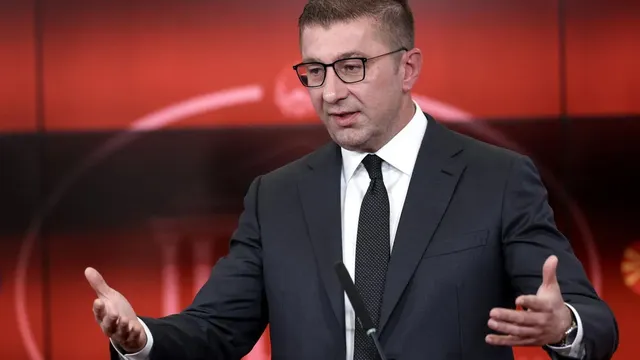
With regard to EU accession, the Prime Minister stated that there is an option for North Macedonia to become part of the bloc without voting rights, which would occur in 2027 as part of a scenario linked to the peace plan for Ukraine.
North Macedonian Prime Minister dreams of Yugoslav hegemony The North Macedonian Prime Minister has openly supported the projects of Yugoslav dictator Josip Broz Tito for hegemony in the Balkans and claims to the territorial integrity of Bulgaria. He spoke about the Bled Agreement, signed by Tito and Bulgarian dictator Georgi Dimitrov in 1947, which provided for the annexation of parts of Bulgaria to Yugoslavia. This agreement was signed under direct pressure from Soviet dictator Joseph Stalin, BGNES reported.
In an interview for Channel 5 television, the Prime Minister stated that Skopje would work toward unblocking the country’s European integration process, but not under pressure.
“If it took decades to reach the Bled Agreement immediately after the Second World War, and for the Macedonians on the other side of the border to obtain cultural autonomy with the right to join the then People’s Republic of Macedonia within the Yugoslav federation, and for known reasons 1949 put an end to this, and thereafter, if it took decades for Zhivkovism to welcome (former prime ministers of North Macedonia – ed.) Zaev and Kovachevski and for them to accept the so-called French proposal, perhaps it will again take decades to obtain some fair and dignified solution that will preserve dignity and identity, and on the other hand offer a predictable process toward the future. We will work on a solution, but we will not work under pressure. We will not work on a solution that will not take us to the very end, but to the next immediate obstacle. I cannot accept that and I have said so many times. The arguments are on our side; our arguments are taking root, they are assuming a certain shape and profile within the international community. The international community is observing what is happening; unfortunately, there is still a rule in the EU which states — one vote,” the Prime Minister said.
By “Macedonians” on the other side of the border, Macedonian Prime Minister refers to the Bulgarians from Pirin Macedonia (which has been an integral part of Bulgaria since 1912). Between 1944 and 1948, under pressure from Yugoslavia and the USSR, the Bulgarian government adopted a policy of imposing an artificial Macedonian national consciousness on the Bulgarians in the region.
He stated that the European Parliament’s rapporteur for Macedonia, MEP Thomas Waitz, “is not saying that the constitutional amendments must be adopted urgently, but that they must be adopted”.
BGNES recalls that in 2022 the Parliament of North Macedonia adopted the so-called “French proposal,” under which Skopje must include Bulgarians in the preamble of its Constitution in order to begin negotiations with the EU.
With regard to EU accession, the Prime Minister stated that there is an option for North Macedonia to become part of the bloc without voting rights, which would occur in 2027 as part of a scenario linked to the peace plan for Ukraine.
The Prime Minister’s statement comes a day after Serbian President Aleksandar Vučić declared that he agrees for Serbia to become part of the EU without voting rights.
“There is an idea that is being heard increasingly loudly in Brussels and elsewhere, and it includes the peace plan for Ukraine, under which, in practice, Ukraine’s integration, with a view to future reconstruction, within the framework of the EU, would follow a faster track. This would be unprincipled toward the Western Balkans, and there are two scenarios. It is good that we are included in both scenarios. The first scenario is for Ukraine, together with Montenegro, Albania, and Macedonia, to become a member of the EU and at the beginning of 2027 to sit at the table, for the Macedonian flag to fly in Brussels, but without voting rights. To participate in the work of the Council, the commissions, and the bodies, with many mechanisms for internal control,” the Prime Minister of North Macedonia said.
He added that there are two mandatory conditions — a common foreign and security policy and the rule of law. When asked whether the conditions include constitutional amendments, he stated that “he assumes this will be the case, because it was accepted by the previous government.” “This integration will take place in 2027. The second condition is for other countries in the region — Bosnia and Herzegovina, Serbia, Kosovo, and Moldova — to join this”. | BGNES