
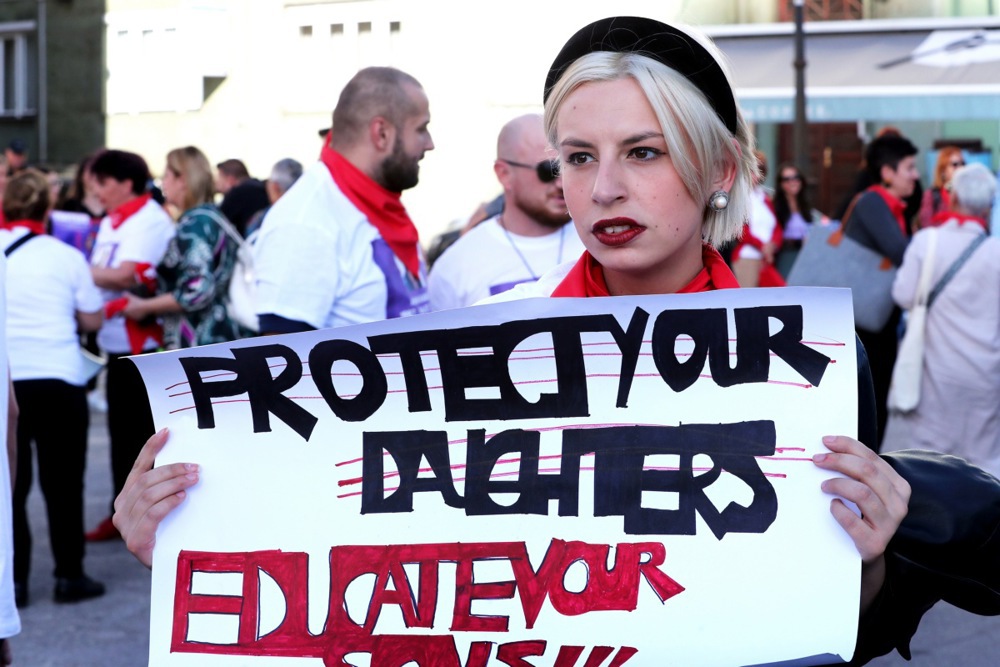
Nationwide statistics are not collected about gender-based violence in Bosnia and Herzegovina. What is known is that between 2015 and 2024, 110 women were killed in the country, and behind some of these deaths lay a chain of missed interventions – unreported violence, unprocessed complaints, suspended sentences and institutional disbelief in victims’ testimonies.
The laws on both femicide and domestic violence are different in Bosnia and Herzegovina’s two entities, the Federation and Republika Srpska.
Recent legal amendments in the Federation entity established femicide – the aggravated murder of a woman – as a specific criminal offence.
A new Law on Protection from Domestic Violence and Violence against Women in the Federation was adopted in February 2025, granting the police greater powers to provide urgent protection to victims, including removing perpetrators from the home and imposing restraining orders.
The domestic violence law introduces other new rights for victims too. “These include the right to information and the right to a personal assistant for victims with disabilities. The new ban on publicly disclosing information that could reveal the identity of a victim represents an improvement in basic protection,” the OSCE Mission to Bosnia and Herzegovina explained in a written statement.
Republika Srpska adopted a law against domestic violence in 2019, establishing new measures to protect victims. However, an attempt to change the criminal code to introduce femicide as a specific offence failed for administrative reasons in 2024.
However, despite stricter legislation, some women’s abusers have not been deterred – and police have continued to be accused of not acting to protect victims.
In the Federation entity in November 2025, the daughter of entrepreneur and humanitarian worker Djemila Talic-Gabriel was brutally beaten by her former partner after telling him she no longer wanted to continue the relationship.
Talic-Gabriel claimed that Sarajevo Canton police were called to intervene, but despite warnings, her daughter Nives Arnautovic was left alone with the abuser. “He beat her for hours,” Talic-Gabriel wrote in a post on Facebook.
Experts argue that the system still reacts too slowly, weakly and inconsistently to stop violence and prevent it from potentially escalating into murder.
“Punishing murder is too late. Femicide is prevented earlier, through sanctions and measures at the first reports,” says Zlatan Hrncic from the Gender Centre of the Federation of Bosnia and Herzegovina, an organisation established by the Federation entity government to promote equality.
Experts agree that almost every femicide is preceded by years of violence – threats, stalking, beatings, humiliation – and that prevention practices must be improved.
The Centre for Social Work in Tuzla has said that more professionally trained staff are needed, as well as more community-based prevention programmes, to give women more security.
Prosecutor Josip Anicic argues for harsher penalties for femicide, but also for offences of harassment. “The focus should be on the criminal offence of stalking, so that [persecution] is eliminated before it reaches that point [of murder]. A perpetrator of femicide, at the moment of committing the act, is not thinking about punishment,” Anicic says.
The OSCE Mission to Bosnia and Herzegovina recommended meanwhile that in order to increase trust in the system, the police, social services and the judiciary should respond swiftly, consistently and sensitively to all reports and ensure that perpetrators are held accountable.
Naida says she spoke out about what she suffered at the hands of her partner in the hope that other victims of violence may survive. “It hurts that we so often read about women killed by partners and that institutions do not react in time,” she says.
Names have been changed to protect interviewees’ identities.
This article was originally published in Bosnian by Fokus.ba.