
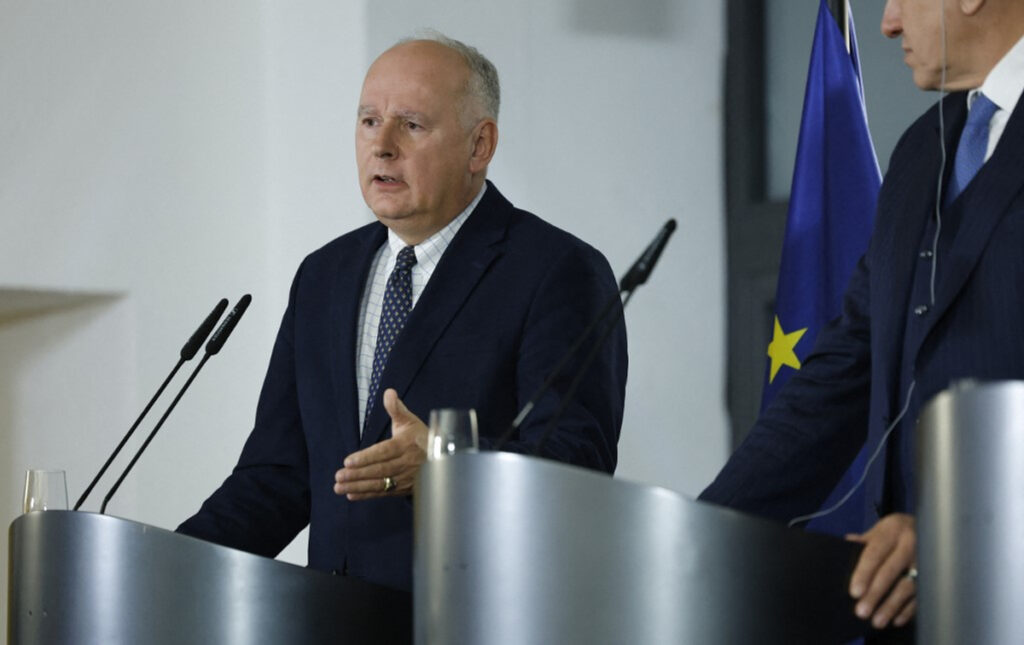
Poland has formally withdrawn from the 1997 Anti-Personnel Mine Ban Treaty and will use antipersonnel and anti-tank land mines to defend its eastern borders against Russia, Deputy Defense Minister Paweł Zalewski announced on Friday, Feb. 20.
The treaty, also known as the Ottawa Convention, prohibits signatories from producing, stockpiling or using antipersonnel mines. The weapons have been widely criticized for causing long-term civilian harm in post-conflict zones such as Cambodia, Angola and Bosnia-Herzegovina.
Follow our coverage of the war on the @Kyivpost_official.
Poland ratified the convention in 2012 and completed the destruction of its antipersonnel mine stockpile in 2016. Warsaw now plans to resume production, Associated Press reports.
“These mines are one of the most important elements of the defense structure we are constructing on the eastern flank of NATO, in Poland, on the border with Russia in the north and with Belarus in the east,” Zalewski said.
He argued that Poland must prepare to defend itself against what he described as increasingly aggressive Russian behavior. Russia is not a party to the treaty, and nor are several other countries, including the United States.
Renewed production
Zalewski said Poland plans to launch domestic production of both antipersonnel and anti-tank mines in cooperation with local manufacturers, aiming for self-sufficiency.
Anti-tank mines are not banned under the Ottawa Convention, as they are designed to detonate under the weight of vehicles rather than individuals.
Other Topics of Interest
Russia Building ‘Parallel Force’ to Protect Putin, Analyst Warns
A Kremlin decree appears to elevate Rosgvardia into a powerful “parallel” force outside the Defense Ministry, bolstering regime security and raising risks of future internal rifts, an analyst warns.
On Thursday, after attending a demonstration of Bluszcz, an unmanned vehicle designed to distribute anti-tank mines –jointly developed by Polish defense company Belma S.A. and a military research institute – Prime Minister Donald Tusk said Poland would “soon” be able to mine its eastern borders within 48 hours if necessary.
Given the length of Poland’s eastern frontier, Zalewski said the country would require “a lot” of mines.
‘Eastern Shield’ and conditional use
Poland intends to incorporate mine stockpiles into its “Eastern Shield” fortification system, which it has been developing since 2024 along its borders with Belarus and Russia.
Zalewski said the mines would only be deployed “when there is a realistic threat of Russian aggression.”
“We very much respect our territory and we don’t want to exclude it from day-to-day use for Polish citizens,” he said.
Human rights groups have criticized the decision by Poland and other countries to withdraw from the treaty, arguing that antipersonnel mines pose an unacceptable risk to civilians long after armed conflict ends.
Zalewski defended the decision as a deterrent measure.
“We are not an aggressive country,” he said, “but we have to use all means to deter Russia.”
In recent years, several countries in Europe have moved away from the pact amid growing security concerns related to Russia’s full-scale invasion of Ukraine. Finland, which joined NATO in 2023, confirmed last year that it would withdraw from the treaty, saying it needed greater flexibility to defend its long border with Russia. The three Baltic states – Estonia, Latvia and Lithuania – have also announced their intention to leave the convention. Like Poland, they cited evolving security threats on NATO’s eastern flank and concerns about their ability to deter potential aggression.
Ukraine, which was not a party to the Ottawa Convention at the time of Russia’s full-scale invasion, has similarly signaled that it may reconsider its stance as it modernizes its military doctrine in response to the war.
Russia has never acceded to the treaty, nor have other major military powers such as the United States and China, meaning that for decades a significant share of the world’s antipersonnel mines remained outside the convention’s scope.