
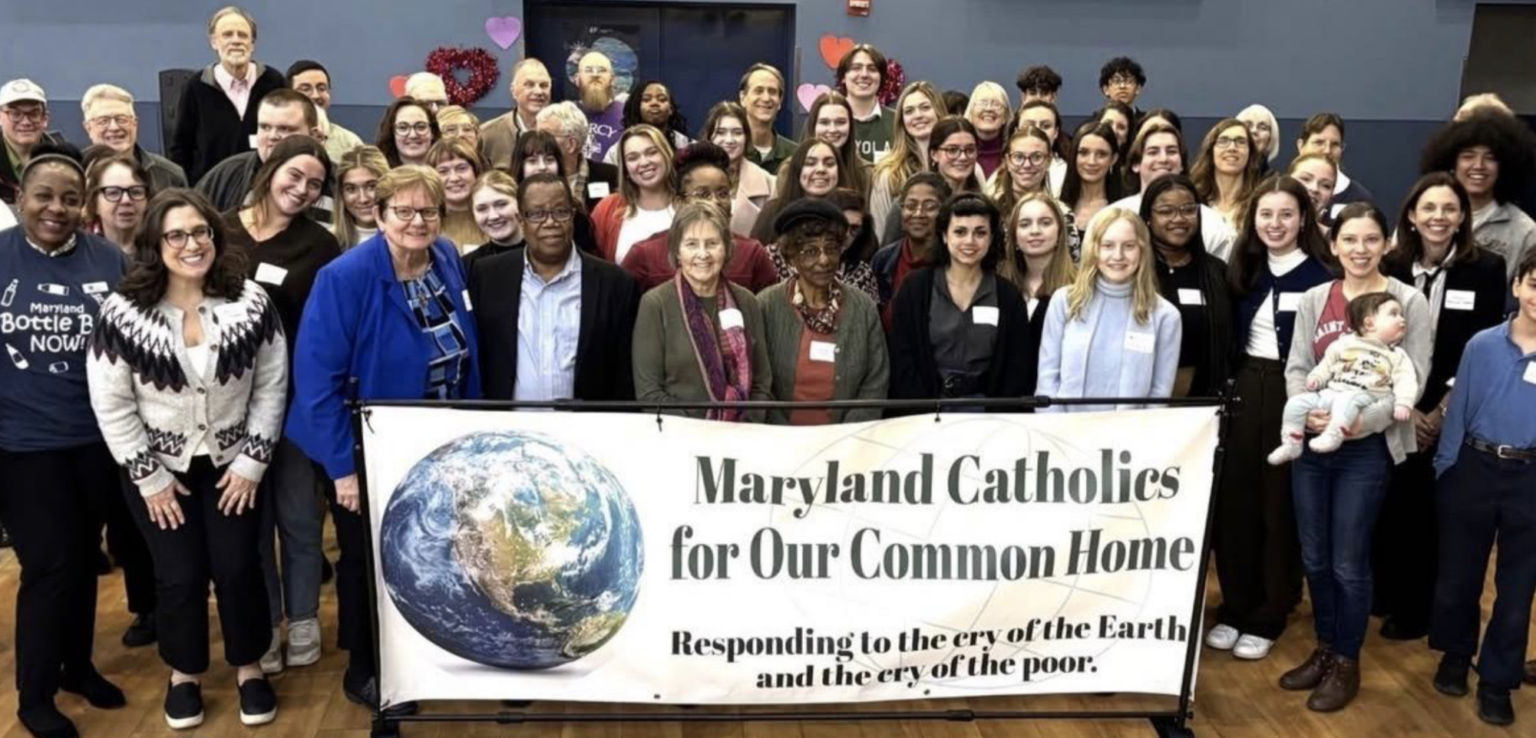
Courtesy of Maryland Catholics for Our Common Home
It was no ordinary Monday for 34 Loyola students as they shuffled onto a bus alongside Sustainability Director Brigid Gregory and Associate Professor of Communication and Media Dr. Paola Pascual-Ferrá. The group traded their typical Monday schedule to spend the day in Annapolis, Maryland, lobbying with Maryland Catholics for Our Common Home (MCCH) in favor of six pro-environment bills proposed for the 2026 state legislative session. The bills cover a wide array of topics, from a bottle redemption program to affordable solar panels and addressing data center construction.
For the fourth year, the Environmental Action Club (EAC) worked with the Office of Sustainability to send students to the state capital to meet with state delegates, senators, and their office staffers to discuss the importance of House and Senate Bills that pertain to the climate crisis, preservation, or environmental justice for Advocacy Day.
The 2026 Maryland Legislative session runs from Jan. 14 to April 13, 2026, making it a brief but action-packed four months. MCCH reviews the bills proposed by local legislators in January and February, and then selects which bills they will be lobbying on behalf of. The lay-led group found their voice in Pope Francis’ Laudato Si’, which preaches the need for Catholics to listen to the cry of the Earth and the cry of the poor. This President’s Day marked the 8th year that MCCH lobbied their representatives to support bills that aligned with their mission to care for our planet and our neighbors.
Lead MCCH Organizer Bob Simon spoke about the importance of legislative action reflecting the issues that matter to electors.
“Our legislators need to hear from the people who elect them, right? They do pay attention, so these kinds of encounters are incredibly important. I’m so grateful and delighted that so many people are willing to give their time, including so many wonderful students from Loyola, who could be doing something else today but instead are here trying to work for better laws for the state of Maryland,” Simon said.
This was the first year, however, that an entire course was in part dedicated to this day. Dr. Paola Pascual-Ferrá is teaching the inaugural Communication for Environmental and Social Justice class. Students in the class have spent the first part of the semester becoming experts on one bill and harnessing their advocacy voice to compel lawmakers and their teams.
For Loyola’s new Sustainability Director Brigid Gregory, engaging students in an active way is a top priority.
“Sustainability is about caring for a common home, which is the Laudato Si’ message, so we have to make sure that it is a part of the culture at Loyola,” Gregory said.
Gregory views the role of student advocates as critical for measurable progress.
“Doing events like Legislative Advocacy Day, where I heard many students share wonderful, personal stories about their connections to their homes, the environment, and nature, and how those experiences shaped them to think more socially and outwardly, is so wonderful,” Gregory said.
The Sustainability Director feels that the tradition extends far beyond a class, or even the Loyola experience.
“We can provide an outlet for student voices to be heard beyond just the Loyola campus. It is really preparing them for the next stage of their life to become good citizens,” Gregory said.
Many of the attendees expressed that this year’s fight was especially critical as the Trump administration continues its aggressive deregulation of the EPA and fight against policies that aim to reduce the dangers of the climate crisis.
For EAC President Lexi Chouinard ‘27, mobilizing against repeals that harm the environment and its inhabitants is not only important, but necessary.
“We’re all about taking action, going out, and doing something that will materially improve the situation. Actually talking to politicians about trying to get legislation through, that’s really the core of what we want as a club,” said Chouinard.
Despite 63% of Loyola students being from out of state, Chouinard believes it is important for the community to view and treat Maryland as their home. Even if many technically have permanent residence in another state, Loyola students spend eight months of the year living in Baltimore.
“You’re living in this space, and whether you like it or not, the air quality in Baltimore is affecting you. You are part of shaping [Maryland’s environment], and shaping how the environment is being treated is shaping you,” Chouindard said.
To learn more about the Office of Sustainability, click HERE.
To join the Environmental Action Club, click HERE.