
![I mapped every parking ticket LA has issued since 2020(10 million). Here's what the data reveals [OC]](https://www.byteseu.com/wp-content/uploads/2026/02/06a9izwacpkg1-1536x882.png "I mapped every parking ticket LA has issued since 2020(10 million). Here’s what the data reveals [OC]")
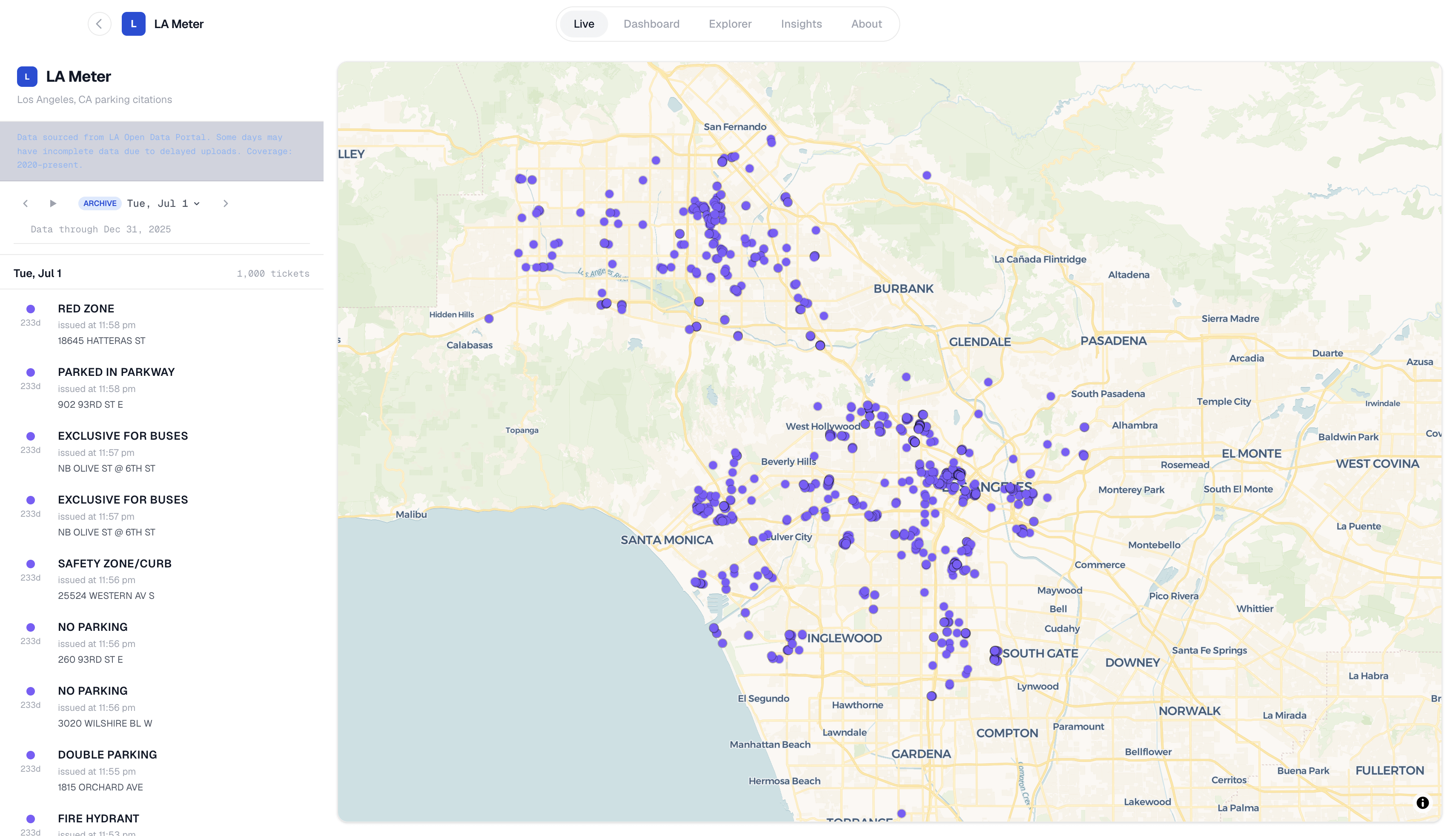
What you're looking at: An interactive map of every parking ticket in LA. You can browse by date, click individual tickets to see violation type + location, and explore patterns across the city. The screenshot shows a typical Tuesday, about 7,000 tickets in a single day. LA writes roughly 5,000 parking tickets per day.
Explore it yourself: ivankuria.com/la-meter/live
Browse any day from 2020-2025. The Insights page has the full equity analysis, enforcement patterns, revenue breakdowns,and anomaly detection.
How I built it: article
What I found after digging into 10M tickets:
- The city loses money writing tickets. LA spends ~$176M/year on parking enforcement but only collects ~$110M. That's a $65M annual deficit that's been growing since 2016 roughly $315M in cumulative losses. (source)
- Lower-income neighborhoods get hit 3.8x harder. The bottom income quartile receives 301 citations per 1,000 residents vs 80 per 1,000 for the wealthiest quartile. The equity analysis is on the Insights page. Click the Equity tab to see the map.
- Street cleaning is the #1 ticket trap. Street cleaning violations are one of the biggest categories. The top 25 locations generate a disproportionate number of tickets, with some spots showing 80%+ the same violation which suggests signage or infrastructure problems, not bad drivers.
- Enforcement basically stops on weekends. Officers work Monday–Friday. Weekends are a relative parking free-for-all.
Posted by Agitated-Somewhere15
24 Comments
Source: Los Angeles Open Data Portal — [data.lacity.org](http://data.lacity.org), dataset 4f5p-udkv. Every parking citation issued from 2020–2025, accessed via the Socrata SODA API. Equity/income data from the American Community Survey (ACS) 2022 5-Year Estimates. Revenue deficit figures sourced from Crosstown LA and LA City Controller reports
Tool: TypeScript data pipeline (custom), Supabase (Postgres) for storage, MapLibre GL for mapping, Recharts for charts, Next.js for the frontend. All code is original.
This is interesting. Do they have parking meters on many streets? If so, any idea how much the city makes from this or other “legal” parking areas (lots, garages, etc). I would guess the city may get a lot of income from these sources, so even if the parking enforcement loses money, the city makes money by having people also pay for legal parking to avoid tickets.
> Lower-income neighborhoods get hit 3.8x harder.
I wonder how much of that is higher income neighborhoods having places to park at residences.
>Lower-income neighborhoods get hit 3.8x higher
Does the data rule out that there are more violations in these neighborhoods?
[deleted]
I live in the middle of one of those big blue dots centered around the Marina Del Rey area. I would kill to have the cops ticketing here so that drunks stop using the neighborhood as bar overflow parking, but it’s just not happening. There are also people constantly parked all along Lincoln without restriction, so it’s not there. It makes me question the data a bit.
>Lower-income neighborhoods get hit 3.8x harder.
I don’t disbelieve you… but I wonder if there are some factors at play here you didn’t account for. I can see gaps on the maps where I am quite sure there are parking tickets written – but they are the incorporated areas of town with their own PDs that might not show up here (notice lack of dots in Santa Monica, Mar Vista area, all the south bay beach cities…). Incorporated areas are disproportionally higher income / higher COL areas as well. If not in the data that would substantially skew # of citations data in that regard.
Again… not saying you are wrong, but something to check. I am sure there are factors that also would cause that outcome: uneven enforcement, more apartment based / lower garage availability forcing street parking for residents, etc.
Is this AI mate? (Nice to have a UI for the data nevertheless.)
Have you sent this to a local station or journalist outfit in LA to see if they’d publish your findings?
> Street cleaning is the #1 ticket trap. Street cleaning violations are one of the biggest categories.
I’ve become convinced street cleaning has very little to do with cleaning the streets and is more of a revenue generator.
>Enforcement basically stops on weekends. Officers work Monday–Friday. Weekends are a relative parking free-for-all.
A lot of parking meters throughout the city are turned off on weekends, so there’s not much to enforce. A lot of the “no parking/stopping” far-right lanes have a weekend exception as well.
#1 spot? Alley next to Venice Erehwon.
Nice work OP, fun to review.
Also, looks like the tickets per day is capped at 1,000, I’d guess that’s the max their API returns.
Can we do something like this for speeding tickets?
I wonder how many warrants are issued for unpaid tickets / violations.
> LA spends ~$176M/year on parking enforcement but only collects ~$110M
Is $110M the fined amount or the actual collected amount? I would guess that lots of fines go unpaid.
Can pyu overlay with crime rates of these areas? Two kinds: homicide, assault, armed robbery, home invasion etc , and. 2) property crime like car theft, vandalism.
If police patrol is more in an area, you are likely to see more traffic and parking infractions but less of crime. Would like to know what the data says.
A wise man once said someone should pay for parking in all of LA for a day
2 – the most unsurprising part of the analysis.
edit to remove unexpected formatting
“The city loses money writing tickets.”
Better phrasing: “Public services cost money.”
Tickets are a mechanism to discourage unwanted behavior and to penalize those who do it, and not something that should be expected to fund itself. Parking enforcement is like other policing but just limited to parking, we don’t expect the police to make money, it’s a public service that needs to be funded. If we start to expect parking enforcement to fund itself then it incentivizes them to be excessive in their ticketing.
Ok, I give up. What is street cleaning? Like, a crew of guys with brooms? Do streets there get dirty somehow? Are they cleaning dirt or trash?
Can we see who gave the most tickets?
Wow…not a single ticket issued in my neighborhood…and there are indeed meters here. Guess I’m never paying for those ever again.
Those most popular locations for collecting tickets being in and around Venice beach makes a lot of sense. It’s one of the most popular places in Los Angeles and the parking situation is terrible. People find spots where ever they can (including commercial parking lots) before walking to the Boardwalk.
I had a friend who lived in Venice for years, where many, many, many of the bungalow style homes don’t have driveways, and the parking is always a nightmare.
This is incredible. Ty for sharing