
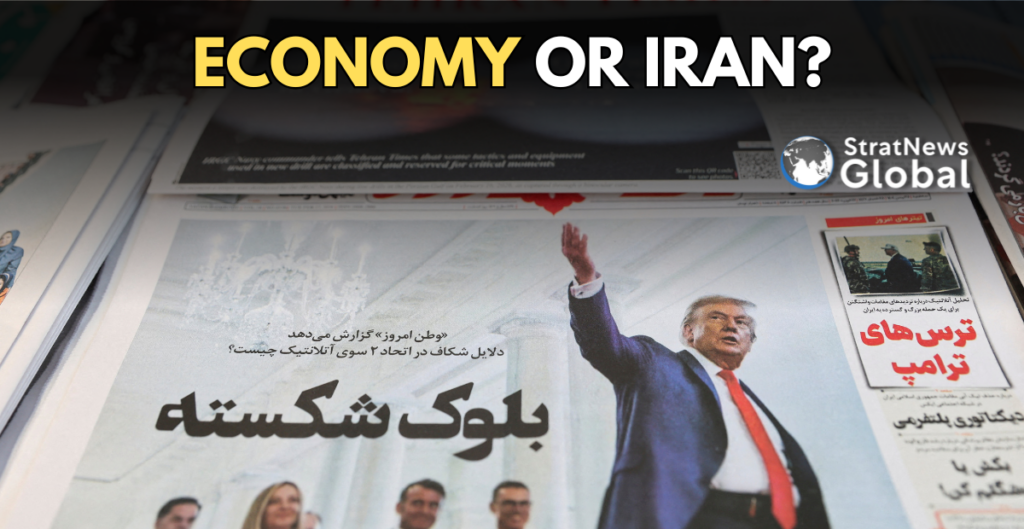

President Donald Trump has pushed the United States to the brink of war with Iran even as aides urge him to focus more on voters’ economic worries, highlighting the political risks of military escalation ahead of this year’s midterm elections.
Trump has ordered a huge buildup of forces in the Middle East and preparations for a potential multi-week air attack on Iran. But he has not laid out in detail to the American public why he might be leading the U.S. into its most aggressive action against the Islamic Republic since its 1979 revolution.
Trump’s fixation on Iran has emerged as the starkest example yet of how foreign policy, including his expanded use of raw military force, has topped his agenda in the first 13 months of his second term, often overshadowing domestic issues like the cost of living that public opinion polls show are much higher priorities for most Americans.
Economy Concerns
A senior White House official said that, despite Trump’s bellicose rhetoric, there was still no “unified support” within the administration to go ahead with an attack on Iran.
Trump’s aides are also mindful of the need to avoid sending a “distracted message” to undecided voters more concerned about the economy, the official told Reuters on condition of anonymity because they were not authorized to speak to the press.
White House advisers and Republican campaign officials want Trump focused on the economy, a point that was stressed as the top campaign issue at a private briefing this week with numerous cabinet secretaries, according to a person who attended. Trump was not present.
A second White House official, responding to Reuters questions for this story, said Trump’s foreign policy agenda “has directly translated into wins for the American people.”
“All of the President’s actions put America First – be it through making the entire world safer or bringing economic deliverables home to our country,” the official said.
Reasons For War
Foreign policy, historically, has rarely been a decisive issue for midterm voters. But, having deployed a large force of aircraft carriers, other warships, and warplanes to the Middle East, Trump may have boxed himself in to carrying out military action unless Iran makes major concessions that it has so far shown little willingness to accept. Otherwise, he may risk looking weak internationally.
The reasons Trump has given for a possible attack have been vague and varied. He initially threatened strikes in January in reaction to the Iranian government’s bloody crackdown on nationwide street protests, but then backed down.
He has more recently pinned his military threats to demands that Iran end its nuclear program and has floated the idea of “regime change,” but he and his aides have not said how air strikes could make that happen.
The second White House official insisted that Trump “has been clear that he always prefers diplomacy, and that Iran should make a deal before it is too late.” The president, the official added, has also stressed that Iran “cannot have a nuclear weapon or the capacity to build one, and that they cannot enrich uranium.”
What many see as a lack of clarity stands in stark contrast to the extensive public case made by then-President George W. Bush for the 2003 invasion of Iraq, which he said was meant to rid the country of weapons of mass destruction. Though that mission ended up being based on bad intelligence and false claims, Bush’s stated war aims were clear at the outset.
Godfrey, the Republican strategist, said independent voters – crucial in deciding the outcomes of close elections – will be scrutinizing how Trump handles Iran.
“Midterm voters and his base will be waiting for the president to make his case,” he said.
(with inputs from Reuters)