
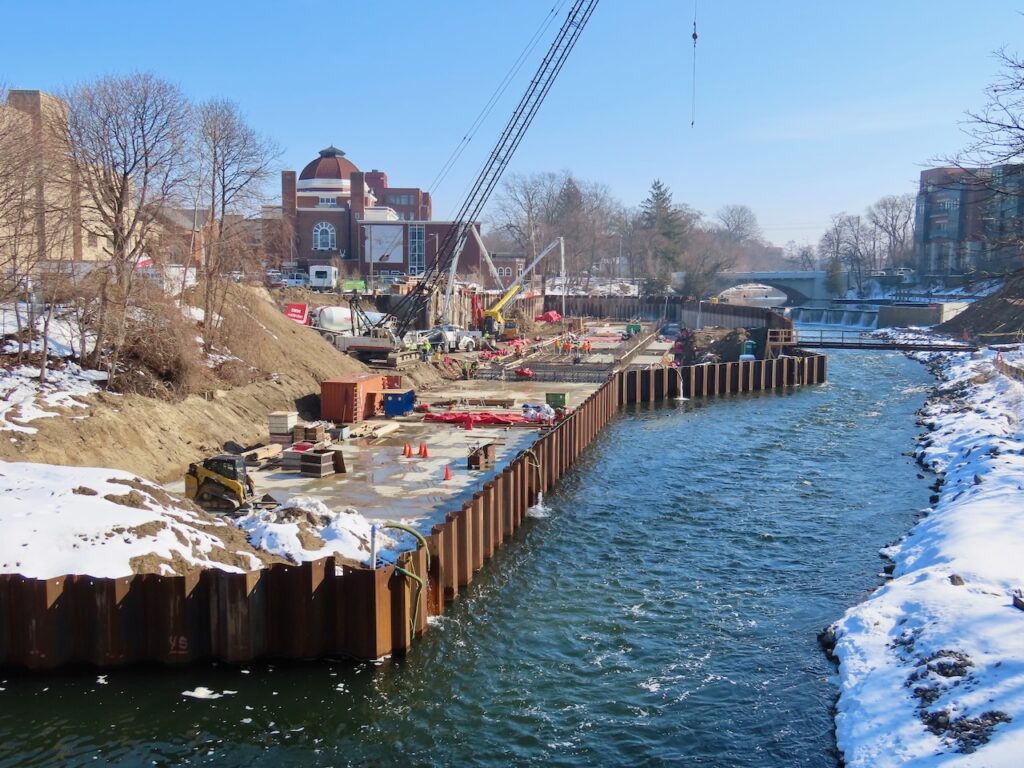
TRAVERSE CITY, MI — An unusual structure is taking shape in the middle of downtown Traverse City.
Crews are pouring the massive sorting channel that will form the core of the FishPass project, a globally unique structure in northern Michigan that’s designed to let native fish move upstream while blocking harmful invasive species like sea lamprey.
The work marks a critical phase for the project on the Boardman River where the former Union Street Dam once stood. Construction teams are building twin 400-foot lanes that will house obstacles designed to selectively sort fish for upstream passage.
“This is kind of the heart and soul of FishPass,” said Leah Bagdon McCallum, community engagement officer for the Great Lakes Fishery Commission, which is spearheading the project. “It’s the most important piece of the actual infrastructure.”
Crews are busy this winter pouring 3,130 cubic-yards of concrete for the sorting channel in a dewatered section of the river. When finished, the channel lanes will have more than 1,000 anchors for attaching obstacles and 13 separate gates for containing, diverting or passing fish.
The in-river phase is expected to wrap up this summer, followed by upland work that will include a research and education facility, trails, landscaping and public spaces. The overall project is expected to finish by the end of 2027, McCallum said.
When finished, the structure will function as a complete barrier that can sort fish not unlike how a municipal recycling center sorts waste materials. The fish will run a gauntlet that sorts them based on how they respond to light, sound, velocity and other stimuli. Desirable species can continue upstream while harmful invaders are sequestered.
McCallum likened it to “an American Ninja Warrior course.”
“When the fish go through that course and they respond to the different things that are there, they’ll be sorted into groups based on the species type and how they behaved,” she said.
FishPass is widely viewed as a global test of selective fish passage technology and is the capstone of roughly two decades of restoration work to reconnect the Boardman River with Lake Michigan’s Grand Traverse Bay after upstream dam removals.
Michigan’s largest dam removal effort eliminated three dams on the river and reopened miles of upstream habitat. The Brown Bridge Dam was removed in 2012 with partial failure during drawdown. The Sabin Dam was removed in 2017 and the Cass Road Dam was removed in 2018.
Removal of the Union Street Dam began in 2024 following the conclusion of litigation that delayed the project several years.
The project is tackling a longstanding challenge in Great Lakes fisheries management: how to restore connectivity for native species without reopening pathways for invasive ones.
For at least the first decade, managers plan to restrict passage to native upper Great Lakes species while researchers study ecological impacts and fine-tune how FishPass operates. That means salmon and steelhead would not pass upstream during the initial study period.
McCallum said the final project cost is expected to land between $20 million and $30 million, depending on bids for remaining phases.
Partners on the project include the City of Traverse City, Grand Traverse Band of Ottawa and Chippewa, Michigan Department of Natural Resources and the Boardman River Dams Implementation Team.
Before full dewatering, fisheries staff and tribal partners recovered fish trapped in cofferdam pools and relocated them downstream, including trout, bass and yellow perch.
The Grand Traverse Band held a lake sturgeon stocking ceremony upstream of the project in September in which 700 juveniles were released. The hope is the fish will return in 15 to 25 years and make their way back upstream through the sorting channel.
When complete, the project will include a park-like public features, including pedestrian trails, a plaza, bridge and kayak launches.