
 사진 확대
사진 확대 The nuclear-themed exchange-traded fund (ETF) has been strong this year. It is more than SK Hynix’s growth rate. Products containing Hyundai Engineering & Construction, which have been reborn as nuclear power plant themed stocks, have a 70% increase rate.
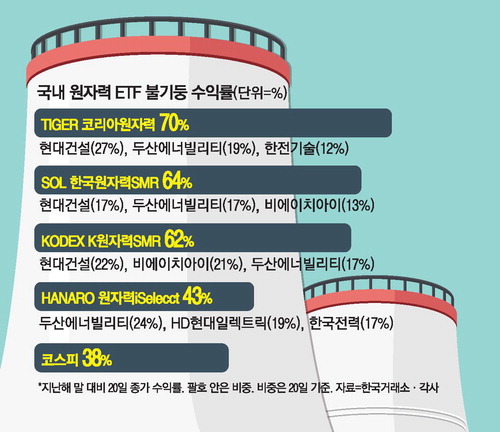
According to the Korea Exchange on the 22nd, all five ETFs investing in domestic nuclear power stocks will exceed the KOSPI yield (38%) this year. As of the 20th, Mirae Asset Asset Management’s “TIGER Korea Nuclear Power” jumped 70% from the end of last year. SOL Korea Nuclear SMR and KODEX K Nuclear SMR, which focus on the theme of SMR, rose 64% and 62%, respectively. ACE Nuclear TOP10 and HANARO Nuclear iSelect, which were released before these products listed last year, rose 54% and 43%, respectively. Four out of five nuclear ETFs exceed SK Hynix’s growth rate (46%) and three exceed Samsung Electronics’ return rate (58%).
Nuclear power generation is drawing attention as a countermeasure as there is concern that there will be a shortage of power supply due to increased investment in artificial intelligence (AI) around the world. Team Korea, led by Korea Hydro & Nuclear Power Co., has been recognized for its large nuclear power plant technology by winning an order for the Czech Dukovani nuclear power plant worth 26 trillion won in project cost, and further cooperation with the United States is expected in the future.
Domestic nuclear ETFs commonly measure the similarity of nuclear industry keywords when deciding on incorporation stocks. Since all five ETFs cover the domestic nuclear value chain, the incorporated stocks are the same. The weight determination method also has something in common that considers the current market capitalization. Recently listed products focus more on SMR keywords to differentiate themselves in detailed strategies.
As of the 20th, Hyundai E&C ranks first in the proportion of four products among the five ETFs. Doosan Efficiency, BHI, and KEPCO Technology are also key incorporation items.
Doosan Efficiency (66 trillion won) is larger than Hyundai Engineering & Construction (14 trillion won), but due to the nature of ETFs that have the maximum weight limit (cap) for each stock, the two stocks are allocated similar weight during regular reorganization. However, Hyundai E&C’s growth rate this year has far exceeded Doosan E&C’s, and Hyundai E&C has become the No. 1 in proportion in the four ETFs. While Doosan E&C is up 37 percent this year, Hyundai Engineering & Construction jumped 83 percent. Hyundai Engineering & Construction is originally a construction owner, but since last year, it has emerged as a nuclear power plant construction company, and the stock price has been reevaluated.
TIGER Korea Nuclear Power Co., the No. 1 increase rate, has the highest proportion of Hyundai E&C among the five ETFs, with about 27% of its portfolio as of the 20th. This product sets the cap at 25% for regular changes (rebalancing), which is higher than competing products. Rather than easing volatility through stock dispersion, the strategy focuses on maximizing upward returns. Woori Technology (8%), which ranks fourth in proportion, also drove the ETF’s rise, rising five times from the end of last year.
The theme of nuclear power plants is a combination of mid- to long-term optimism and short-term uncertainty concerns. “The nuclear power plant industry is favorable in the mid to long term,” said Na Yong-soo, head of the ETF division of Korea Investment Trust Management, but added, “In the short term, uncertainties such as political and external variables remain, so it is necessary to check the global power infrastructure investment and replacement cycle.”
[Reporter Jeong Jaewon]