
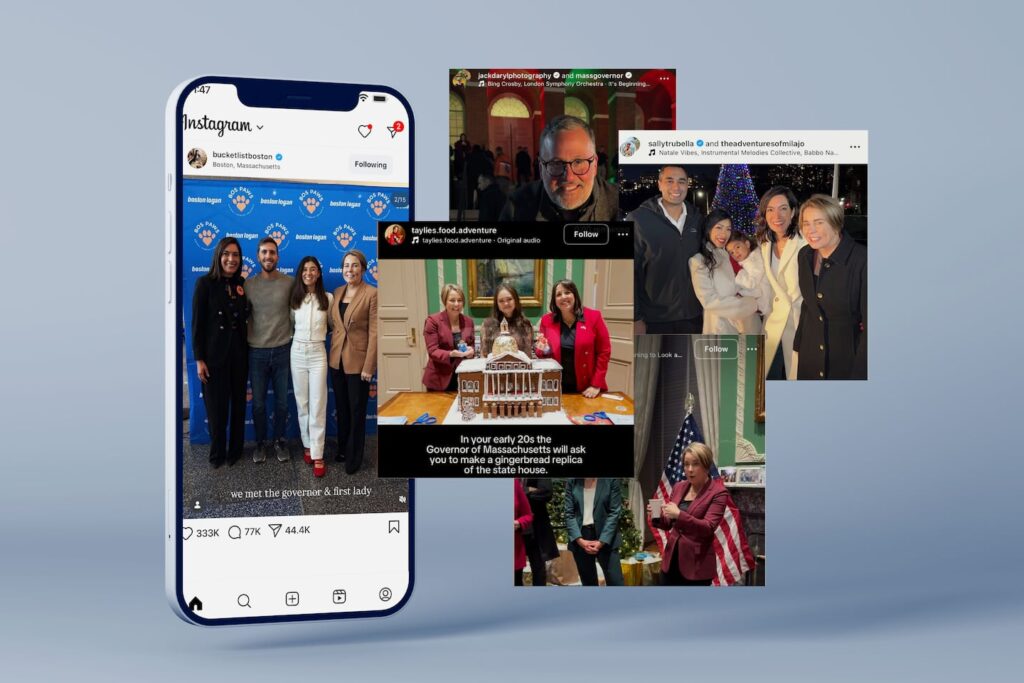
Healey is offering creators one-on-one interviews, inviting them to events, and promoting their social media accounts on her own. An influencer now sits on a city of Boston nightlife committee. The state’s attorney general appeared on another’s podcast.
In Massachusetts and beyond, politicians have increasingly turned to people with armies of followers to promote events, boost policies, or build coalitions in election years. That shift has raised questions about how transparent politicians and the influencers they work with should be as they knit their social feeds together.
“Democrats have been playing catch-up — right-wing influencers are so embedded into the political system that they’re being appointed to [high-level] positions,” said Carly Carioli, of Boston-based marketing agency, Gupta Media. “We’re seeing the rise of politicians who are acting like creators to take advantage of ways that the platforms we all watch rank and distribute content.”
“Creators” was a buzzword of the 2024 election season, as campaigns on both sides of the aisle scrambled to take control of their narratives online, vying for the affections of young people by speaking with podcast hosts and making cameos in get-ready-with-me — or “GRWM” — vlogs.
As trust has eroded in political institutions, and with many younger people getting their news from social media, politicians acknowledge influencers are crucial to the news ecosystem. They’re also a growing part of local economies: The so-called creator economy was expected to become a $480 billion industry globally by 2027.
In Massachusetts, those relationships are bidirectional. Politicians gain exposure by appearing with friendly creators, who bolster their political bona fides by posing with the state’s most powerful elected officials.
Last year, in partnership with Carioli’s firm, Boston Mayor Michelle Wu hosted the city’s first creator summit, where more than 75 local influencers gathered in Back Bay to connect with the mayor and with one another. Wu wrote in an Instagram post at the time that content creators are “treasured and welcomed” and government has a responsibility to “meet residents where they are” as they increasingly get news from creators.
That event was a turning point for digital content creation being treated as more than just a hobby in Boston, said Weiser, the “Bucket List Boston” creator.
The first time Weiser said she was invited to a political event was Wu’s first mayoral inauguration in January 2022. Since then, Weiser — whose posts amassed an Instagram following of over 220,000 people over the last decade — became the only influencer to join the mayor’s Nightlife Initiative for a Thriving Economy committee. She also repeatedly partnered with Healey, at one point receiving a tour of the State House.
“There’s immense value,” Weiser said of elected officials working with influencers. “Creators have built these loyal audiences over years . . . and therefore they have credibility with their community. That’s a lot of what politicians are always working on.”
That credibility boost goes both ways, she added. Weiser plans to turn a clip where she asked Healey about her dream day in Boston into a series featuring other influential figures.
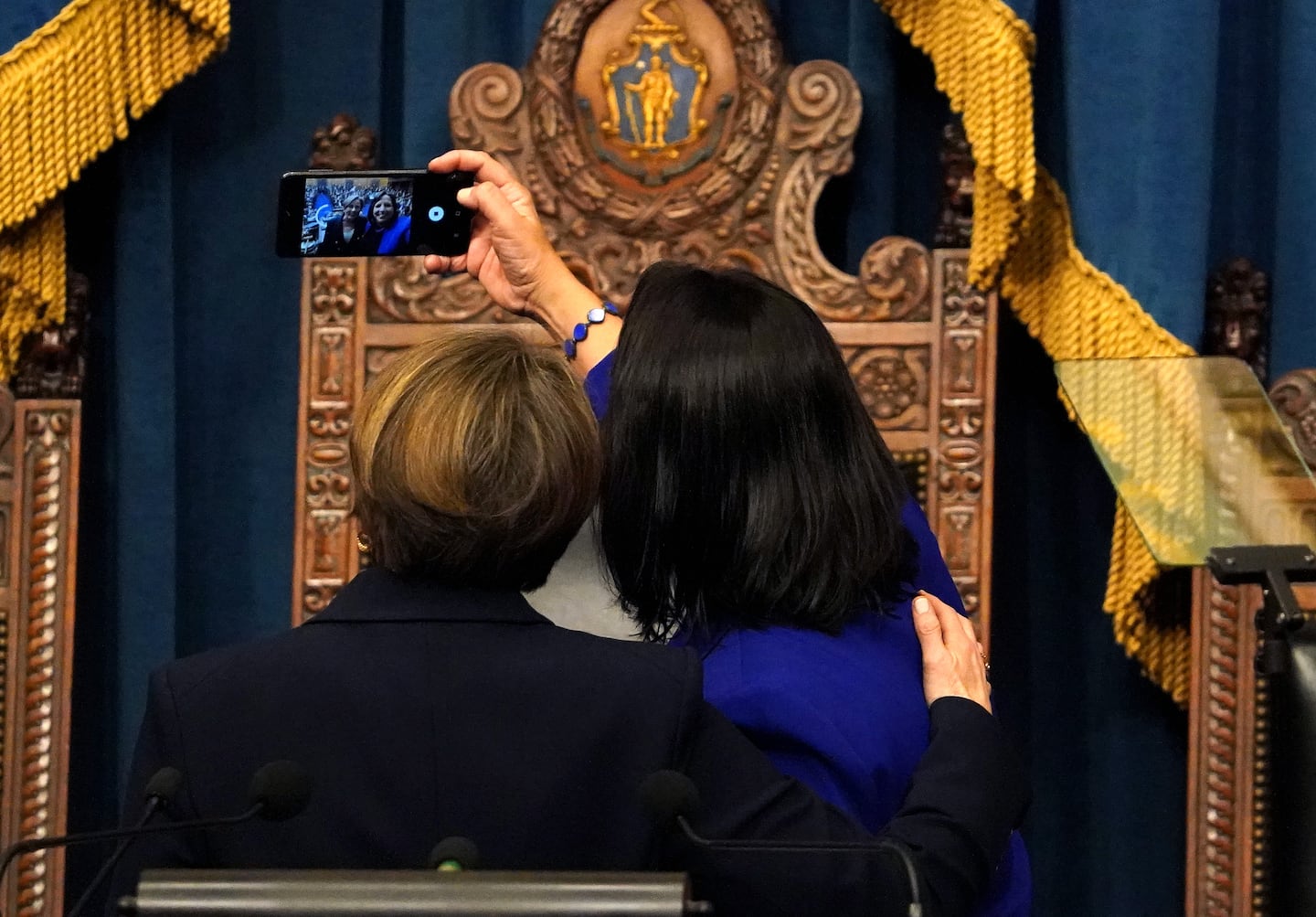 Governor Maura Healey, seen here taking a selfie with Lieutenant Governor Driscoll during her first State of the Commonwealth address, has regularly posted her own content online.Barry Chin/Globe Staff
Healey and Wu frequently post their own content, whether the mayor records herself commuting with residents or Healey lip-syncs to trending sounds. Cross-posting with creators with larger followings than them is an opportunity to broaden their reach.
Allison Mitchell, the mind behind Healey’s expanding digital presence, said she began ramping up outreach to creators over the last several months, inviting them to exclusive opportunities such as a meet-and-greet with therapy dogs at Logan International Airport or one-on-one interviews in Healey’s ceremonial office. They’ve also engaged virtually, such as chatting with medical influencers over FaceTime calls that are then posted to the creators’ — and sometimes Healey’s — profiles.
“There’s never been a situation where we’ve been like, ‘Oh, we’re not going to get a creator involved.’ We always love to have them on board,” Mitchell said. “It’s a way for us to to tap into new audiences, to talk to people that might not be as inclined to read the news.”
Healey’s official Instagram account follows dozens of travel reviewers, stay-at-home-mom creators, and enough “lifestyle” influencers and podcasters to fill a Beacon Hill committee room. That includes beverage influencer “Nail the Cocktail,” who shows off flashy manicures holding drinks from local bars, and an American Girl Doll meme account that boasts nearly 125,000 followers.
They’ve become a staple in Healey’s orbit. Influencers stood in a reserved section at the State of the Commonwealth address. In November, Healey dropped $500 on catering from the local chain Flour Bakery + Cafe for a State House “creator event,” campaign finance records show. And Taylie Kawakami, a food blogger now on Healey’s staff, posted about making a 30-pound gingerbread State House replica for the building’s tree lighting event.
The governor’s office does not pay influencers it works with, Mitchell said.
Nguyen, who posts travel and lifestyle content, said Healey’s office invited her family to the tree lighting ceremony in December, and asked to meet about future collaborations afterward.
“I don’t post political content, but I do feel like posting the photo of the tree lighting was kind of my way of showing where I stand,” Nguyen said. “We’re kind of a bridge between her and the everyday resident.”
Attorney General Andrea Campbell has worked to boost her work through influencers, too. Campbell appeared in November 2024 on a podcast hosted by Sammy Kanter, a social media strategist known as “Girl and the Gov,” to discuss taking on the Trump administration.
Given Massachusetts’ “uniquely blue” reputation, left-leaning politicians can experiment on social media more creatively, with influencers or otherwise, than they might in a red “or even a purple state,” Kanter said.
“It’s one thing to just be on socials,” Kanter said. “You also have to be thinking: What’s the long term goal? What are we trying to achieve?”
Still, political influencing has become a lucrative business: Kanter, for instance, charges $300 a pop for an hour-long social media strategy session.
The rise of creators during the 2024 election quickly sparked questions about whether they were being, or should be, paid by political campaigns. Without clear rules in place, influencers tend to “fall through the cracks” of social media policies and laws around political contributions, said Isabel Linzer, an analyst with the Center for Democracy and Technology in Washington, D.C.
“While on one hand they’re expanding the model of democratic participation … there are times where creators can be a vector for foreign influence or undermine transparency when it comes to political speech or campaign finance,” Linzer said.
There are also risks with working with influencers online. Texas State Representative James Talarico, a US Senate candidate, faced a firestorm after an influencer he spoke with claimed Talarico called former US Representative Colin Allred a “mediocre Black man” — which Talarico called a “mischaracterization of a private conversation.”
There are other potential pitfalls, namely a once-friendly creator using their platform to turn on the politician, said Adriana Lacy, a digital consultant and Brandeis University journalism professor.
“We’ve seen where creators are in favor of one politician, they do something they don’t like, and all of a sudden they’re launching a public campaign against them,” she said.
Lacy said politicians still need to employ traditional news outlets, whose readership typically includes more people who participate in elections.
“If you put all your money into creators, sure, you’re hitting a younger demo, but are those folks actually going to go out and vote for you?” Lacy said. “This is a type of marketing to reach a specific audience, but it cannot be your only strategy.”
Anjali Huynh can be reached at anjali.huynh@globe.com. Samantha J. Gross can be reached at samantha.gross@globe.com. Follow her @samanthajgross.