
Jim Spears, the retired Fort Smith municipal judge who helped lead the effort to place the large Bass Reeves statue in downtown Fort Smith has another idea for an historic marker in the city’s downtown. And he’s asked for help from the Central Business Improvement District (CBID).
Spears spoke Feb. 19 to the CBID, a semiautonomous governing body involved in efforts to enhance downtown Fort Smith, saying that the multi-year effort to build the Bass Reeves statue has proven to be a tourism image for the state.
“That (Reeves statue) is now on almost every publicity thing that the state of Arkansas puts out,” Spears said.
Spears said the Reeves statue installation was followed by the William O. Darby statue on the east end of Garrison Avenue in downtown Fort Smith, the statues in Gateway Park in downtown Fort Smith, and the statue of a Native American lawman at the U.S. Marshals Museum.
Spears’ idea is to create a monument, and find a downtown location, to note the city’s role in being a key stop in the historic Butterfield Stagecoach line. The Butterfield stop in Fort Smith was at the John Rogers’ City Hotel, near the southwest corner of North 2nd Street and North A Street.
“In 1858, Fort Smith became a hub of the Overland Mail,” notes a National Park Service report. “The first Butterfield Mail stagecoach passed through Fort Smith in September on route to El Paso and then to California. This was a 15 day trip. The Concord stages came across the Arkansas by flatboat at Van Buren then carried passengers and mail on to Fort Smith. On the trip westward to California, mud wagons were used.”
 A picture from the Arkansas Advocate of a stagecoach used on the Butterfield Trail.
THE TRAIL
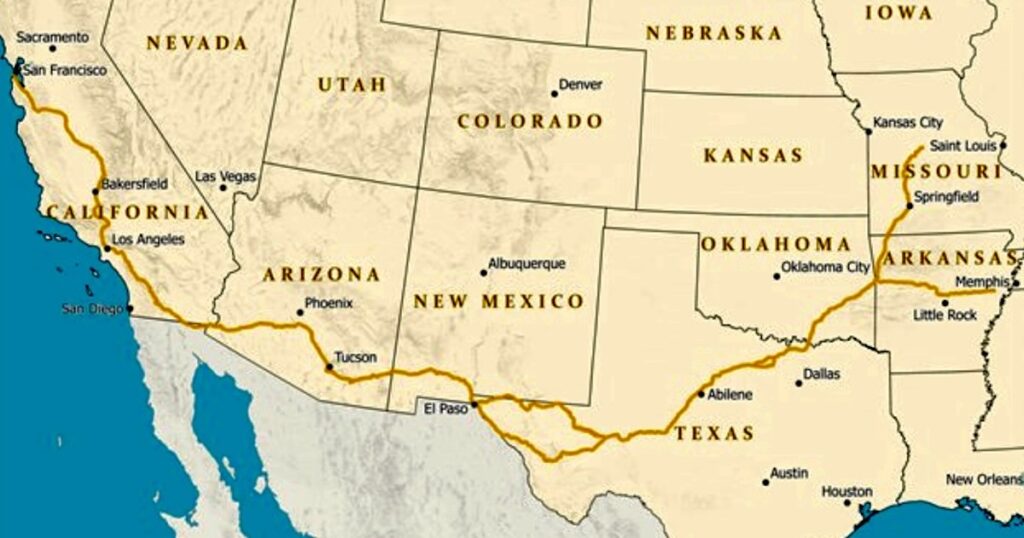
The Butterfield line was approximately 3,553 miles of trails in Arizona, Arkansas, California, Missouri, New Mexico, Oklahoma, Tennessee and Texas. Fort Smith was the connection point for the Butterfield routes leading to Memphis and St. Louis.
“John Butterfield, a former stagecoach driver from New York, established the Butterfield Overland Mail Route in 1858 with the goal of connecting the Mississippi River and the Pacific Ocean, delivering mail far faster than by sea,” according to the Arkansas Department of Parks, Heritage and Tourism. “Lines were established from Missouri to Fort Smith and then points west, and from Memphis to Fort Smith, with a side-run to Little Rock. The Butterfield Overland Trail was eclipsed by the faster Pony Express in 1860, and Civil War bushwhackers and hostile Indians in the west spelled an end for the company by 1861. The Butterfield Overland Mail Trail Route is currently being considered as a possible National Historic Trail.”
U.S. Sen. John Boozman, R-Ark., successfully pushed legislation in 2022 that designated the entire route as a National Historic Trail.
“This is a long-overdue recognition for the Butterfield Trail. Designating it as a National Historic Trail will preserve the story of westward expansion and Arkansas’ significant role in the growth and development of our country,” Boozman said in this report from the Arkansas Advocate.
NOT A SMALL PROJECT
Spears said he does not have a definite idea for a Butterfield monument, but told CBID members that he envisions two large steel plates, possibly life-size, that are cutouts of a stagecoach, drivers and horses. The plates, which would sit on a base, would use lighting to create silhouettes at night. He also said the monument should cost less than the more than $300,000 that was raised to complete the Reeves statue.
“That’s not going to be a small project, but I think it’s one that could be done, and with the welding, the fabrication talent at the college (University of Arkansas at Fort Smith), that would help with that (cost),” he said.
Spear said his health will not let him devote time and energy toward the concept, and hoped the CBID could help make it happen. CBID member Phil White agreed to take the lead on the Butterfield monument idea, telling Spears, “You’ve got my brain turning on this.”
“You know, he (Spears) started something,” White said as he turned to the CBID members. “He’s right. We really have a lot to be proud of with what started with (the) Bass Reeves (statue).”
Adam Beeco, superintendent of the Fort Smith National Historic Site, also expressed interest in helping, noting the National Park Service connection with downtown Fort Smith.
In an interview after the CBID meeting, White said he will begin working on a plan and could even have an initial cost estimate in 30 days.
“Is it doable? Yes,” White said. “We have two companies in Fort Smith that can laser cut that steel. All we need is a drawing. Once you have a drawing they download it into a robotic machine. It’s a pretty simple process.”
While the monument creation process may be simple, White said the design work, effort to find a location, and fundraising will be a challenge. White said he wants to do it not just because Fort Smith has a unique connection to the trail, but because of his respect for Spears’ civic accomplishments.
“For Jim, and what all he has done, I’m going to give this all my effort and my priority right now,” White said. “We’ll come up with a cost, and then we’ll raise the money.”
Related