
Brussels, Belgium
Reuters
Hungary maintained its veto on Monday on new EU sanctions on Russia and a huge loan for Ukraine amid a dispute over oil supplies, in a blow to Europe’s pro-Ukrainian consensus on the eve of the war’s fourth anniversary.
On the ground in Ukraine, Kyiv claimed a rare frontline advance, though Moscow continued its campaign of targeting Ukrainian cities, killing two people in drone strikes in the south.
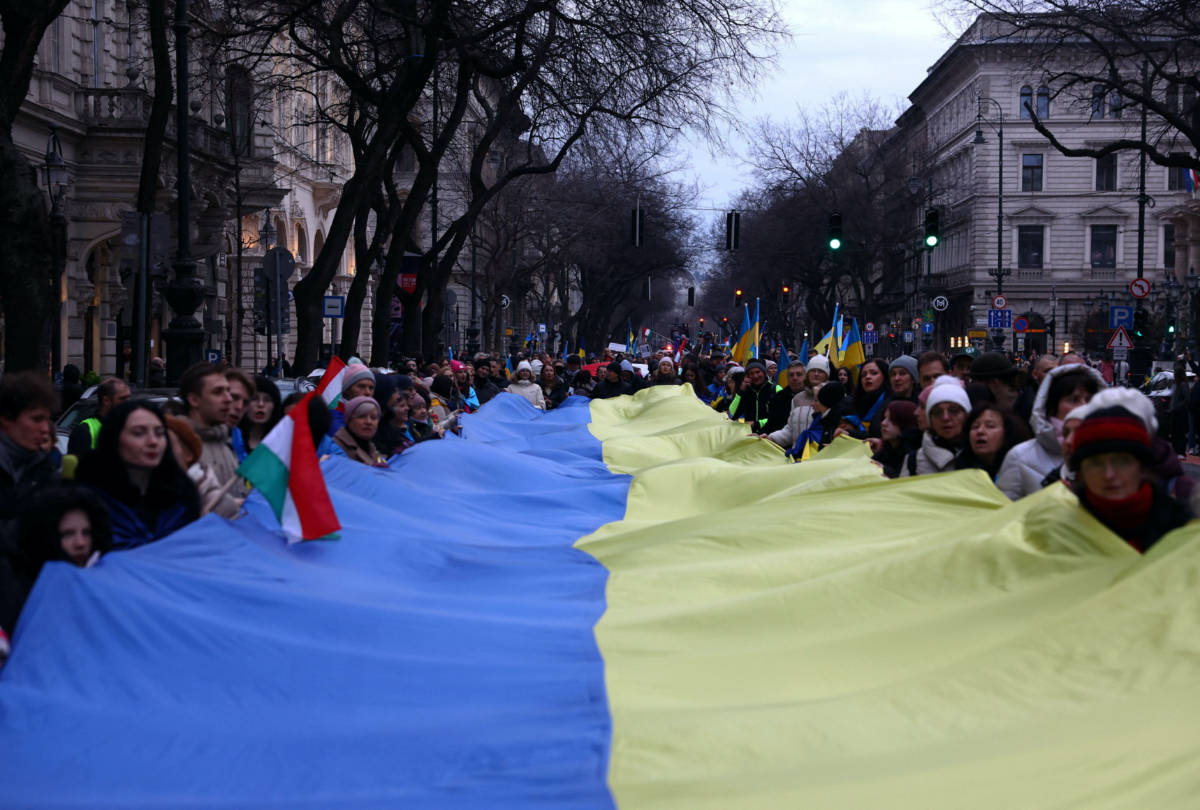
People take part in a solidarity march ahead of the fourth anniversary of the full-scale Russian invasion of Ukraine, in Budapest, Hungary on 22nd February, 2026. PICTURE: Reuters/Bernadett Szabo
The diplomatic spotlight was on Brussels, where European foreign ministers tried unsuccessfully to persuade Budapest not to punish Ukraine for delays restarting the flow of Russian oil to Hungary via a Soviet-era pipeline.
Soon after, another of Ukraine’s EU neighbours, Slovakia, said it would refuse any requests from Kyiv for emergency electricity supplies from Monday until oil flows resume via the Druzhba pipeline.
Potentially escalating the crisis further, Ukraine said its drones struck a Russian pumping station overnight serving the pipeline. It was set up to supply Moscow’s crude through Ukraine to eastern Europe, but shipments to Slovakia and Hungary have been cut off since 27th January.
“This is a setback,” says EU’s Kallas
“We have not reached an agreement on the 20th sanctions package,” EU foreign policy chief Kaja Kallas told reporters. “This is a setback and a message we didn’t want to send today, but the work continues.”
European Council President Antonio Costa urged Hungarian Prime Minister Viktor Orban to honour an EU deal for a €90 billion loan to Ukraine.
But he replied in a letter seen by Reuters that Ukraine could restart the oil flows if it wanted and: “I am not in a position to support any decision whatsoever favourable to Ukraine until they return to normality.”
EXPLOSION IN MYKOLAIV INJURES SEVEN UKRAINIAN POLICE OFFICERS, POLICE CHIEF SAYS
An explosion in Ukraine’s southern city of Mykolaiv injured seven police officers on Monday, two of them seriously, the head of the national police said, marking the second attack involving police in three days.
Ivan Vyhivskyi said the officers had parked their cars in anticipation of a shift change when the explosion occurred.
On Saturday, an explosion in Lviv killed a woman police officer and injured 24 people.
“The day before yesterday, a terrorist attack against police officers took place in Lviv,” Vyhivskyi wrote on Facebook, referring to the city in western Ukraine near the Polish border.
“This is not a coincidence. The enemy is deliberately trying to kill Ukrainian police officers who defend people and the state every day.”
Later on Monday, police in the south-eastern city Dnipro reported an explosion at a city police station, which smashed windows and damaged furnishings inside. No injuries were reported and police made no comment on what might have caused the explosion.
– RON POPESKI/Reuters
We rely on our readers to fund Sight’s work – become a financial supporter today!
Ukraine says the oil flows stopped after a Russian attack on pipeline infrastructure in January and it is fixing the damage as fast as it can.
But Slovakia and Hungary – who have the EU’s only two refineries that still rely on oil via Druzhba – say Ukraine is to blame for the outage, in one of the angriest disputes yet between the three neighbours.
Hungary and Slovakia both have leaders who have bucked the European consensus by maintaining close relations with Moscow, but have previously stopped short of blocking EU sanctions on Russia or loans to Ukraine.
Ukraine claims frontline gain
Russian President Vladimir Putin’s decision to send his forces into Ukraine on 24th February, 2022, triggered Europe’s deadliest conflict since World War II. Russian forces have killed tens of thousands of Ukrainian civilians and destroyed Ukrainian cities. Hundreds of thousands of soldiers on both sides have died or been wounded.
In the war’s first year, Ukraine forced back the Russian offensive at the gates of Kyiv and reclaimed swathes of occupied land. But a Ukrainian counteroffensive failed the following year, and since then Moscow has made slow but relentless gains in costly battles along a 1,200-kilometre front.
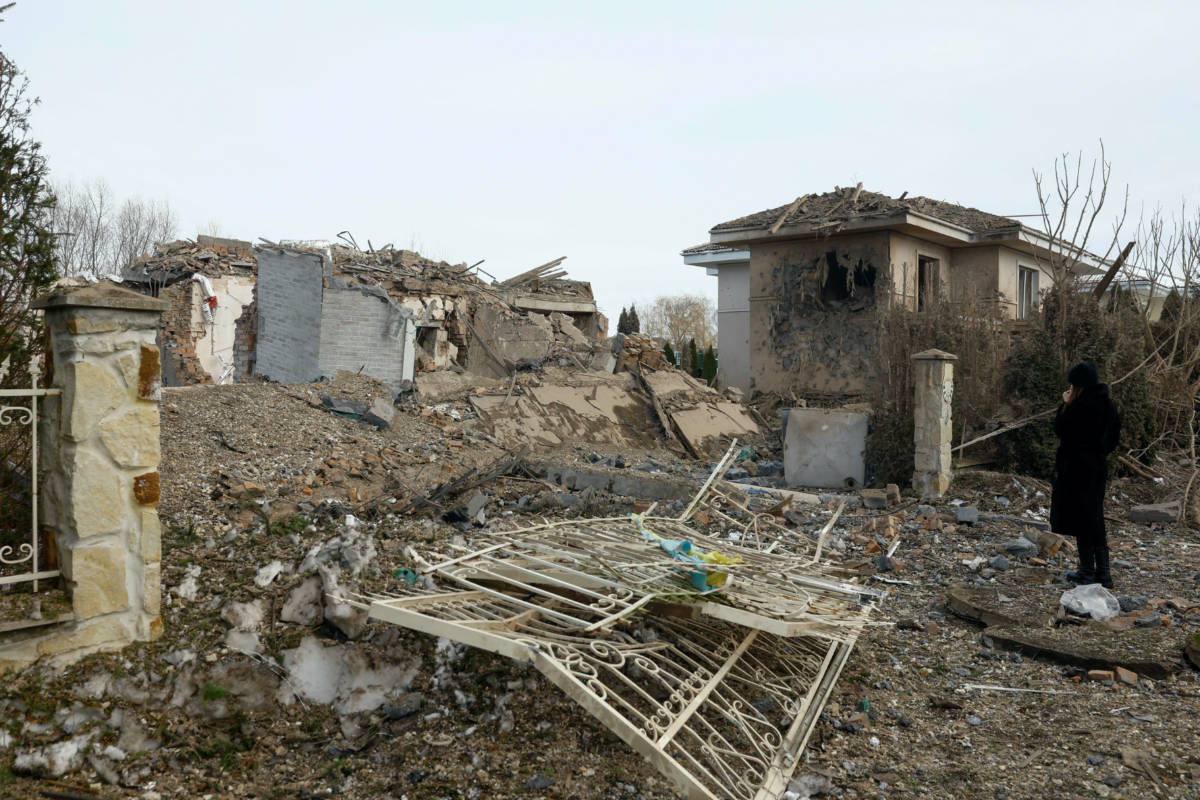
A woman looks at houses heavily damaged by a Russian missile strike, amid Russia’s attack on Ukraine, in Kyiv region, Ukraine on 22nd February, 2026. PICTURE: Reuters/Valentyn Ogirenko
In a rare announcement of a Ukrainian advance, the commander-in-chief of Ukraine’s armed forces, Oleksandr Syrskyi, said on Monday his forces had “restored control” over 400 square kilometres of territory along a stretch of the southern frontline.
Reuters was not immediately able to confirm the claim, and there was no immediate response from Moscow. If true, it would be the first big Ukrainian gain since December and one of the biggest in many months.
The US has been trying to broker a peace deal between Russia and Ukraine, but progress has proved elusive. Their most recent talks, in Geneva on 17th and 18th February, did not produce a breakthrough.
Another round of talks aimed at ending the war in Ukraine could be held at the end of this week, President Volodymyr Zelenskiy’s chief of staff told Ukrainian media on Monday.
As President Donald Trump has steered the United States away from providing military and financial support for Ukraine, European countries have increasingly stepped in. But the threats from Slovakia and Hungary put that consensus in jeopardy.
Four diplomats in Brussels told Reuters that Hungary’s Foreign Minister Peter Szijjarto drew sharp criticism from EU colleagues behind closed doors in Brussels, with some ministers accusing Orban’s government of using the issue for political gain ahead of a tough election in April.
Russia hits Odesa
Russia has been relentlessly targeting Ukraine’s power grid and energy system in nightly drone and missile attacks, arguing such infrastructure is a legitimate target because it helps the war effort. Kyiv, which has also struck Russian oil infrastructure, says Moscow’s aim is to break the national will by freezing Ukrainians in their homes.
Ukraine’s emergency services said two people were killed and three wounded overnight in the latest drone attacks that hit the southern Odesa region. Ukraine’s Infrastructure Minister Oleksiy Kuleba said Russia had attacked port infrastructure there.
Russian state news agency RIA, citing the country’s Defence Ministry, said Moscow’s forces had carried out successful strikes on Ukrainian transport, energy and fuel infrastructure.
– With reporting by KATE ABNETT and JULIA PAYNE in Brussels, Belgium; PAVEL POLITYUK AND MAX HUNDER in Kyiv, Ukraine; ANNA PRUCHNICKA in Gdansk, Poland; BART MEIJER in Amsterdam, The Netherlands; FRIEDERIKE HEINE in Berlin, Germany; JASON HOVET in Prague, Czech Republic; and PAWEL FLORKIEWICZ in Warsaw, Poland