
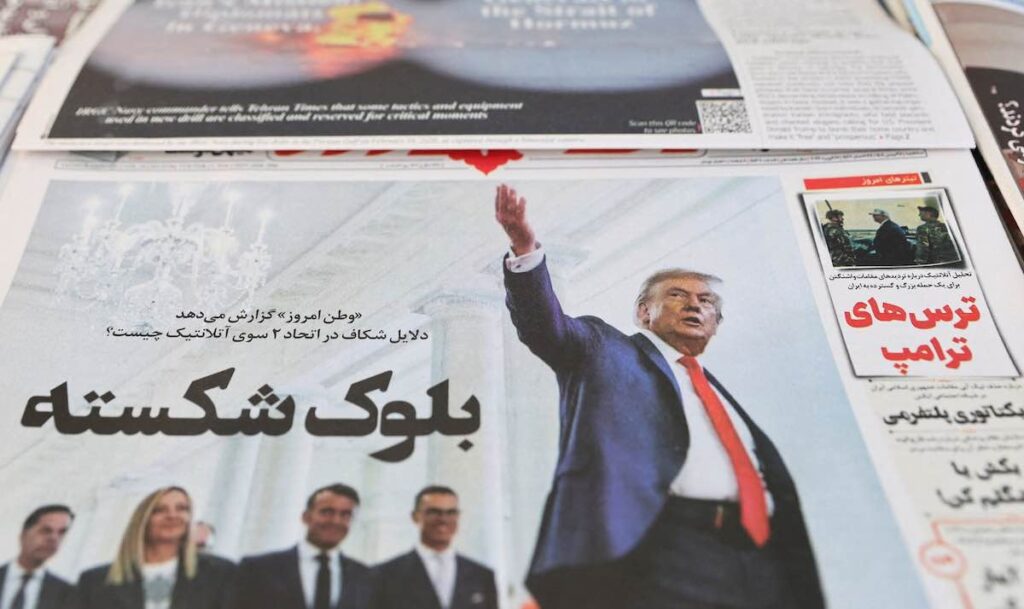
The FINANCIAL — Iran is navigating an intensifying confrontation with the United States — marked by nuclear diplomacy, military posturing, and domestic unrest — even as Tehran’s role in global conflicts such as the war in Ukraine remains a peripheral but politically sensitive issue.
Iranian state and semi-official media have echoed government messaging this week that Tehran will not bow to U.S. pressure amid stalled nuclear negotiations — a stance underlined by President Masoud Pezeshkian’s vow that Iran will remain firm in talks with Washington. Iranian outlets have carried Pezeshkian’s remarks in the context of rising U.S. military deployments in the region, portraying them as external coercion rather than productive diplomacy.
Iran argues that uranium enrichment is its sovereign right under the Nuclear Non-Proliferation Treaty (NPT), which allows non-nuclear-weapon states to develop peaceful nuclear technology under IAEA safeguards. Iranian officials and analysts frame enrichment as a matter of national dignity and technological self-determination, not a concession to external pressure. Even when offered alternatives like exporting enriched material, Tehran insists on maintaining some level of domestic enrichment capability.
Iran’s enrichment activities — and particularly enrichment to levels well above the limits of the 2015 Joint Comprehensive Plan of Action (JCPOA) — give Tehran diplomatic leverage in negotiations with the United States and European powers. Possessing advanced enrichment capacity allows Iran to bargain over sanctions relief and to argue it should not be treated as a “compliant zero enrichment” state without reciprocal concessions on sanctions and security guarantees.
While Iran denies seeking nuclear weapons, enrichment to 60 percent brings it significantly closer (technically) to weapons-grade (90 percent) material than conventional civil nuclear levels. Independent expert analysis suggests that high levels of enrichment — even if not militarized — shorten the breakout time needed to build a weapon if the political decision were made to do so. This acts as a form of strategic deterrence in a highly adversarial regional environment.
Iran and Russia share a common interest in resisting U.S.-led pressures — whether over nuclear policy, sanctions, or geopolitical influence. Both governments view Western sanctions and military pressure as existential threats to their domestic political systems and global ambitions, which creates a basis for cooperation.
Tehran and Moscow have found mutually reinforcing geopolitical interests in regional conflicts. Iran’s support for Russia’s war effort in Ukraine (through drone and missile supplies acknowledged by Western officials) and Russia’s diplomatic backing for Iran’s nuclear rights illustrate the transactional nature of the partnership. Each side trades political and military support to offset Western pressure.
Academic analyses highlight that Russia’s approach to Iran’s nuclear program is often dual-track — working with Iran on civilian nuclear cooperation (e.g., supplying fuel or building reactors) while at times signalling to Western powers that it seeks stability and restraint. Moscow’s rhetoric supports Iran’s right to enrich under the NPT, yet in private diplomatic channels it has even encouraged “zero enrichment” deals at times — underscoring that Russia’s primary objective is strategic leverage with both Tehran and the West, not unconditional support of all Iranian ambitions.
A major internal survey conducted by the Iranian Students Polling Agency (ISPA) — reportedly commissioned by a governmental office — found an exceptionally high level of public dissatisfaction with the state of the country:
The poll indicated that about 92 percent of Iranians said they were unhappy with the current conditions in Iran, including political, economic, and social issues. The figure was widely reported by Iranian and international outlets based on leaked or semi-official disclosures from the polling organization and government communications officials.
According to the survey, the government’s performance and that of local representatives were overwhelmingly seen by respondents as weak or ineffective.
The best available recent survey data suggest that a vast majority of Iranians (around 92 percent) are dissatisfied with the country’s political and economic situation. This encompasses perceptions of governance, economy, and social stability — and is one of the highest dissatisfaction figures reported in modern Iranian polling history.
Iran’s severe internet blackouts, censorship, and political repression throughout 2025–2026 have made it difficult for independent polling organizations to operate fully, meaning most public opinion insights come from either confidential internal surveys or earlier research conducted under very different conditions.
Major polls show Americans are broadly against direct U.S. participation in conflict involving Iran. In a June 2025 Economist/YouGov survey, about 60 % of Americans said the U.S. should not get militarily involved in a conflict between Israel and Iran, while only about 16 % supported military intervention and 24 % were unsure. Across political groups — Democrats, independents, and Republicans — the majority opposed intervention
Feb. 23Trump’s approval rating dropped to 36% in the latest CNN/SSRS poll, from 48% a year ago (the poll of 2,496 U.S. adults conducted Feb. 17-20 has a margin of error of 2.5), with the steepest declines among adults ages 35-49 (-19 points), Latinos (-19) and adults ages 18-34 (-16).
His approval rating is down three points from the last CNN/SSRS poll in January and his disapproval rating has increased two points.
Feb. 23Trump logged a 39% approval rating and 60% disapproval rating in a Washington Post-ABC News-Ipsos poll released Monday, compared to a 41% approval/59% disapproval rating in the groups’ last poll in October (the latest poll of 2,589 U.S. adults was conducted Feb. 12-17 and has a margin of error of 2.2).
Trump on Monday rejected the polls as “fake” and claimed, without evidence, he’s “much higher” than 40%.
A new Pew Research Center survey of 8,512 U.S. adults, conducted Jan. 20-26, also finds that – across six key qualities and abilities needed to serve as president – more Americans express little or no confidence in Trump than say they are extremely or very confident in him.
There has also been a significant decline over the last year in the share of adults who say they agree with Trump’s plans and policies.
Last year, 35% said they supported all or most of his plans, 17% supported some of them and 47% supported only a few or none.
Today, 27% say they support all or most, 20% support some and 52% support few or none.
Democrats overwhelmingly say their congressional leadership should stand up to Trump. Today, 82% (up from 70% last year) want to see their leaders pushing back against Trump, even if that makes it harder to address problems. A smaller majority of Republicans (61%) say Trump should stand up to Democratic leaders. This is similar to their views a year ago.
Nearly half of Americans (47%) now say Trump will be an unsuccessful president in the long term. This share is up 14 points since last year, with most of this change occurring among Democrats. A majority of Republicans continue to say Trump will be successful in the long run.
Trump’s approval among Republicans is now 73% – down slightly since September.