
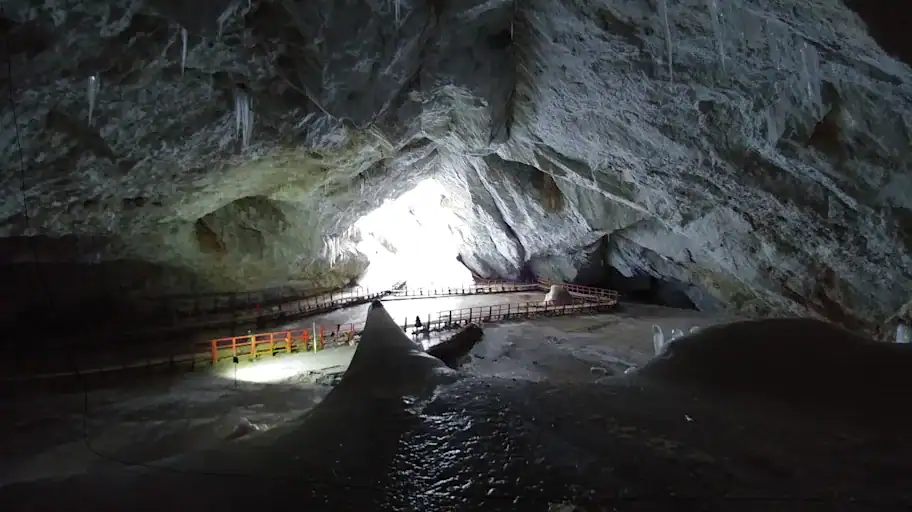
 Scărișoara Ice Cave in Romania. Credit: Păun V.I.
In Romania’s Apuseni mountain range, one cave maintains a body of perennial ice, about the size of an apartament building. Inside that frozen archive in the Scărișoara Ice Cave, researchers have now found a novel living bacterium that shows resistance to many antibiotics used in modern medicine.
The catch is that this microbe, called Psychrobacter SC65A.3, was recovered from cave ice about 5,000 years old. In tests, it resisted 10 antibiotics spanning eight drug classes, despite existing long before the discovery of penicillin or any other antibiotic.
Unknown Breaking Point
To reach the layers where SC65A.3 was entombed, the team drilled a roughly 25-meter ice core from an area of the cave known as the Great Hall. Those ice layers preserve a climate timeline reaching back about 13,000 years. The bacterium, however, came from a slice dated to about 5,335 years old.
Back in the lab, the scientists isolated bacterial strains from the core and sequenced SC65A.3’s genome. They found a compact circle of DNA about 3.05 million base pairs long, containing more than 2,500 genes, hundreds of them with unknown functions.
When they cultured and tested the bacterium against 28 antibiotics, SC65A.3 resisted 10, including drugs used for serious infections. “The 10 antibiotics we found resistance to are widely used in oral and injectable therapies used to treat a range of serious bacterial infections in clinical practice,” researcher Cristina Purcarea said in a statement.
The genome helped explain why. The researchers identified 107 genes associated with antimicrobial resistance, including well-known types involved in blocking drugs, pumping them out of the cell, or altering drug targets.
The team also urged caution in reading too much into the resistance tests. Because there are no standard medical guidelines for Psychrobacter, the researchers had to estimate how the bacterium might respond to antibiotics by comparing it with similar bacteria, an important limitation when judging real-world risk.
A Double Agent
 The team drilled a 25-meter ice core from the area of the cave known as the Great Hall. Credit: Itcus C.
Antibiotic resistance has become one of the defining public-health problems of the 21st century, driven by heavy antibiotic use in medicine and agriculture and by the rapid spread of resistant genes among bacteria.
So what should we make of a resistant bacterium locked in ice?
The authors frame it as both a warning and an opportunity. “If melting ice releases these microbes, these genes could spread to modern bacteria, adding to the global challenge of antibiotic resistance,” Purcarea said.
That’s not to say ancient “superbugs” will soon storm the world. Most microbes released into new environments fail to thrive. But researchers increasingly treat frozen environments, such as permafrost, glaciers, cave ice, as reservoirs of genetic material that could, under the right conditions, mingle with today’s microbes.
But what surprised the researchers is that SC65A.3 not only resists antibiotics but also appears to fight off dangerous bacteria.
In lab assays, extracts from SC65A.3 inhibited 14 pathogens, including members of the notorious ESKAPE group that often drive hospital-acquired infections, such as Enterococcus faecium, Pseudomonas aeruginosa, and Klebsiella pneumoniae.
The team reported 11 candidate genes linked to making antimicrobial compounds, including ones associated with glycopeptides and bacitracin-like pathways.
This dual nature—resistant to many antibiotics of last resort yet capable of suppressing other highly resistant microbes—fits what scientists have learned from soils, oceans, and other ecosystems. In nature, bacteria compete constantly, deploying chemical weapons and evolving defenses in response. Human antibiotics did not invent that arms race; they simply entered it.
“These ancient bacteria are essential for science and medicine, but careful handling and safety measures in the lab are essential to mitigate the risk of uncontrolled spread,” Purcarea concluded.