
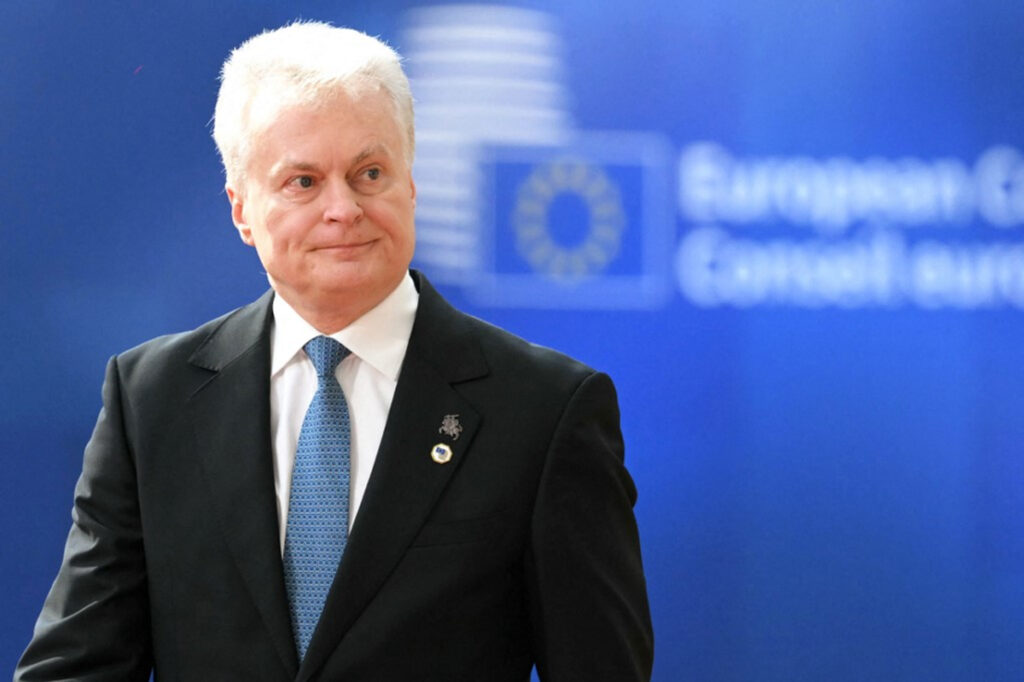
Four years after Russia launched its full-scale invasion of Ukraine, Lithuania has no illusions. In an exclusive interview with Kyiv Post’s correspondent, the country’s President, Gitanas Nausėda, speaks about the role of the US, Europe’s unity, and the need to build a “wall of deterrence.”
Michał Kujawski (MK): Mr. President, we are meeting the day after the anniversary of the adoption of the Act of Independence of Lithuania, which was signed on Feb. 16, 1918. The more than 100 years that followed have brought wars, border changes, occupations, and other political upheavals for the entire region. What situation are we in today?
Follow our coverage of the war on the @Kyivpost_official.
President Gitanas Nausėda (PGN): The situation is complex and full of challenges. However, it differs significantly from that of 100 years ago. Today, we are part of collective organizations and benefit from collective defense structures such as NATO and the European Union. This is a fundamental difference compared to the time when every country acted alone.
For Lithuania, this means a great deal. I often summarize it in a phrase I like very much: membership in the European Union is “for a better life,” and membership in NATO is “for a life.” NATO is particularly important as an umbrella of collective defense. Of course, this does not mean that we should not make additional efforts to strengthen our defense and our armed forces. Lithuania is committed to doing so not only for the next two or three years, but for the long term.
Other Topics of Interest
‘Truth of War Is Adapt or Die’: Veterans Return to the Firing Line
Two Ukrainian veterans who had stepped away from war chose to return. On the fourth anniversary of Russia’s full-scale invasion, they explain why – and what their service looks like now.
You understand very well that Russian imperial ambitions will not disappear once the war in Ukraine ends. The threat will remain. It may not target Ukraine next time, but rather the EU’s eastern flank or the EU as a whole. We must be prepared and take all the necessary measures at both the European and national levels. We must build a wall of deterrence.
MK: Mr. President, are you concerned that the American presence in Europe, and particularly in this region, may decrease? Does Lithuania and the region need a “Plan B”?
PGN: We must speak about reality, not hypothetical scenarios. The reality is very clear. Yesterday, I received a letter of congratulations on Lithuania’s Independence Day from [US] President Donald Trump. It emphasized that the US appreciates Lithuania’s support for American soldiers stationed here. This leads us to the conclusion that the US military presence will remain and continue to be a crucial element of our security architecture.
Lithuania is doing everything to ensure that their stay here is successful – not only in terms of quality of life, but also training conditions, infrastructure, and overall readiness. We take our obligations seriously. I see no reason to suggest that NATO may face problems in the near future. The Munich Security Conference, which I attended, was a clear manifestation that the US needs Europe and Europe needs the US. NATO is our Plan A, B, and C.
MK: In a few days, it will be four years since the start of Russia’s full-scale aggression against Ukraine. You were already President of Lithuania at that time. You were in Kyiv on the eve of the Russian attack. How do you remember those days?
PGN: I was in Kyiv together with the then-President of Poland, Andrzej Duda. It was an unforgettable visit. You could feel the approaching war in the air. Yet President [Volodymyr] Zelensky was calm and focused. He looked to the future with enormous courage. The following weeks and months showed that President Zelensky’s commitment to mobilizing the country and surviving the Russian attack was extremely firm. He endured the pressure very successfully.
Four years have passed, and this brutal war continues. I am not optimistic about a positive resolution in the near future. The US is the key player here, and only it can push Russia into a corner and to the negotiating table. At the same time, I see that Russia has absolutely no intention of ending this war. They are playing for time to seize more Ukrainian territory. What is the worst? Russia targets innocent people, attacks civilians and infrastructure, and weaponizes the freezing winter. Russia’s approach is deeply cynical.
MK: What are your expectations regarding the ongoing trilateral talks?
PGN: I do not have high expectations. Ukraine clearly signals its willingness to engage in constructive talks and negotiations. On the Russian side, I see only imitation negotiations and attempts to buy time in order to achieve more military goals and negotiate from a position of strength. That is the current objective of the Russian Federation.
Europe must also play its role by strengthening relations with the US and reinforcing Ukraine’s negotiating position. For Russia, the US is the real negotiating partner. Europe has already signaled to Washington that the first draft of the peace plan was extremely unfavorable to Ukraine. Europe managed to improve this draft to Ukraine’s benefit.
MK: Is Europe doing enough?
PGN: Europe is trying to do what it can. However, our diversity, the large number of member states, and differing perceptions sometimes make it difficult to make decisions smoothly, especially when consensus is required. We are doing what we can, and no one would have imagined in February 2022 that the EU would be as decisive as it has become. We are already discussing the 20th package of sanctions against Russia, not to mention the financial and military support provided to Ukraine.
MK: After four years, we still hear voices saying, “this is not our war,” and political parties proposing a reset of relations with Russia are gaining popularity in Europe. Will Europe remain united?
PGN: I observe such voices, and it is a pity to say that these people have learned nothing over the past four years. They behave like children and never grow up. They do not understand that this war directly concerns us; it is not only about Ukraine. It is a challenge thrown by the Russian Federation, which dislikes our model of governance, rule of law, democracy, and electoral rights.
Russia is an autocratic system. What they hate most is that our economies perform better, that we simply live better, and have achieved a certain level of prosperity. If Russians begin comparing their standard of living not with Germany or France, but with Lithuania or other former Eastern Bloc countries – the Baltic states or Poland – that would be dangerous from the Kremlin’s perspective. It would raise the question: what have you done for us, beyond pursuing aggressive policies toward your neighbors?
MK: From the very beginning, Lithuania was among the countries warning about Russia. However, many held a different view, did business with Russia, and did not believe it would attack Ukraine. It turned out that countries such as Lithuania were right. Has anything changed over these four years in the perception of Russia? Does the West understand Russia?
PGN: I would have preferred that we did not have to be right. Lithuania spoke about this, as did our colleagues from the other Baltic states and Poland. We warned many times that doing business with Russia would not end well. Dealing with a state that has fundamentally different goals and expectations is dangerous. Russia did not cooperate with Europe to strengthen Europe, but to strengthen itself and weaken Europe. Some failed to understand this and treated Russia as a normal business partner. They listened to us, but they did not draw conclusions.
Today they see that we were right. We simply had no illusions. For us, it was clear from the beginning that Russia wanted to attack Ukraine. It was not ready in 2021, although it initially considered doing so then. It attacked in 2022. We should increase pressure on Russia and force it into genuine negotiations – not fake ones, as we see now.
MK: Recently, French President Emmanuel Macron has said he wants to include European partners in a resumption of dialogue with Russia. Are you concerned that some European politicians, even with good intentions, may repeat the same mistake?
PGN: Some people do not learn from past mistakes. We remember the many meetings and phone calls with Putin, and their results were zero. Yet some still believe that perhaps this time the outcome will be different. It is a pity to say, but Putin does not fear Europe. He does not treat Europe as a partner he must seriously consider. He fears only the US – and that is significant leverage.
Europe can contribute, but not necessarily through direct negotiations with Russia. Moscow would simply reject such talks. A better approach is to coordinate with the US and strengthen Ukraine’s negotiating position. Of course, after the war, there will be a need for certain relations with Russia, but this will not be a return to business as usual. That can only happen after the war.
MK: Why does Putin not fear Europe?
PGN: He does not perceive Europe as a military power. Economically, yes – he would certainly like sanctions lifted – but even that is not decisive for him at this stage. He ignores economic reality, just as he ignores the needs of his own society. He is willing to absorb economic losses caused by the war. For him, the war is more important than economic costs. He will stop only if confronted with a severe economic crisis. We see that the Russian economy is weakening, but at this stage Putin can still ignore it.
MK: Ukraine is seeking membership of the EU, and this topic is appearing more and more frequently in the media. Some countries, for example Hungary, are opposed. As President of Lithuania, do you support this idea? If so, will Lithuania set conditions for Ukraine?
PGN: Lithuania is a strong supporter of EU enlargement. If countries deserve membership by implementing reforms, meeting economic and legal standards, and respecting the rule of law, they should become EU members. In Ukraine’s case, there is one additional element: Ukraine needs EU membership as motivation. It would be very positive news for Ukrainian society, which continues to suffer from the war.
Despite the ongoing conflict, Ukraine is implementing reforms and deserves serious treatment from the EU and the European Commission. Lithuania is among the strongest advocates for Ukraine’s accession as soon as possible. We propose a membership perspective for Ukraine, Moldova, Montenegro, and Albania by 2030. This does not mean the date is binding, but it can be considered a political objective. We will continue to support this idea.
MK: There are also closer dates being mentioned – 2027.
PGN: That date appeared in connection with the peace plan proposed by the US. However, even theoretically, it cannot be treated as a realistic perspective for full EU membership. In that timeframe, we may speak about Ukraine’s participation in certain EU processes, including security, defense, and elements of the single market. Technically, full membership within such a short period is impossible, not least because of the negotiation process itself. Completing it within a year is simply unrealistic.