
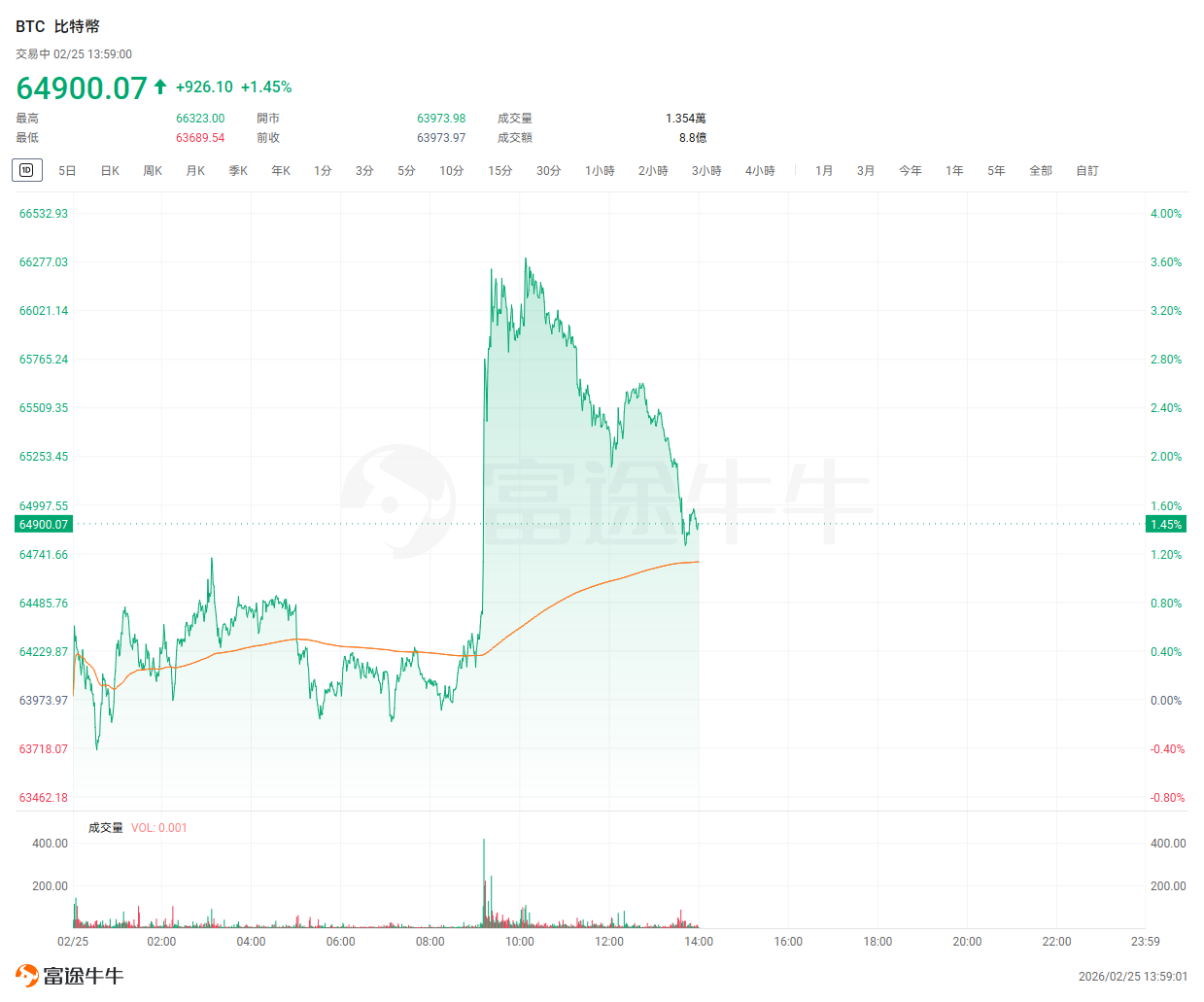
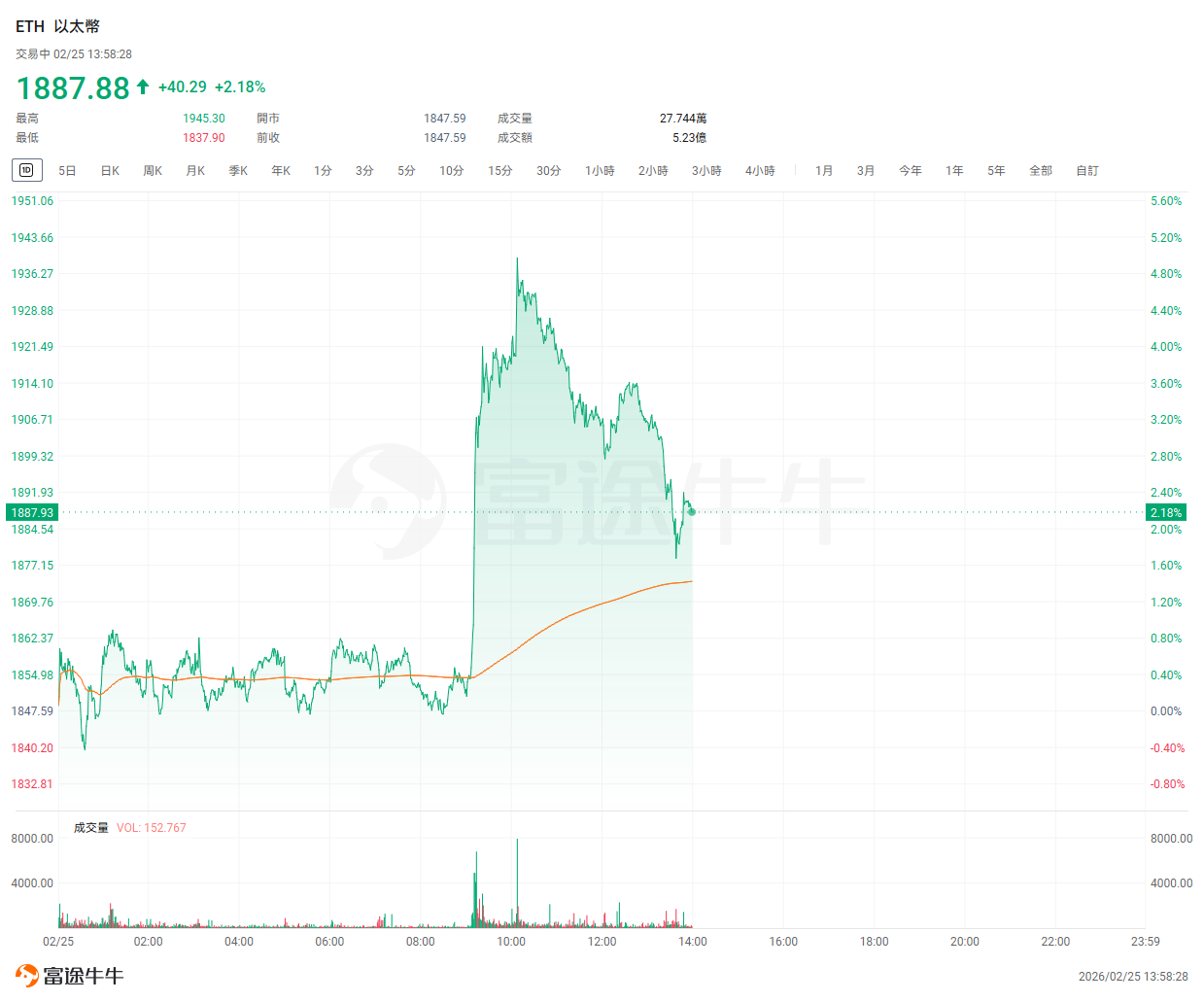
On February 25, reports indicated that the cryptocurrency market has rebounded. As of press time, $Bitcoin (BTC.CC)$ Bitcoin rose by 1.45%, reaching $64,900.07; $Ethereum (ETH.CC)$ Ethereum increased by 2.18%, trading at $1,887.88, with a gain exceeding 3% in the past 24 hours.
According to the Hong Kong Economic Times, Financial Secretary Paul Chan stated in the 2026 Budget that the government plans to submit a draft ordinance on digital asset policies within the year, establishing a licensing system for service providers engaged in digital asset trading and custody. Currently, Hong Kong has already implemented a licensing framework for fiat-backed stablecoin issuers and will issue the first batch of licenses in March. The government and financial regulatory authorities will continue to facilitate licensed issuers in exploring more use cases under compliant and risk-controlled conditions.
 Paul Chan noted that the Securities and Futures Commission (SFC) of Hong Kong will further enhance liquidity in Hong Kong’s digital asset market while fully safeguarding investors. It aims to provide professional investors with a broader range of products and services and will establish an accelerator to expedite market innovation.
$Coinbase (COIN.US)$ Coinbase has opened its stock trading feature to all U.S. users, marking a full-scale rollout following a limited pilot program launched in December last year. The exchange has also partnered with Yahoo Finance, adding a ‘Trade [Asset] on Coinbase’ button on the latter’s stock and crypto pages. Neither party disclosed the financial terms of the deal. This collaboration will offer Yahoo Finance users a one-month free trial of Coinbase One Basic membership, which includes zero trading fees and $USDCoin (USDC.CC)$ additional rewards.
Coinbase plans to share more details about tokenized stocks in the coming months and intends to launch perpetual products for U.S. equities to traders outside the U.S. via its Bermuda subsidiary after obtaining regulatory approval this spring.
According to a report by CoinDesk citing three informed sources, $Meta Platforms (META.US)$ the company intends to enter the stablecoin sector later this year, contingent upon successful integration with third-party firms to enable payments using tokens pegged to the US dollar. This tech giant owns Facebook, WhatsApp, and Instagram, boasting over 3 billion users.
One of the sources stated that Meta Platforms hopes to begin its stablecoin integration efforts in the early part of the second half of this year. The source requested anonymity as the plans have not yet been made public. He also noted that Meta Platforms plans to integrate with a firm to assist in managing stablecoin-backed payments and launching a new digital wallet.
Another source indicated that Meta Platforms has issued a Request for Proposal (RFP) to third-party companies, mentioning that Stripe could become a partner for Meta Platforms’ stablecoin pilot program. Stripe, which acquired the stablecoin company Bridge last year, has been a long-term collaborator of Meta Platforms. Furthermore, Stripe CEO Patrick Collison joined Meta Platforms’ board of directors in April 2025.
Meta Platforms, Stripe, and Bridge were all contacted for comment but had not responded as of press time.
According to CoinDesk, $Strategy (MSTR.US)$ Michael Saylor, founder of Strategy, compared Bitcoin’s current 45% retracement during a podcast interview to $Apple (AAPL.US)$ Apple’s decline in 2013. At that time, Apple’s stock price fell 45% from its peak, with its price-to-earnings ratio dropping below 10x, leading to market skepticism about its future. However, it took seven years, supported by Carl Icahn and Warren Buffett, to fully recover its valuation. Saylor believes that any successful technology investment must endure a 45% retracement and a ‘valley of despair.’ Bitcoin’s retracement has lasted 137 days so far but may extend for two, three, or even seven years.
According to an announcement by Bitwise, the company has acquired Chorus One, an institutional-grade staking service provider managing over $22 billion in staked assets. Chorus One will be integrated into Bitwise Onchain Solutions (BOS) to help expand its reach to more than 30 Proof-of-Stake (PoS) networks, including $Solana (SOL.CC)$ 、 $Avalanche (AVAX.CC)$ 、 $Sui (SUI.CC)$ 、 $NEAR Protocol (NEAR.CC)$ 、 $Aptos (APT.CC)$ 、 $Toncoin (TON.CC)$ . This transaction will add 50 technical personnel and enhance protocol and governance research capabilities. After the completion of the deal, Bitwise’s total number of employees will approach 200, managing over $15 billion in client assets.
$Meta Platforms (META.US)$ Spokesperson Andy Stone stated in a post, “Business as usual—there is still no Meta stablecoin at present. The key point about Meta’s plan to resume its stablecoin business in the second half of 2026 is to enable individuals and businesses to make payments using their preferred payment methods on Meta’s platforms. It is also worth noting that Meta already supports more than 50 currencies, digital wallets, instant inter-account payments, debit and credit cards, as well as local payment methods such as PIX and UPI across more than 100 countries/regions.” According to previous reports from ChainCatcher, Meta plans to re-enter the stablecoin sector in the second half of this year.
The Central Bank of Russia (CBR) and the Ministry of Finance have drafted the Law on Digital Currencies and Digital Rights, which is set to take effect on July 1. The draft will facilitate state agencies’ access to cryptocurrency wallet and transaction data while strengthening industry supervision. According to the draft, only licensed exchanges can organize cryptocurrency trading, and currency exchangers must be registered with official authorities and meet capital requirements.
Non-qualified investors are required to pass a test, with a single investment cap potentially set at 300,000 rubles (approximately $3,300). Exchanges and currency exchangers must disclose fund flows to the central bank, Rosfinmonitoring, and other relevant authorities. Unauthorized use of offshore platforms not legalized in Russia may incur fines starting from 2027.
Digital asset management firm 21Shares has introduced $21Shares Sui ETF (TSUI.US)$ , which is now tradable on Nasdaq. This product adopts a spot structure, following the launch of the 2X SUI Leveraged ETF by 21Shares in December last year. Recently, Canary Stake SUI ETF and Grayscale Sui Staking ETF have also gone live, accelerating the rollout of spot SUI ETF products.
-
Coinbase Research Report: BTC’s decline to $60,000 may be accelerated by negative Gamma, while an upward move to $90,000 could face fluctuation resistance.
Coinbase Institutional released its latest Bitcoin market research report, introducing the ‘Gamma Exposure (GEX)’ metric from the options market to analyze liquidity and price fluctuations. The report notes that the most concentrated support level for Bitcoin currently lies around $60,000, with the first significant resistance zone near $82,000.
Based on Gamma Exposure analysis, the range between $60,000 and $70,000 exhibits pronounced negative Gamma (market makers tend to chase gains and cut losses, amplifying volatility), while the $85,000 to $90,000 range shows clear positive Gamma (tending to sell high and buy low, dampening volatility). This implies that a downward trend toward $60,000 might accelerate, whereas an upward trend toward $90,000 could progress in a slow and volatile manner.
BNP Paribas Asset Management has issued tokenized shares of a French-registered money market fund on a public blockchain. Announced on February 20, the project marks a significant advancement in the bank’s exploration of tokenization technology, transitioning from private ledgers to the Ethereum public network. The project employs a permissioned access model on Ethereum, allowing only pre-approved regulated participants to hold or transfer tokenized shares, ensuring compliance with financial regulations while leveraging the transparency and security of public blockchains.
The experiment integrated multiple business lines of BNP Paribas: the asset management company acted as the fund issuer, the securities services department served as the transfer agent and was responsible for wallet infrastructure and private key custody, while the AssetFoundry platform of the corporate and investment bank handled the tokenization process and provided connectivity to Ethereum. This pilot was based on the experience gained from issuing tokenized money market funds using a private blockchain in Luxembourg, with different models tested to evaluate the technological and operational frameworks.
According to monitoring by @EmberCN, eight hours ago, Ethereum treasury firm FG Nexus reduced its holdings by 7,550 ETH (worth $14.06 million). Analysis indicates that FG Nexus has incurred losses of $86.98 million from investing in ETH. The company purchased 50,600 ETH at an average price of approximately $3,940 during the peak period of DAT companies from August to September last year, which was valued at $200 million at the time. After the decline in ETH prices, they began reducing their ETH holdings in November, and so far, they have sold a total of 21,000 ETH (worth $55.69 million) at an average price of $2,649.
$Coinbase (COIN.US)$ CEO Brian Armstrong warned on Tuesday that the Bank of England’s proposed cap on stablecoin holdings could cost the UK its status as a global financial hub. He stated, ‘The UK’s stablecoin regulations are being finalized but may hinder the country’s global competitiveness in the digital economy.’
The current direction of the rules is counterproductive and will become an obstacle to innovation.’ Last year, the Bank of England proposed a cap of $26,350 (20,000 pounds) on individual stablecoin holdings and $12.7 million (10 million pounds) for enterprises, requiring 40% of reserves to be held in non-interest-bearing central bank accounts. UK lawmakers have also warned that this plan would ‘hinder innovation, limit adoption, and push activities overseas.’
Payment processing company Stripe is considering acquiring $PayPal (PYPL.US)$ all or part of its business. Sources familiar with the matter noted that discussions are still in the early stages, and whether a deal can ultimately be reached remains uncertain.
According to The Block, Bitcoin extended its decline on Tuesday, briefly falling below $62,900, with intraday losses of approximately 4%. Analysts warned that against the backdrop of ongoing outflows and accumulating macro risks, the market could still face a larger-scale ‘washout.’ Samer Hasn, senior market analyst at XS.com, stated that Bitcoin has exited a consolidation phase and entered a new downtrend cycle. Geopolitical tensions, tariff uncertainties, and tightening liquidity are driving an accelerated withdrawal of funds from the cryptocurrency market.
He believes that if selling pressure persists, the range between $53,000 and $55,000 represents a potential downside target. Matt Howells-Barby, Vice President of Kraken, pointed out that Bitcoin may experience its first consecutive six-week decline since May 2022. The $60,000 level is a key support; if it breaks below this, the price could fall to around $55,000.
On February 25, according to hedge fund position data from Goldman Sachs, $Strategy (MSTR.US)$ has become the most heavily shorted constituent stock in the U.S., with its short-selling ratio as a percentage of market capitalization ranking highest among large-cap stocks. Last week, Strategy purchased 592 Bitcoins for $398 million, bringing its total holdings to 717,722 Bitcoins.
With Bitcoin trading near $66,000, its average purchase price stands at $76,020, resulting in unrealized losses of approximately $7 billion currently. Among 16 brokerage firms, 14 have assigned Strategy a strong buy rating, accounting for about 94%.
According to Cointelegraph, Glassnode data shows that the realized profit-to-loss ratio for Bitcoin traders (90-day moving average) has fallen below 1, indicating investors are selling their positions at a loss—a signal not seen since 2022. Historical data reveals that when this indicator drops below 1, it is usually followed by at least six months of loss realization and foreshadows further price declines: during the 2022 bear market, Bitcoin fell 25% within six months after the indicator breached 1, while in 2018, it dropped over 50% within five months. Glassnode noted that if history repeats, Bitcoin may ‘fully transition into an excessive loss realization phase,’ with downward price trends potentially lasting over five months.
According to The Block, Binance has re-entered the tokenized stock market via a partnership with Ondo Finance. Ian De Bode, President of Ondo Finance, stated that Binance has listed 10 Ondo tokenized U.S. equities and ETFs on Binance Alpha and Binance Wallet, including AAPLon, GOOGLon, TSLAon, NVDAon, and QQQon. A Binance spokesperson said that Ondo tokens are classified as digital securities, and Binance offers these products under its regulatory license from the Abu Dhabi Financial Services Regulatory Authority. The tokenized stocks and ETFs offered by Binance and Ondo are not available to U.S. users.
-
MoonPay launches MoonPay Agents, enabling AI agents to autonomously access wallets, funds, and execute transactions
According to PRNewswire, cryptocurrency payment company MoonPay announced the launch of MoonPay Agents, a non-custodial software layer allowing AI agents to autonomously access wallets, funds, and conduct transactions via MoonPay CLI. After users verify and fund their wallets through MoonPay, AI agents can perform token trading, exchanges, and digital asset transfers on behalf of the user. MoonPay Agents is built on MoonPay CLI, a command-line interface for developers, enabling AI systems to generate and manage non-custodial wallets, recharge them through MoonPay’s global on-ramp, and execute on-chain transactions programmatically.
“1011 Insider Whale” representative Garrett Jin posted on the X platform: “This will be a long winter, not just for the crypto sector.”
According to Businesswire, WisdomTree announced that its WisdomTree Treasury Money Market Digital Fund (WTGXX) now offers round-the-clock 24-hour trading and instant settlement capabilities. This marks the first time registered tokenized mutual fund shares have been approved for 24/7 trading and instant settlement within U.S. regulatory frameworks via a dealer-principal liquidity model. The introduction of this feature required coordination of multiple regulatory approvals, with various entities under WisdomTree receiving exemptions from the U.S. Securities and Exchange Commission (SEC).
According to Cointelegraph, Bhutan has launched a Solana-backed digital nomad visa.$Solana (SOL.CC)$Investors can obtain residency for 36 months by investing $10,000 in TER tokens and paying $2,800.
-
Glassnode: Over 400,000 Bitcoin accumulated in the $60,000 to $70,000 range, forming a dense cost support zone.
According to CoinDesk, Glassnode data shows that during Bitcoin’s recent decline, more than 400,000 BTC were accumulated within the $60,000 to $70,000 price range. The supply in this price range increased from approximately 997,000 BTC on January 1 to around 1.43 million BTC currently, marking a 43% rise and accounting for over 8% of the circulating supply outside exchanges, forming a dense holding cost area.
This analysis is based on Glassnode’s UTXO Realized Price Distribution indicator, which groups the existing supply by the price at which each Bitcoin was last moved on-chain. It excludes internal transfers within the same entity and exchange balances through entity adjustments to more clearly reflect the cost basis of real investors. The range between $70,000 and $80,000 has previously been described as a ‘vacuum zone,’ where historically trading volume has been sparse.
According to *Walter Bloomberg, analysts at Saxo Bank stated that cryptocurrencies fell alongside other risk assets due to concerns over the impact of artificial intelligence and tariff uncertainties dampening investor sentiment. The US spot Bitcoin and Ethereum ETFs saw net outflows of approximately $203.8 million and $49.5 million respectively, indicating reduced risk appetite. Analysts noted that cryptocurrencies are currently trading in line with overall market sentiment rather than following their own fundamentals.
Executives of Emirates NBD (Emirates NBD) stated in an interview with CNBC that the bank has opened the possibility of allocating Bitcoin in its investment process, viewing it as a store of value and ‘digital gold,’ recognizing its proof-of-work mechanism, limited supply, and low inflation characteristics. The executive frankly stated that Bitcoin’s current valuation is more attractive compared to six months ago when its price was excessively high.
He revealed that the bank’s internal fair value model indicates that Bitcoin’s reasonable price within 12 months could approach $100,000, although the model is still being refined. He also mentioned that the bank has not yet finalized the allocation of Bitcoin, but if included in the portfolio in the future, it will adopt a limited proportion allocation. This is because Bitcoin correlates with market risk appetite and exhibits extreme volatility, while the bank aims for portfolio diversification.
According to The Crypto Basic, Cathie Wood, founder of Ark Invest, reiterated her firm confidence in Bitcoin during an interview with Bloomberg, stating that it is ‘undoubtedly’ superior to gold. She believes that Bitcoin serves as a hedge against both inflation and deflation, and its digital attributes provide a structural advantage in the modern financial system, whereas gold’s demand pattern has matured. Wood pointed out that Bitcoin is still in the early stages of institutional and retail adoption, with institutional exposure still developing and younger investors increasingly favoring digital assets over physical gold. She views Bitcoin as representing a generational shift in store-of-value investments.
Editor/Joe