
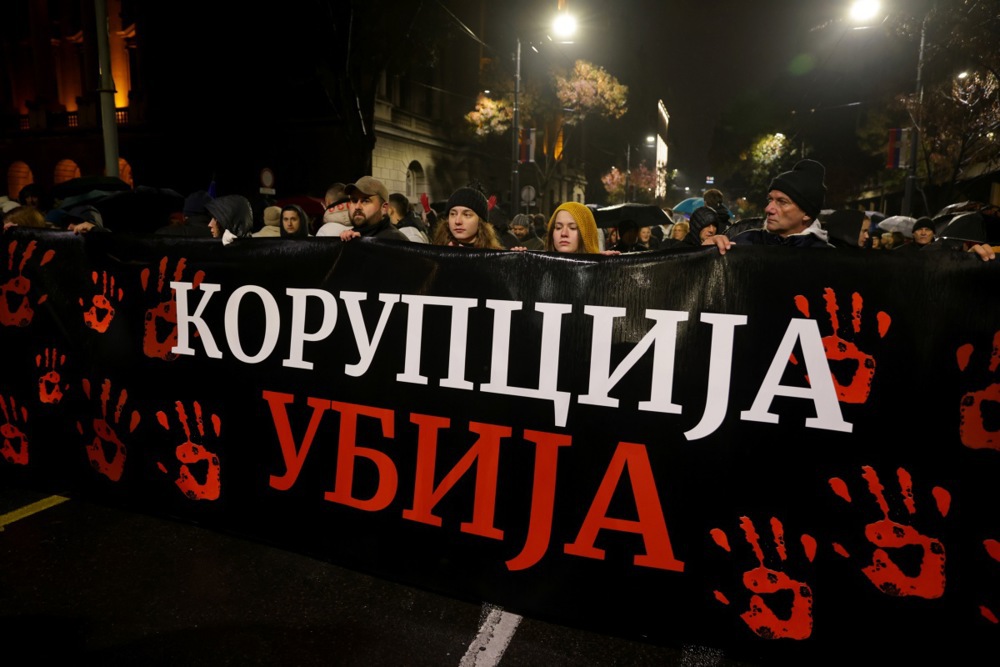
In Serbia, we have reached a point where no investigation, regardless of the evidence it contains exposing corruption or other criminal wrongdoing, can expect to shift public opinion by even the tiniest degree.
In a society still scarred by the Yugoslav wars of the 1990s and by a bruising transition to capitalism that bred resentment, the prevailing belief is that every politician is corrupt. The poorer the person, the deeper their cynicism.
The most accurate analysis of the Serbian political context I have ever heard came from a villager I interviewed while covering local elections in western Serbia in 2018.
Referring to President Aleksandar Vucic, the villager said: “We don’t have a better one, but we’re unlikely to find a worse one.”
No one can match the precision, cynicism, and hard-earned wisdom of an old man who had lived in five different states without ever leaving his backyard.
In such a context, investigative journalism often feels like ‘casting pearls before swine’ – offering something of great value to someone who cannot appreciate it.
Perhaps the only move left is undercover reporting. We have tried almost everything else, and the results have been modest at best.
Why didn’t we try it earlier? Media outlets rarely have the time or resources to plan such operations. Or they adhere too rigidly to a school of journalism that errs on the side of caution and safety.
But maybe it’s the only way to really make an impact in this viraly-spiraly attention-lacking world of numbness and relativisation.
Perhaps a shocking video that catches the powerful red-handed is so unmistakable that its meaning is clear both to an educated urban student as well as to a ruling-party supporter content to have a factory job and an evening drip feed of state propaganda.
The only credible undercover work carried out in Serbia was by CINS, which infiltrated one of its reporters into a call centre linked to the ruling Serbian Progressive Party in 2023.
The reporting pointed to vote-buying through offers of cash and incentives in exchange for votes.
CINS is a small investigative media, but, according to its own data, the story reached over 3.5 million people – more than half the population of Serbia.
‘If you can’t stand the heat…’
I have dabbled in what you might call ‘undercover’ reporting a few times during my career, mostly while working on investigations into people smuggling gangs. But most instances were ad hoc, without advance editorial approval, and the material they yielded did not appear in print.
The basic rule is – only engage in undercover reporting when you cannot get the story any other way, and only if it is of significant public interest.
In Serbia, I believe we have reached that point.
Anywhere else, any number of the investigations BIRN publishes every year would lead to the resignation or dismissal of government officials.
In Serbia, however, criminals sanctioned by other states are feted as “respectable” businessmen, handed state-funded construction projects, while alleged drug lords become television personalities, publicly embraced by the president.
Moreover, much of the most serious crime, corruption, and influence-peddling never sees the light of day. In such cases, hidden cameras or covert documentation may be the only way to obtain proof.
But before engaging in anything, there must be clear rules, ethical guidelines and safety measures.
No story is worth risking a life. But as Anas says, from behind his veil: “Journalism is like a hot kitchen: if you don’t have the ability to stand the heat, you get out. It’s difficult, but who said we thought journalism was going to be a tea party?”