
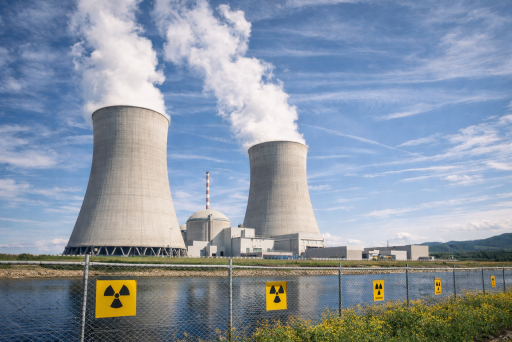
The government has positioned nuclear power plants (PLTN) as a last-resort energy source to ensure the reliability of Indonesia’s electricity system. However, the plan continues to draw debate, not only over safety concerns but also over whether nuclear energy can truly be considered sustainable.
The Indonesia Environmental Forum (WALHI) argues that nuclear energy still depends on extractive mining practices because its fuel, uranium and thorium are classified as critical and rare minerals.
“If we talk about nuclear, its fuel comes from critical and rare minerals. It comes from mining,” Wahyu Eka Styawan, Urban Justice Campaigner at WALHI’s national executive board, said during a discussion held by the Clean Indonesia Coalition in Jakarta as quoted by Katadata.co.id on Monday, February 23, 2026.
Limited domestic reserves
According to Indonesia’s National Electricity General Plan (RUKN), the country’s nuclear energy potential includes:
- 5,234 tons of uranium (U3O8);
- 4,729 tons of torium.
Thorium deposits are found only in Bangka Belitung Islands, while uranium reserves are located in Bangka Belitung and West Kalimantan. Unlike other primary energy sources that are more geographically dispersed, nuclear fuel resources are relatively concentrated in limited areas.
For WALHI, this means nuclear power would perpetuate extractive mining practices.
“In other words, nuclear power continues extraction,” Wahyu said.
Thorium reactor technology
Wahyu also highlighted Indonesia’s development of thorium-based reactor technology. PT Thorcon Power Indonesia has obtained a Site Evaluation Approval from the Nuclear Energy Regulatory Agency for its planned 500 MWe Thorium Molten-Salt Reactor (TMSR) project in Bangka Belitung.
“He wants to look for thorium there, whose effectiveness has never been tested. There are easier and less risky alternatives, yet suddenly we choose the risky one,” Wahyu said.
He argued that Indonesia has more accessible renewable options, such as solar energy, which is abundant across the country.
Beyond technical risks, WALHI also raised governance concerns, pointing to ongoing corruption issues among stakeholders in Indonesia.
“Who can trust a project as large as nuclear power if the country is still corrupt?” Wahyu questioned.
Proven reactor technology
Meanwhile, Syaiful Bakhri, Head of the Nuclear Energy Research Organization at the National Reearch and Innovation Agency (BRIN), said that as a newcomer to nuclear power, Indonesia would likely choose reactor technologies that are already widely tested.
Referring to data from the International Atomic Energy Agency’s Power Reactor Information System (PRIS), the Pressurized Water Reactor (PWR) is currently the most widely adopted nuclear reactor technology globally.
“If you’re offered two motorcycles, one that is the first ever produced in the world, and another that already has a long track record and widespread use, you’d naturally choose the proven one,” Syaiful said on Monday.
He added that various reactor types could technically be built in Indonesia, including Molten Salt Reactors (MSR), Pressurized Water Reactors (PWR), and Pressurized Heavy Water Reactors (PHWR), as long as they meet safety and environmental criteria such as:
- Volcanology;
- Seismic conditions;
- Geological stability;
- Demographic factors;
- Environmental impact.
Fuel supply and import options
Regarding fuel, Syaiful cited that in the early years of PLTN operations, Indonesia would likely rely on fuel supplies from vendor or partner countries.
“The fuel is specific, depending on the type of reactor,” he said.
Uranium imports would therefore be an option at the initial stage. However, technology transfer partnerships could eventually enable Indonesia to produce its own nuclear fuel domestically.
“If by the third or fourth year our nuclear plants are operating profitably and in sufficient numbers, why not produce our own fuel?” he said.
Nuclear emissions compared to other energy sources
Data compiled by Our World in Data, based on scientific journals and international institutions, shows that nuclear energy produces among the lowest lifecycle carbon emissions:
- Nuclear: ~6 tons CO₂ equivalent per gigawatt-hour;
- Coal: ~970 tons CO₂ equivalent (around 160 times higher than nuclear);
- Solar: ~53 tons CO₂ Equivalent.
While nuclear energy offers low-carbon advantages, the debate in Indonesia continues to revolve around resource extraction, governance, technological readiness, and long-term risk management.