
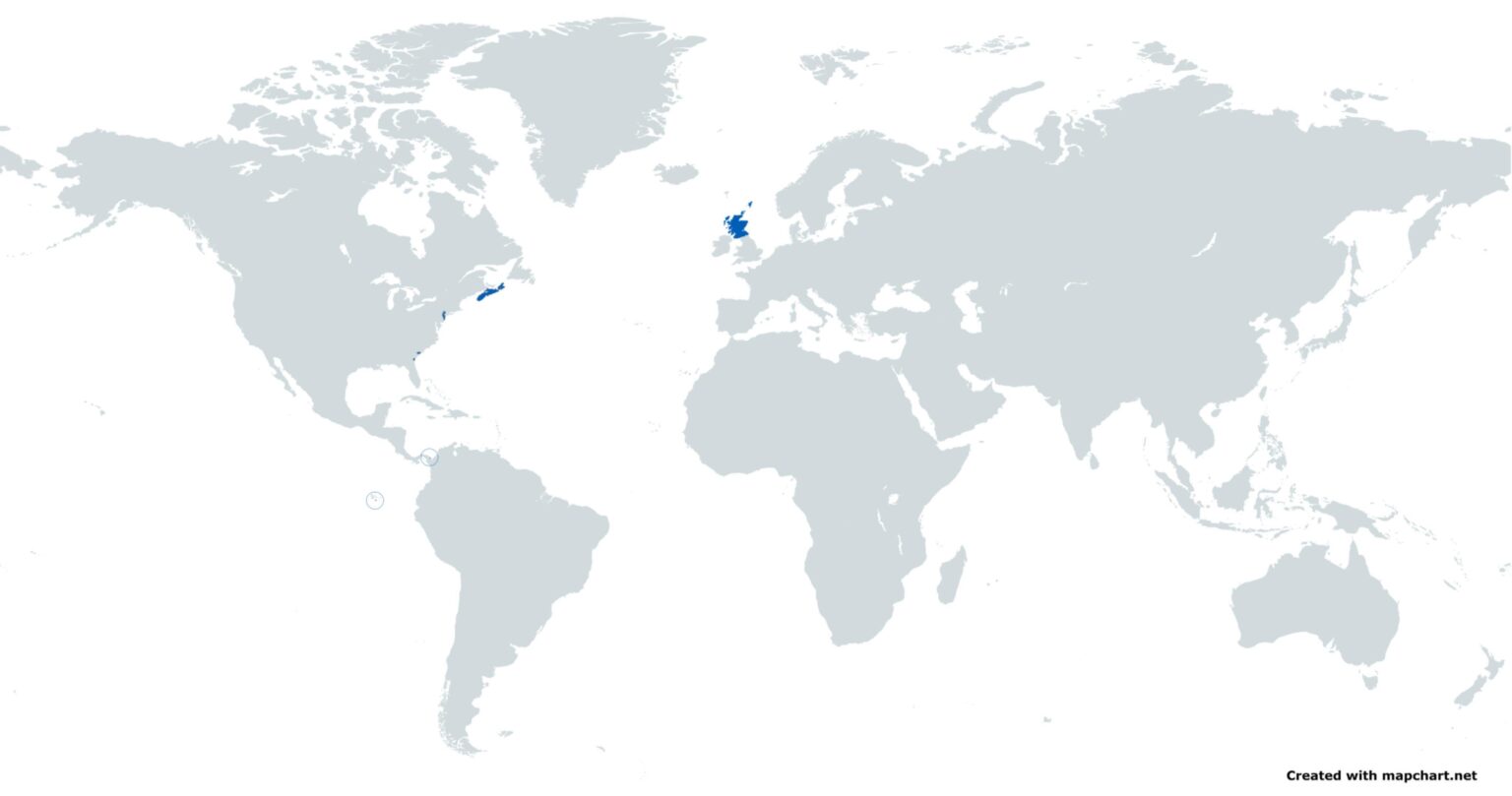
Scottish colonization in the Americas was a series of small and often short-lived attempts by Scotland to establish overseas settlements during the 1600s and early 1700s. These efforts happened before and shortly after the 1707 union with England. The most notable projects included colonies or settlements in Nova Scotia, East New Jersey, Stuarts Town, and the ambitious but disastrous Darien scheme colony.
The first major effort was Nova Scotia. In 1621 King James VI of Scotland granted a charter to Sir William Alexander to establish a colony in the region. After several failed attempts, settlers finally arrived in 1629 and briefly created a Scottish foothold in what is now Atlantic Canada. The colony did not last long. Political negotiations between England and France led to the territory being returned to France in the early 1630s, forcing the Scottish settlers to leave.
Later efforts shifted farther south. In the 1680s Scots helped develop East New Jersey, where many immigrants arrived and the provincial capital was established at Perth Amboy. Scottish influence was strong in the colony’s government and society for several years. Around the same time, a separate group founded Stuarts Town in Carolina as a refuge for persecuted Covenanters and a semi-autonomous Scottish community. However, tensions with Spain and regional conflicts led to the settlement being destroyed only a couple of years later.
The most famous attempt was the Darien scheme in the 1690s. Scotland invested a huge portion of its national wealth into creating a trading colony on the Isthmus of Panama. Thousands of settlers sailed there hoping to build a commercial hub linking the Atlantic and Pacific. Poor planning, disease, lack of supplies, and Spanish hostility quickly devastated the colony, and it collapsed within a few years. The financial losses were enormous and contributed to the political pressures that eventually pushed Scotland toward union with England.
Posted by Beenet_
19 Comments
Perth Amboy mentioned!
*cries in Nova Scotian*
Hell ya I am a citizen
The Panama thing is too funny (or would be, if it hadn’t ruined so many lives). The Scots bet the house on colonizing one of the most inhospitable places in the entire world and the financial fallout arguably drove Scotland to merge with England.
[Here’s an excellent podcast episode about it, from Anita Anand and William Dalrymple](https://open.spotify.com/episode/6GBuKBmSeVoHdUNrjm24G8?si=KhcV8rVKQmmL4GTcEy9s0Q)
My understanding is that the English basically used the Scots-Irish* to do the heavy lifting for the colonization of North America. There’s a large concentration of people that trace to the Scots-Irish in the US mid-Atlantic and inwards towards Kansas/Nebraska. As well, basically all of Canada (not just Nova Scotia).
*Calvinists originally from Scotland and Northern England that emigrated to North America by way of Northern Ireland. Aka Orangemen.
That part of Nova Scotia is still populated by people with Scottish Ancestry. There’s also a sign on the way to Cape Breton indicating that it was a Scottish colony.
Why is the Darien scheme not pictured here?
Is that the Galapagos circled as well?
The Kingdom of Scotland’s colonization attempts gets over-looked because the personal union between Scotland and England.
the darien scheme has always felt like one of those wild what if moments in history. my old history teacher used to say it wasn’t just a failed colony, it basically changed scotland’s future overnight. it’s kind of crazy how a single overambitious project can reshape an entire nation
We couldn’t do any colonising because we were being stripped of our resources and identity and our people were being killed by the English. Scotland was the first victim of the empire and we’re still being fucked by Westminster to this day. If we had independence I’m sure we’d be more than happy to try our hand at the colonising again
And it’s gone, got proves that you need more than reach a place to colonize it.
What about the Red River Colony?
https://en.wikipedia.org/wiki/Red_River_Colony
Idi Amin was the last king of Scotland so Uganda should be included here.
Ah yes, the great Scottish diaspora of New Jersey.
Little of Ireland too
Since Scotland is half of Great Britain, shouldn’t it therefore be responsible for half of the British Empire?
But seriously, despite the Braveheart view of history that some romanticise, in actuality Scots were willing collaborators with the English in subjugating a huge chunk of the globe. Scots were disproportionately represented in the British army, colonial administration and settler colonies.
What are the spots in Georgia or South Carolina?
You forgot northern Ireland…