
The Hamas movement denied an Israeli media report alleging it had taken steps to reactivate its rocket system, calling the claims a “pretext” Israel was promoting to justify a return to war and the occupation of the Gaza Strip.
The Israeli Public Broadcasting Corporation said on Monday that vital materials had been smuggled into Gaza to operate Hamas’s rocket system, including hydroxyl-terminated polybutadiene (HTPB), a key component of solid rocket fuel that significantly boosts missile range and stability.
Hamas sources told Asharq Al-Awsat the allegations were “completely untrue,” noting that Israeli naval forces control all access points along Gaza’s coastline. They dismissed the report as “media fabrications.”
The sources said Palestinian armed wings have the right to possess weapons for self-defense, but described Israeli claims of smuggling explosive materials for solid rocket fuel as “baseless accusations” aimed at securing a green light for new strikes in the enclave.
They warned that Israeli security bodies were circulating such claims to the media as a “pretext for launching severe attacks inside the Strip.”
Asked whether the armed wing had resumed rocket production or rebuilt its military infrastructure, the sources declined to confirm or deny, saying only that “the resistance has the right to retain all its weapons to confront any new aggression.”
‘State of defense’
Days earlier, Israel’s Channel 14 cited an Israeli security source as saying Hamas could rebuild tunnels faster than the Israeli military could detect and destroy them, and that it retained vast financial resources and an advanced logistical network to safeguard key strategic assets.
The source said significant infrastructure in northern Gaza had not been reached by Israeli forces, despite the destruction of more than 40 tunnels over the past two months.
Last week, Israeli Prime Minister Benjamin Netanyahu said around 350 km of tunnels in Gaza remained intact — a figure Channel 14 described as “astronomical,” saying achieving that objective would take considerable time, particularly without fully occupying the Strip.
Hamas sources said most tunnels were destroyed during the war, though some were damaged and partially intact. They said the bodies of Israeli hostages were recovered from some tunnels after the war ended, but declined to say whether any had since been rehabilitated.
On the ground, Hamas is reinforcing its civilian control and retains authority over government operations in Gaza, including the security apparatus. Militarily, it has not publicly signaled any renewed activity by its armed wing.
Movement sources said the leadership is focused on administrative and organizational restructuring, while preparing contingency plans to confront any renewed Israeli assault amid repeated threats to resume fighting. They said the armed wing would remain in a defensive posture alongside other Palestinian factions if Israel returns to war, a scenario they said the various brigades do not seek.
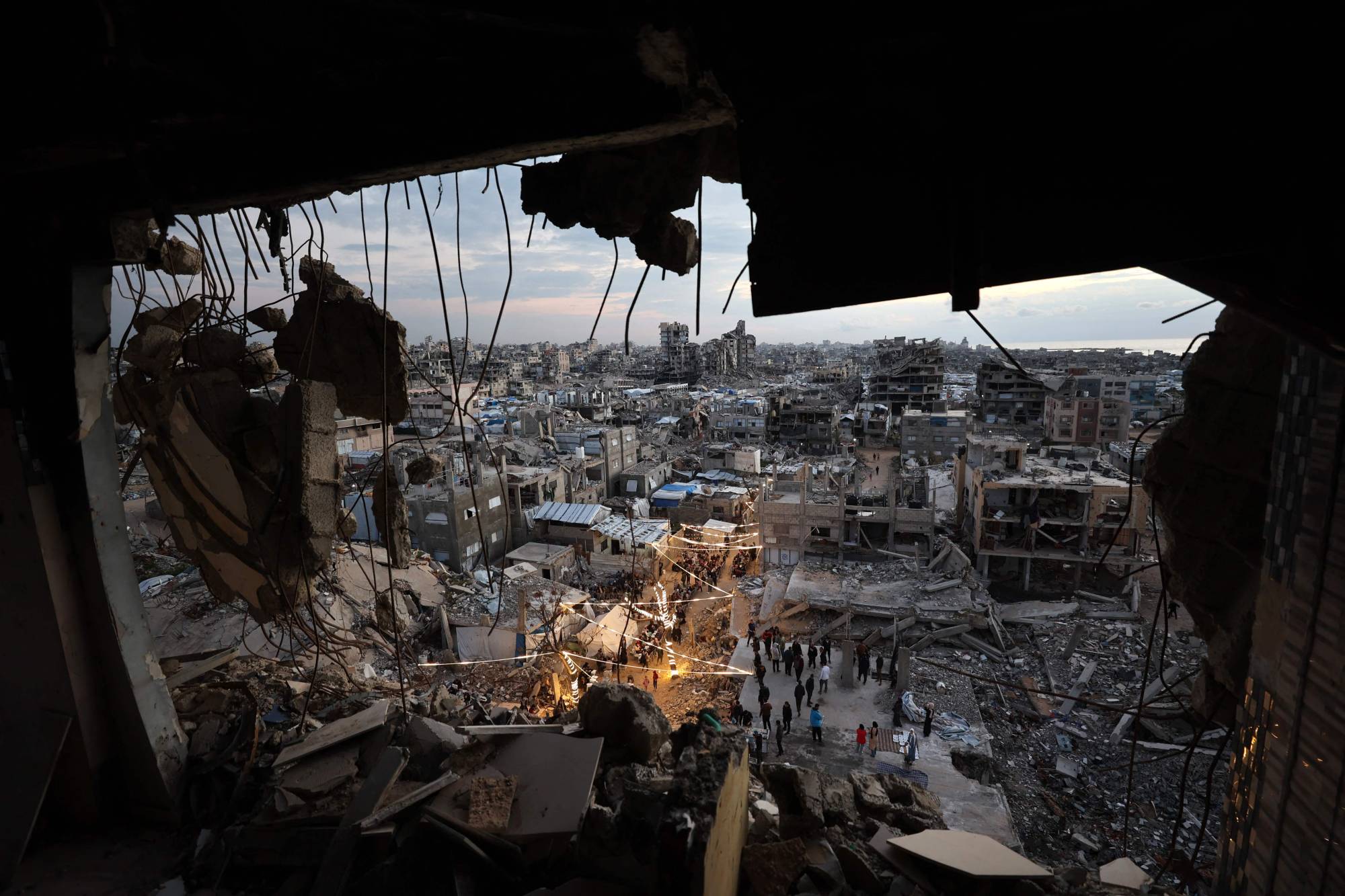 Displaced Palestinians gather for an Iftar meal amid the rubble of destroyed buildings at the Jabalia refugee camp in the northern Gaza Strip, during the Muslim holy fasting month of Ramadan, on February 23, 2026. (Photo by Omar AL-QATTAA / AFP)
Occupation threat raised
Israel insists Hamas must surrender all its weapons, light and heavy, even in stages, according to leaks about a related US document.
Israeli Finance Minister Bezalel Smotrich, a member of the security cabinet, said the next phase would include “an official ultimatum” demanding Hamas hand over its weapons, headquarters and tunnels.
Failure to comply would grant Israel the right to take direct military action to achieve its objectives, he said, signaling the possibility of occupying parts of Gaza.
In remarks to the Israeli Public Broadcasting Corporation on Monday, Smotrich reaffirmed that Israel has not abandoned its goal of eliminating Hamas, but is giving US President Donald Trump the opportunity to implement this in his own way.
Hazem Qassem, a Hamas spokesperson, said Smotrich’s threat to resume fighting showed “disregard” for arrangements to end the war, accusing Israel of failing to meet its commitments in the first and second phases of the ceasefire agreement since it took effect in October last year.