
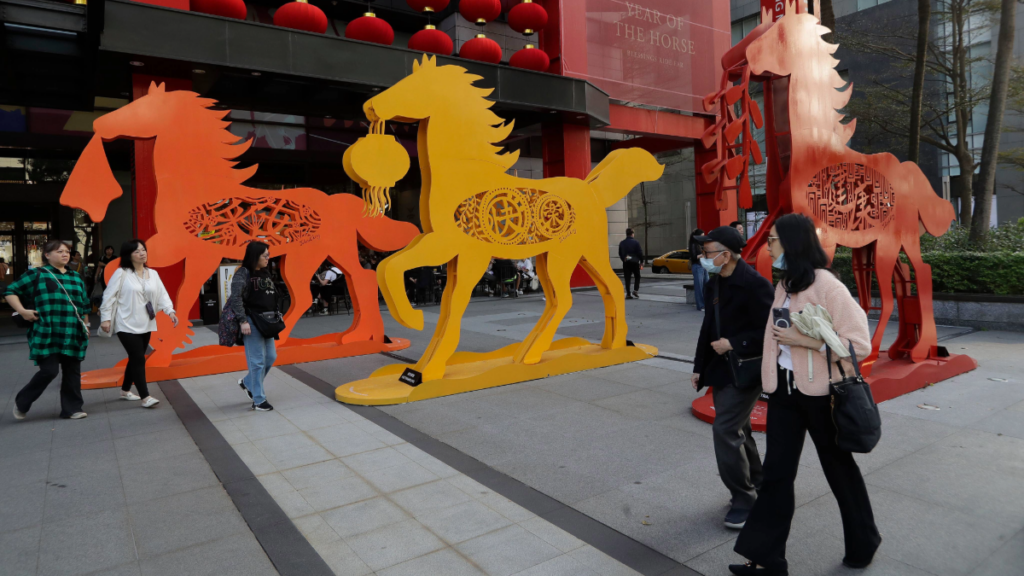
People walk past horse decorations displayed for the Lunar New Year celebrations in Taipei, Taiwan, Saturday, Feb. 14, 2026. (AP Photo/Chiang Ying-ying)
On December 23, 2025, Taiwan’s Legislative Yuan passed the AI Basic Act, and on January 14, the Act was officially promulgated and entered into force by President William Lai Ching-te. The law, consisting of only 20 clauses, is intended to lay the groundwork for building a ‘smart nation’ by fostering human-centric artificial intelligence research and industry development with an emphasis on constituting a safe application environment with fundamental rights protection, in order to balance the needs of the citizens’ quality of life and the nation’s sustainable development while safeguarding national cultural values and social ethics and promoting international competitiveness.
Like many other countries, Taiwan seeks to establish its own framework to balance the need to innovate and compete with risk-based governance. However, it is taking a “principle-based” approach to its legislation, more closely aligned with the US and Japan, compared to the stricter regimes undertaken by the European Union and South Korea.
First, the law defines AI as “a system with autonomous operational capability that, through input or sensing, and via machine learning and algorithms, can achieve predictions, content, recommendations, or decisions for explicit or implicit objectives, producing outputs that affect physical or virtual environments.” Then, it establishes the governance authority and designates the responsibilities of agencies, with certain timelines for the implementation of further regulations.
Here, we summarize the strategic importance of this legislation into five main areas:
1. Establishing trust in the global AI supply chain
Taiwan undoubtedly occupies a critical role in the global semi-conductor and AI supply chain. As a result, it is important for it to demonstrate its resolve to set up a governance system that other countries and global enterprises can find confidence in complying with, and trust. This is consistent with President Lai’s declaration for the development of “Five Trusted Industry Sectors,” namely semiconductors, AI, military, security and surveillance, and next-generation communications, in his inaugural address.
2. A clear message of innovation first
In the inevitable choice to make in balancing invitation and regulations, Taiwan sends a clear message to global developers and enterprises that it favors innovation first. Clause 11 of the law clearly laid down the principle that, as the government continues to refine laws affecting AI development and applications, in cases where the AI regulatory regimes contradicts existing laws, fostering new technologies and applications will take priority. In Clause 17, the law also absolves developers of the duty to provide relief or compensation for high-risk applications during its research and development phase.
3. Soft-law approach to lower compliance costs
Taiwan’s “soft law” approach, unlike the direction undertaken by the EU and South Korea, has refrained from legislating specific penalties over violations by domestic or global firms. Nonetheless, the law attempts to align Taiwan with the governance regimes in the rest of the world through its definition for AI as well as the emphasis on international cooperation, as stated in Clause 12. The Ministry of Digital Affairs (MODA) is also tasked with the responsibilities to establish an AI risk classification framework consistent with global standards. This approach emphasizes flexibility in this early phase of global AI governance development, leaving more room for innovation and competitiveness as more nuanced regulatory action may take place in time.
4. Layered umbrella governance headed by a competent central authority
The AI Basic Law establishes a three-tiered authority and executive structure in the Taiwan government for AI governance, led by the AI Strategy Special Committee under the Executive Yuan, Taiwan’s cabinet, under Clause 6, and with the National Science and Technology Council (NSTC) as the central competent authority of execution, under Clause 2. The Ministry of Digital Affairs (MODA) will set up a risk classification framework, based on international standards, as per Clause 16. This “umbrella governance” first establishes the legal central authority to allow further delegation of power to various ministries and agencies to formalize specific regulations in their jurisdictions, for example, from social welfare or healthcare to financial services or transportation, and all aspects of administration.
5. Empowering data and AI sovereignty
Taiwan is taking a two pronged approach to institute its AI sovereignty. First, the government will amend relevant laws such as the Copyright Act, and will advance legislation of the Data Innovation Utilization Development Act to ensure the provision of high-quality and reliable open data for public use, both from the government as well as vitalizing data sharing from and among industrial sectors. For instance, TAIDE, the Taiwanese Native Large Language Model, requires a more relaxed copyright regime to enable more traditional Chinese and Taiwanese language materials to be used to train its model as well as to enable it to be utilized under open source and in a trustworthy way. Second, the government will also continue to strengthen the development of hyperscaler datacenters and cloud platforms to upgrade the compute power of the island, with a target to place Taiwan among the top three in Asia. These two objectives are enshrined in Clause 13 of the AI Basic Law.
6. Public-private partnership
In addition to Clause 6 requiring industry representation in the AI Strategy Special Committee, the Act also encourages human resource and infrastructure development cooperation between the industry and academia with government, in Clause 8. Another more concrete example of a requirement for industry collaboration is in Clause 16, where government agencies are mandated to assist their respective industry sectors to set up their own AI safety guidelines and codes of practice.
7. What about digital rights?
If there is one area where the Act may be lacking, it is over the protection of digital rights from a civic point of view. While in Clause 4 the Act reaffirms the respect for human autonomous rights and integrity, rule of law and democratic values, the guarantee of human-centered supervision for AI, and the call for avoidance of algorithmic discrimination, and in Clause 15 mandates the government to apply AI to “guarantee the labor rights of workers,” and to compensate for any skills mismatch caused by AI development, it is not entirely clear how these ideals can be fulfilled, and what role the civil society can play in co-formulating policies and co-monitoring the execution, alongside the private industry sector and the government itself. In fact, leveraging Taiwan’s strong tradition for civic activism, the government should proactively draw on the strength of its civil societies and communities, in the formulation of the necessary safety guardrails on AI development and adoption, to ensure public acceptance and support.
Developing an AI shield for Taiwan’s economic security
As a linchpin of the global supply chain, Taiwan cherishes its role as an indispensable and trusted partner to much of the world in the AI era. Building on this foundation, the AI Basic Act sends a clear signal to the global community: Taiwan is establishing a robust governance framework that solidifies international confidence. By providing a predictable and transparent system to oversee AI development, Taiwan remains a secure, reliable harbor for innovation.
By setting out the fundamental directions and high-level principles that the government will adopt to lead its AI development strategy and upcoming legislative efforts, the Act has the potential to become a model to follow for other countries in Asia, beginning with Japan, which has yet to formally legislate its AI governance framework but has also expressed its inclination to adapt a “soft law” approach.
The Act is clearly the beginning, not the end, of a continuous process to find an ideal balance for regulations while the AI industry, its related technologies and adoptions are rapidly taking shape and transforming all industries as well as public sectors. Internally, Taiwan’s critical and leading role in the AI supply chain and ecosystem means it faces particular urgency in making sure its industries and society as a whole can take full advantage of its global position.
The administration has announced an ambitious industrial support plan to support “10 major AI projects” to turn Taiwan into an “AI island,” in parallel with its legislative efforts. A draft budget for 2026 will include over NT$30 billion (US$950 million) of investment, with a total potential multiyear investment of over NT$100 billion ($3.2 billion). Essential emerging technologies identified for development include silicon photonics, quantum computing and AI robotics. The goal will be to build up a domestic AI supply chain covering compute power, human resources training, and attracting global firms to expand their investment in Taiwan.
However, in Taiwan’s present contentious internal political environment, large budget allocations will not come easy. On the other hand, huge investments also do not come with guaranteed success. Taiwan must be bold yet remain prudent, and leverage its present advantages, including its close relationship with the global tech industry and regional like-minded partners for more technology collaboration, while carefully and strategically mitigating the risk factors it faces, including energy and human capitals, with smart and agile policies and investments.
As Taiwan continues to face geopolitical pressures in its region, it must redouble its effort to consolidate and diversify its positions in the AI global supply chain, as a matter of both economic and national security. As Taiwan’s chip industry has shown, only by carving out a critical and indispensable role in the global supply chain can it elevate and solidify its economic and geopolitical importance to the world, which will in turn serve to protect its national security.