
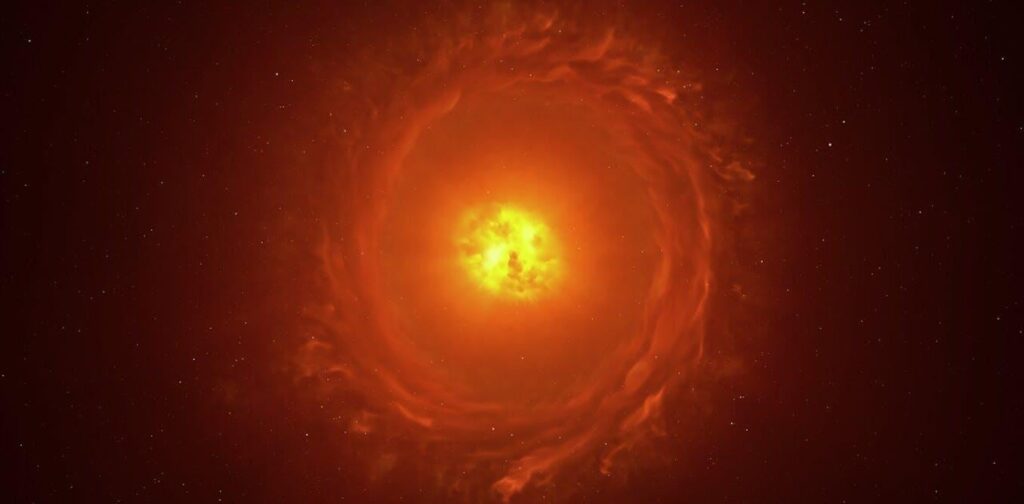
WOH G64, one of the biggest stars in the universe, has transitioned from a red supergiant to a yellow hypergiant, in what may be evidence of impending supernova
https://theconversation.com/one-of-the-biggest-stars-in-the-universe-might-be-getting-ready-to-explode-276519

6 Comments
If this star explodes, how bright would it be here on Earth?
Ah ok, it’s in the Large Magellanic Cloud. Busy little galaxy that one, I remember another supernova there I think that in the 80s.
Anyway, we don’t have to worry about going to a radiation shelter or whatever we have to do in the case of a nearby supernova.
At this point it should have a proper name. I vote for Luthen’s Star
man, watching a nova in real time would be sick
Astronomer here! Discovery paper is [here](https://www.nature.com/articles/s41550-026-02789-7), unfortunately paywalled. It is important to remember though- *astronomically* soon does not mean *human lifetimes* soon- this thing can easily have hundreds or thousands of years to go, and we are not great and knowing which stars are about to go supernova to a few years precision (let alone shorter).
WOH G64 is in the Large Magellanic Cloud (LMC), ~170,000 light years away from us. The LMC is despite this distance actually gravitationally interacting with the Milky Way, and that friction is causing a lot of gas in it to create the biggest star forming region that we know of in our local universe. That also means if you want the biggest stars we know of (aka ones that will go supernova) they’re pretty much all in the LMC. Like this one!
The LMC is also the location of SN 1987A (which actually had its 39th anniversary this week!), the closest supernova to earth since the invention of the telescope. When that one occurred it was actually bright enough to be seen by the naked eye for about a month in the southern hemisphere despite being ~170,000 light years away- my PhD adviser remembers stepping outside to his back yard in suburban Sydney and seeing it. So if it happens you ought to have time to buy plane tickets south if you really want to look!
As I said earlier though, astronomically soon does not automatically mean within our lifetimes. It could easily have a couple thousand years to go at minimum. In this case, we expect the yellow hyper giant stage to last at least 10,000 years or so- astronomically soon but not on our life times soon. Sorry!
It being 160,000 light years away – it has already probably occurred. We just don’t know yet.