
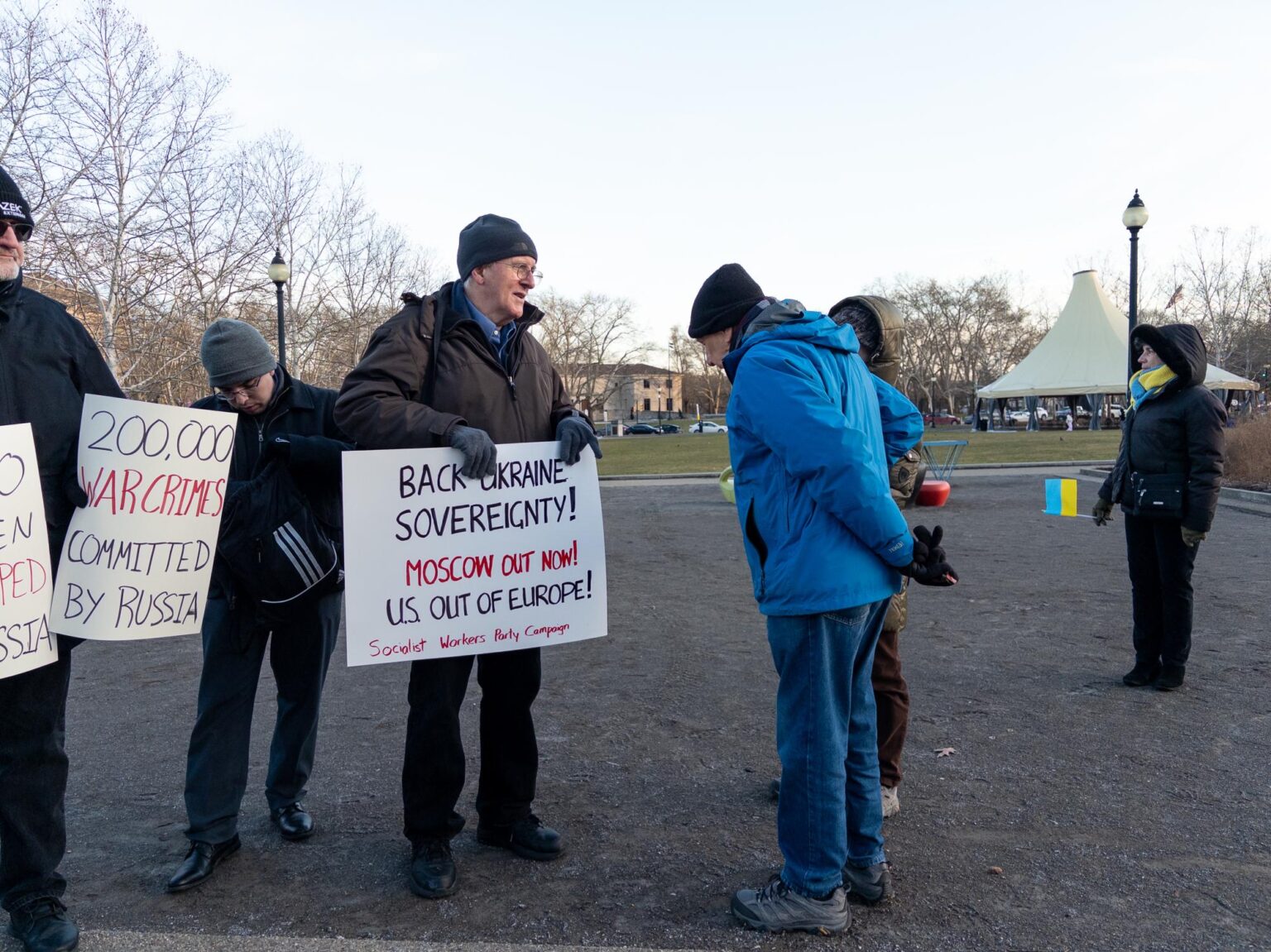
The Ukrainian Student Association hosted its fourth annual “Pittsburgh for Ukraine” demonstration, remembering the lives lost and advocating for an end to the Russo-Ukrainian war on Tuesday evening in Schenley Plaza and Heinz Chapel.
The event, which was hosted in partnership with Ukrainian Cultural and Humanitarian Institute, Vovk Foundation, Free Russia Pittsburgh and Fulbright Ukraine, featured speakers with close ties to Ukraine. It concluded with a Panakhyda, a memorial service used by the Byzantine Catholic Church for those who have passed.
Russia invaded Ukraine four years ago on Feb. 24, 2022, and the conflict has since become the largest in Europe since WWII. Since 2022, an estimated 1.8 million soldiers have been killed, wounded or gone missing. The 2022 invasion was an expansion of Russia’s illegal annexation of Crimea in 2014.
Andrew Romanchik, a sophomore political science and philosophy major and president of Ukrainian Culture Club, discussed what led to the start of the war.
“At 5 a.m. on February 24, 2022, Russia began its full-scale war against Ukraine,” Romanchik said. “After a month of military and weaponry build up, the Russian army invaded the sovereignty of a peaceful people.”
Romanchik said he believes discussions on the issue should focus on those who have lost their lives during the war.
“We do not need hate, we do not need accords — we need our memories,” Romanchik said. “Russia willingly, systematically, surgically, chooses to kill these people with precision.”
Oleh Tsumbek, a first-year political science major, described his experience living in Ukraine. He said since the start of the war, it has gone from a place full of beauty to despair.
“[It was a] city full of life, families and opportunity. It was a place where children played in a playground, where people walked the streets without fear,” Tsumbek said. “When I finally came home, I saw a completely different city. I saw the residential network was destroyed. I stopped at streets that had once been normal and peaceful and went empty inside, and I saw graves in the residential borders.”
Ted Cmarada, a 75-year-old attendee from Friendship, said he is not Ukrainian but “stands with the people of Ukraine” and described his own family’s suffering in an invasion by another country.
“I feel a particular connection to what’s going on right now because my mother was a young person during the invasion of the Nazis in Belgium, and her and her family’s homes were destroyed, just like what’s going on in Ukraine right now,” Cmarada said. “We need to absolutely stay alert and cognizant and open-hearted to the suffering.”
Cmarada emphasized that all people should care for each others’ struggles, and that students should be aware of the war.
“None of us succeed if we don’t look after all of us and all the others, so this is critical,” Cmarada said. “It’s critical that students pay attention to this war and to the impact that it has on all the rest of the world, and also welcome Ukrainians into our country.”
Elsa Limbach, 71-year-old attendee from Shadyside, said her partner is a Ukrainian pianist currently touring Africa, which she believes is important to spreading Ukrainian culture.
“He’s doing cultural diplomacy in various places around the world, trying to bring Ukrainian music, Ukrainian arts and collaborating with artists in many different countries,” Limbach said. “[He’s] trying to tell the story [of Ukraine] in a cultural manner.”
Limbach said her grandmother is from Western Ukraine and migrated to the U.S. at the age of 12.
“I’ve heard about Ukraine from the time I was tiny,” Limbach said. “It’s something that’s always been in my heart and in my imagination. I had the chance to travel there twice, so I hope that I can travel there again soon.”
Andrew Schafer, a senior molecular biology major from Russia, said he is “strongly pro-Ukrainian.” Schafer said some of his friends were imprisoned after protesting against Putin following Alexei Navalny’s death. Schafer said he wished he was “more political back then,” but is now involved in advocating against Russia’s actions.
“I now donate money to the Ukrainian military,” Schafer said.
Demirel Dzhaparov, a first-year business major and member of Ukrainian Culture Club from Crimea, ended the demonstration by proclaiming “Slava Ukraini,” which means “glory to Ukraine.”
“All I want to say is that I know and I believe that Ukraine will occupy its territory soon, and Ukraine will win,” Dzhaparov said.