

A total of 19 people were murdered in Norway last year, the lowest number of registered homicides since 1990. At the same time, though, police report a rise in serious crime among youth, often tied to drug smuggling and brutal gang violence that span borders.
 This is the photo chosen to adorn the cover of the Norwegian police’s new threat evaluation for 2026: A police officer on border patrol in areas increasingly used to smuggle in drugs, other contraband or carry out human trafficking. PHOTO: Politi
“It’s digital, it’s ruthless, and it’s professional and extremely profit-oriented,” said Håkon Skulstad, director of Norway’s state police, on Wednesday. Skulstad and the leaders of the country’s international- and economic crime units presented their annual threat evaluations for the year ahead, and warned of a “complex” crime threat across borders.
Last fall, a grenade thrown in the direction of a nail salon on a busy street in Oslo, and another at a sushi restaurant in Strømmen, are believed to be among threats made by international gangs that employ underage messengers. The case against two 13-year-old suspects in the case later had to be dropped, since they couldn’t prosecuted.
Both were linked to international criminal networks, while Swedish gangs have also keen to establish themselves in Norway. It’s a new form of organized crime attracted not least by Norway’s emergence as a wealthy country. That makes it one of Europe’s most lucrative markets for cocaine and other drugs, reflected in how drug traffic to Norway has risen. Police fear Norway can also become a transit point for smuggling of drugs to the European continent.
 One of the blocks of cocaine found at a fruit terminal in Oslo last spring, after the bananas surrounding it were removed. PHOTO: Tolletaten/Norwegian Customs
When blocks of cocaine first started being found hidden within banana crates arriving in Norway, police initially thought they’d been missent to Oslo instead of to Antwerp, Hamburg or other major European ports. Now police are acutely aware that drug prices in Norway are among the highest in Europe, according to their threat evaluation, and that makes Norway attractive. Rival gangs are competing to set up bases for business, and it was likely no mistake that the cocaine in the banana boxes was sent to Oslo.
“Organized crime poses a serious threat to our security,” stated Kristin Kvigne, chief of Norway’s international crime unit Kripos. She believes criminal networks have been established in all the police districts in the country, financed by the puchase and sale of narcotics. Demand is high, with cocaine playing a major role in the ongoing criminal prosecution of the crown princess’ son in an Oslo courtroom. The trial itself has shown how common cocaine use in at nightclubs and late-night parties in the Oslo area and elsewhere.
Police are now “working closely,” according to their new report, with other state agencies, local governments, business, civil society and international partners to reveal and halt the criminal networks. Especially their recruitment of youngsters, with new laws opening for their detainment and reform. Many, according to the report, have been through a process of “targeted and cynical exploitation.”
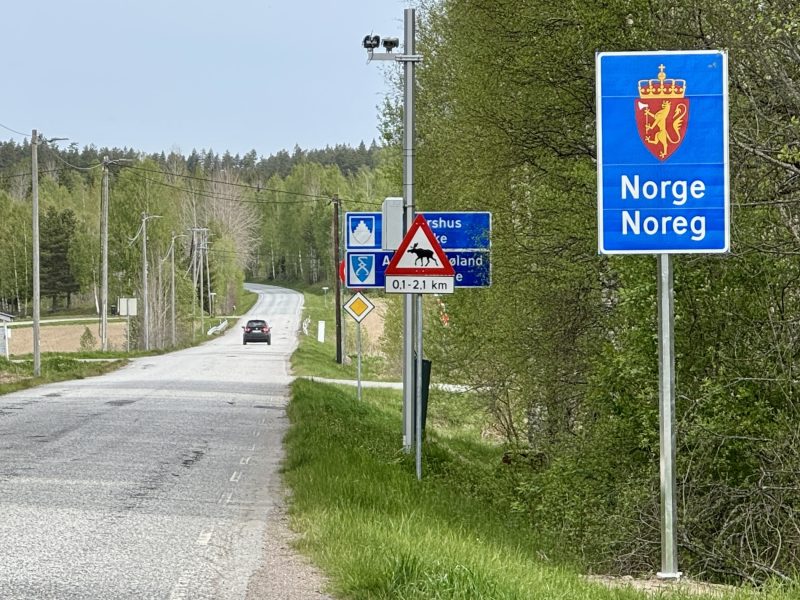 This low-profile border crossing in rural Østfold, southeast of Oslo, is also known as a “smugglers’ road” between Sweden and Norway. Lots of other smuggling occurs via digital means, not least financially. PHOTO: NewsinEnglish.no/Morten Møst
Kvigne said many of the suspected networks operate from countries without extradition treaties with Norway. “We’re directing our efforts, therefore, at the structures behind the violence and the economy that hold up the networks,” she said. “That demands endurance and strong international cooperation.”
Digitalization also can ease the flow of money and contraband over borders, especially regarding economic crime. Pål K Lønseth, head of Norway’s economic crime unit Økokrim, warned of a “parallell financial underworld” that international police efforts aim to crack.
The nature of crime in Norway has thus changed dramatically in the past few years, into an Internet-based community known for an “extremely violent culture.” There’s also, meanwhile, been a major increase in fraud and swindle, especially targeting “vulnerable elderly” Norwegians who grew up in a more trustworthy and analog society.
Domestic violence also remains a problem, especially violence against women, but the actual murder rate has taken a dive. Norway has long been known for few murders, with the exception of the scores carried out during a right-wing extremist’s terrorist attack on a Labour Party summer camp in 2011. Police report that there’s been an average of 28 murder cases a year since 1990, but just 19 last year. There was no explanation for the decline, with the police claiming that the murder rate should be viewed over several years. They thus lean on the figure of 28, in a country with 5.6 million residents.
NewsinEnglish.no/Nina Berglund