
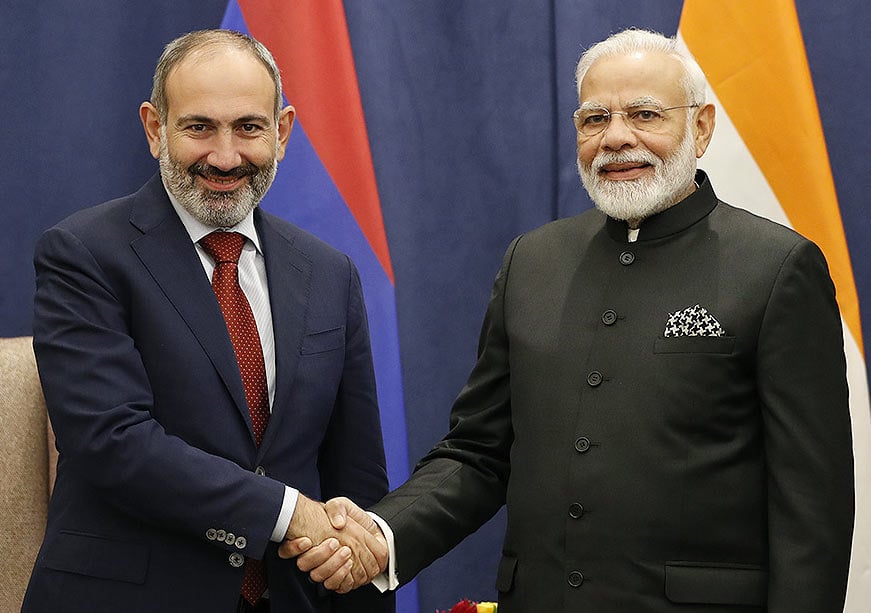
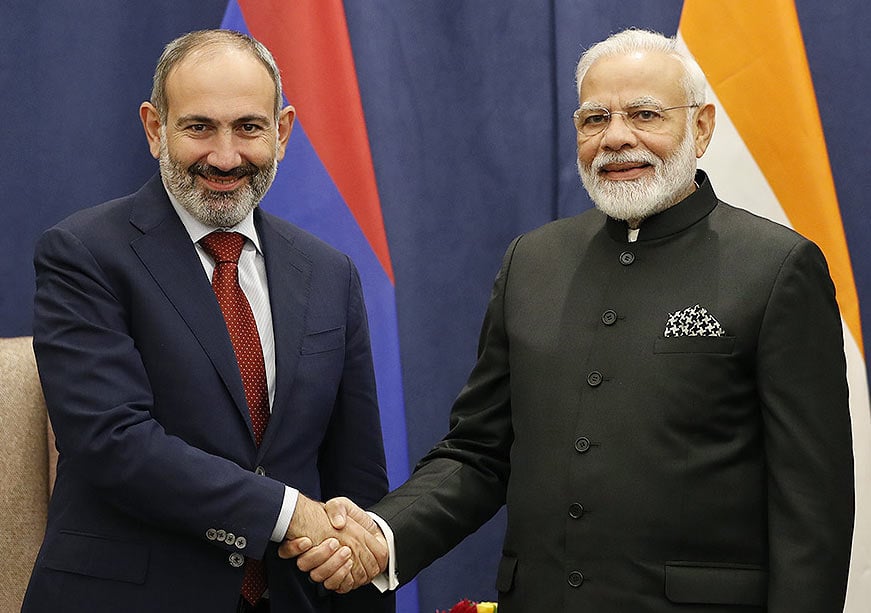
On 1 February 2026, India’s Chief of Defence Staff (CDS), General Anil Chauhan, led a defence delegation on a four-day official visit to the Republic of Armenia. The visit sought to reinforce long-term defence and security cooperation amid shifting geopolitical dynamics and emerging regional alignments in the South Caucasus. It marked a step towards expanding bilateral defence industry collaboration, including joint initiatives and R&D projects, to strengthen cooperation and advance shared strategic objectives.
The CDS met Armenian Defence Minister Suren Papkyan, addressed students at the National Defence Research University (NDRU) on integrating technology into modern warfare, and inaugurated the IT laboratory and distance-learning centre at the Vazgen Sargsyan Military Academy. Both sides also emphasised professional training, exercises, and drills to facilitate the exchange of operational experience across security sectors.
Driven by shared geopolitical and geostrategic interests, a historically rooted partnership between India and Armenia has evolved into a frontline strategic partnership.
Driven by shared geopolitical and geostrategic interests, a historically rooted partnership between India and Armenia has evolved into a frontline strategic partnership. This strategic realignment goes beyond a diplomatic gesture; it reflects a shared aspiration for a multipolar order amid perceived threats from neighbouring states.
Expansion of Defence Engagements
Armenia and India established diplomatic relations in 1992. In 2020, India secured a US$ 40 million contract to supply Swathi weapon-locating radars, which provide rapid and accurate detection of enemy weapons within a 50-kilometre range. Armenian security agencies considered the indigenously developed Swathi system superior to Russian and Polish radar systems during the bidding process. This defence agreement supported Prime Minister Narendra Modi’s Make in India initiative to boost defence exports. The relationship became more strategic and security-focused following the visit of India’s External Affairs Minister to Armenia in October 2021, leading to deeper defence cooperation.
Evolving regional and geopolitical tensions have contributed to India’s growing ties with Armenia. During the 44-day Nagorno-Karabakh conflict in 2020, Türkiye provided active support to Azerbaijan in its conflict with Armenia. Pakistan also supported Baku, driven by a close strategic partnership and shared perspectives on issues such as Kashmir and Nagorno-Karabakh. According to Armenian sources, the Pakistani military, including special units, participated in combat operations alongside Azerbaijani forces during the conflict, contributing to Baku’s victory.
Amid these tensions, Moscow—the primary arms supplier to Armenia, accounting for 94 percent of total supplies from 2011 to 2020—arranged a ceasefire and deployed Russian peacekeepers but reportedly held back arms deliveries to Armenia due to its focus on Ukraine. As a result, Yerevan began seeking a more reliable partner for arms transfers, prompting it to turn to India. Additionally, Indian arms and defence systems were easily harmonised with the Armenian armed forces, as both countries had imported most of their arms from Russia.
Between 2020 and 2024, Yerevan emerged as the principal recipient of Indian defence exports, with contracts estimated at approximately US$ 2 billion.
In 2022, Armenia became the first foreign buyer of the Akash missile system, placing an order for 15 units valued at US$ 720 million. Designed by India’s Defence Research and Development Organisation (DRDO) and produced by Bharat Dynamics Limited (BDL), the system protects against a range of air threats, including fighter aircraft, guided missiles, and drones. In 2024, New Delhi began delivering the system, significantly enhancing Yerevan’s military capabilities and reinforcing its defence posture. To strengthen Armenia’s protection against unmanned aerial threats, India also supplied an advanced anti-drone system capable of detecting, tracking, and neutralising rogue drones, thereby improving resilience against UAV attacks.
As defence and security cooperation between the two countries deepened, Yerevan appointed a defence attaché to its embassy in New Delhi in 2023 to strengthen military coordination. Armenia also finalised agreements to acquire Pinaka multi-barrel rocket launcher batteries, with deliveries commencing in July 2023 and an additional consignment dispatched from Nagpur in January 2026. Earlier variants had a range of up to 37.5 kilometres; recent upgrades have extended this to 75 kilometres, improving both range and accuracy.
Between 2020 and 2024, Yerevan emerged as the principal recipient of Indian defence exports, with contracts estimated at approximately US$ 2 billion. Armenia has also expressed interest in procuring 8 to 12 Indian-manufactured Su-30MKI multirole fighter jets, valued at around US$ 3 billion. This follows Azerbaijan’s acquisition of China-made JF-17 fighter jets from Pakistan under a deal reportedly worth US$ 4.6 billion.
Due to Russia’s ongoing involvement in Ukraine, Armenia is pursuing joint production and development of high-tech arms with India to reduce reliance on a single foreign supplier.
The Strategic Calculus Behind India–Armenia Cooperation
Due to Russia’s ongoing involvement in Ukraine, Armenia is pursuing joint production and development of high-tech arms with India to reduce reliance on a single foreign supplier. New Delhi has also supported Yerevan in rebuilding its security architecture and supplied advanced military hardware. During his visit, the Chief of Defence Staff (CDS) underscored the importance of joint exercises and training. This approach ensures that Armenian personnel are trained in India’s modern mountain-warfare doctrines, replacing outdated practices and further strengthening the bilateral defence partnership.
The India–Armenia bilateral relationship has acquired significant strategic weight amid the evolving geopolitical landscape of Eurasia. This trajectory reflects a calibrated response to shifting power dynamics beyond India’s immediate neighbourhood, particularly as the Pakistan–Türkiye–Azerbaijan axis expands its influence across the Caucasus, South Asia, and Central Asia. New Delhi recognised that closer ties with Yerevan would secure a strategic foothold in the South Caucasus, help offset this alignment, and underscore the region’s changing geopolitical context. India’s defence exports to Armenia were intended to preserve the regional balance of power rather than escalate tensions. In this sense, they also contributed to creating conditions conducive to the subsequent peace process between Armenia and Azerbaijan. Although initially rooted in shared security concerns, India–Armenia defence cooperation has acquired wider strategic and geopolitical significance, as the South Caucasus emerges as an arena of renewed great-power competition.
This trajectory reflects a calibrated response to shifting power dynamics beyond India’s immediate neighbourhood, particularly as the Pakistan–Türkiye–Azerbaijan axis expands its influence across the Caucasus, South Asia, and Central Asia.
The expanding defence relationship between Armenia and India signifies a significant shift in the evolving geopolitical framework of the South Caucasus. With this relationship having matured into a comprehensive strategic partnership, it consolidates India’s strategic presence in Eurasia. New Delhi, through its carefully coordinated efforts, not only maintains regional peace and balance of power but also demonstrates its emergence as a dependable defence exporter and a staunch supporter of a multipolar world founded on principles of equality rather than coercion.
Ayjaz Wani is a Fellow with the Strategic Studies Programme at the Observer Research Foundation.
The views expressed above belong to the author(s). ORF research and analyses now available on Telegram! Click here to access our curated content — blogs, longforms and interviews.