
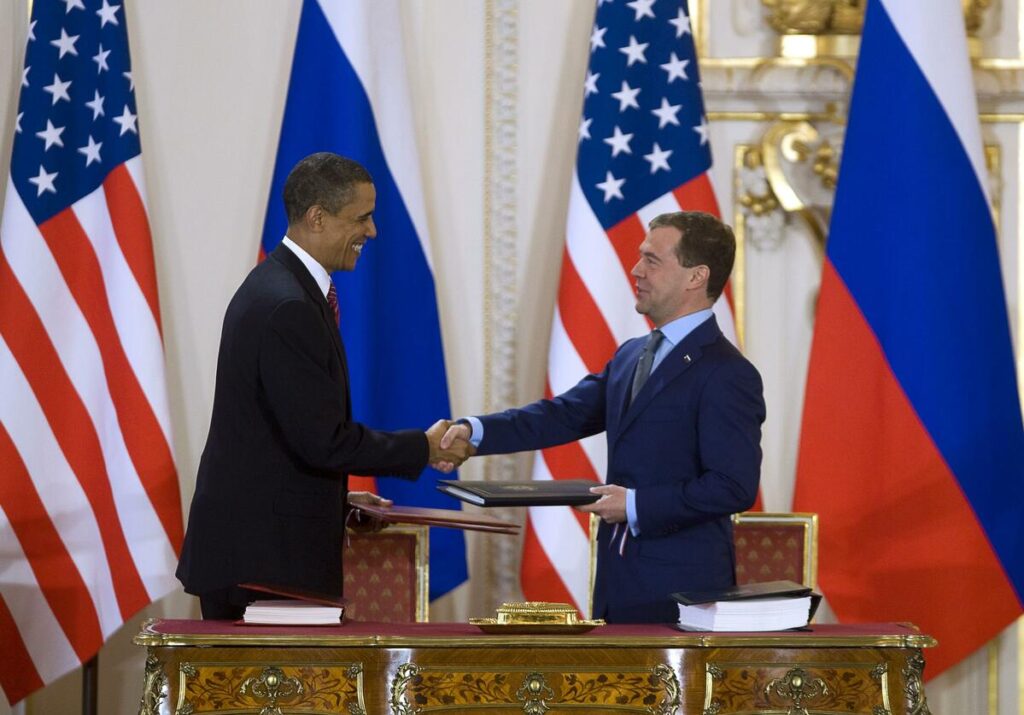
TOKYO – The New Strategic Arms Reduction Treaty, or New START, which capped the number of strategic nuclear warheads deployed by the United States and Russia at 1,550, has expired, raising concerns as it was the only remaining nuclear disarmament treaty between the two countries.
Russia had proposed extending the numerical limits on nuclear weapons for one year even after the treaty’s expiration, but the United States did not agree.
New START also included provisions for mutual inspections to monitor violations, and its continuation would have been desirable for confidence-building, while at a minimum, the numerical limits should have been maintained.
There was also a period before New START took effect in 2011 when its predecessor, the first Strategic Arms Reduction Treaty, or START I, had lapsed. As neither Washington nor Moscow is likely to sharply expand its nuclear forces immediately, both sides should voluntarily observe New START limits while aiming to conclude a new nuclear arms control treaty.
Japan, which has long called for nuclear disarmament as the world’s only country to have suffered atomic bombings in war, is still expected by many nations to play that role, and the Japanese government should strongly urge the United States and Russia to begin talks toward a new treaty.
Some may argue that Japan cannot do such a thing because it is protected under the Japan-U.S. security framework, including the “nuclear umbrella.”
However, based on my experience when I was in charge of disarmament at the Foreign Ministry, the United States would show understanding if Japan spoke up in this way.
In the past, the United States and Russia also discussed negotiating a successor treaty to New START and further lowering the cap of 1,550 warheads. But with China now rapidly expanding its nuclear forces, both countries may be unwilling to accept additional reductions.
In the United States, some voices, citing China’s current moves, say it can no longer continue New START-era limits.
U.S. President Donald Trump has suggested that after the treaty expires, a new pact could be considered that includes China. The best outcome would be a new treaty framework involving the United States, Russia, China and, depending on circumstances, Britain and France.
However, the United States and Russia, which hold an advantage in nuclear forces, want any deal with China to allow for a certain numerical gap, and China would likely reject that, meaning negotiations among the three countries to craft a new treaty would not be easy.
Even so, a way forward could be found with ingenuity. For example, the United States and Russia could first conclude a bilateral treaty and include a “reservation clause” allowing a review if China’s arsenal exceeds a certain level, indirectly deterring its nuclear expansion.
The key issue, in other words, is how to marshal ideas. As a country to be heavily affected by China, Japan may also be able to contribute ideas on how to advance nuclear disarmament in ways that also serve its own security.
When weighing the U.S.-China balance, the United States possesses a large number of long-range strategic nuclear weapons, such as intercontinental ballistic missiles and submarine-launched ballistic missiles, while China holds a vast arsenal of intermediate-range ballistic missiles that can reach Japan and other targets.
How to maintain the U.S.-China balance under such “asymmetry” is a key area where fresh thinking is needed, and it is also a matter of serious concern for Japan.
It is not too late for the Japanese government to strongly urge the United States and Russia to pursue nuclear disarmament talks, while also devising ways to address China’s nuclear forces.
(Nobuyasu Abe, born in 1945, held key disarmament posts at the Foreign Ministry, served as U.N. under-secretary-general for disarmament affairs from 2003 to 2006, and also worked as ambassador to Japan’s mission in Vienna and as deputy chair of the Japan Atomic Energy Commission.)