

Listen to this article
Estimated 6 minutes
The audio version of this article is generated by AI-based technology. Mispronunciations can occur. We are working with our partners to continually review and improve the results.
Iran and the United States began indirect talks Thursday in Geneva over Tehran’s nuclear negotiations, viewed as a last chance for diplomacy as the U.S. has gathered a fleet of aircraft and warships to the Middle East to pressure Tehran into a deal.
U.S. President Donald Trump wants a deal to constrain Iran’s nuclear program, and he sees an opportunity while the country is struggling at home with growing dissent following nationwide protests last month.
If an American attack happens, Iran has said all U.S. military bases in the Mideast would be considered legitimate targets, putting at risk tens of thousands of American service members. Iran has also threatened to attack Israel, meaning a regional war again could erupt across the Middle East.
“There would be no victory for anybody — it would be a devastating war,” Iranian Foreign Minister Abbas Araghchi told India Today in an interview filmed Wednesday just before he flew to Geneva.
“Since the Americans’ bases are scattered through different places in the region, then unfortunately perhaps the whole region would be engaged and be involved, so it is a very terrible scenario.”
Potential dispute over enriching uranium
Araghchi is passing messages to Steve Witkoff, a billionaire real estate developer and friend of Trump who serves as a special Mideast envoy for the president. The talks are being mediated by Oman, a sultanate on the eastern edge of the Arabian Peninsula that’s long served as an interlocutor between Iran and the West.
Araghchi met Oman’s Foreign Minister Badr al-Busaidi after arriving in Geneva on Wednesday night. The men “reviewed the views and proposals that the Iranian side will present to reach an agreement on the Iranian nuclear program, based on the guiding principles agreed upon in the previous round of negotiations,” a report from the state-run Oman News Agency said.
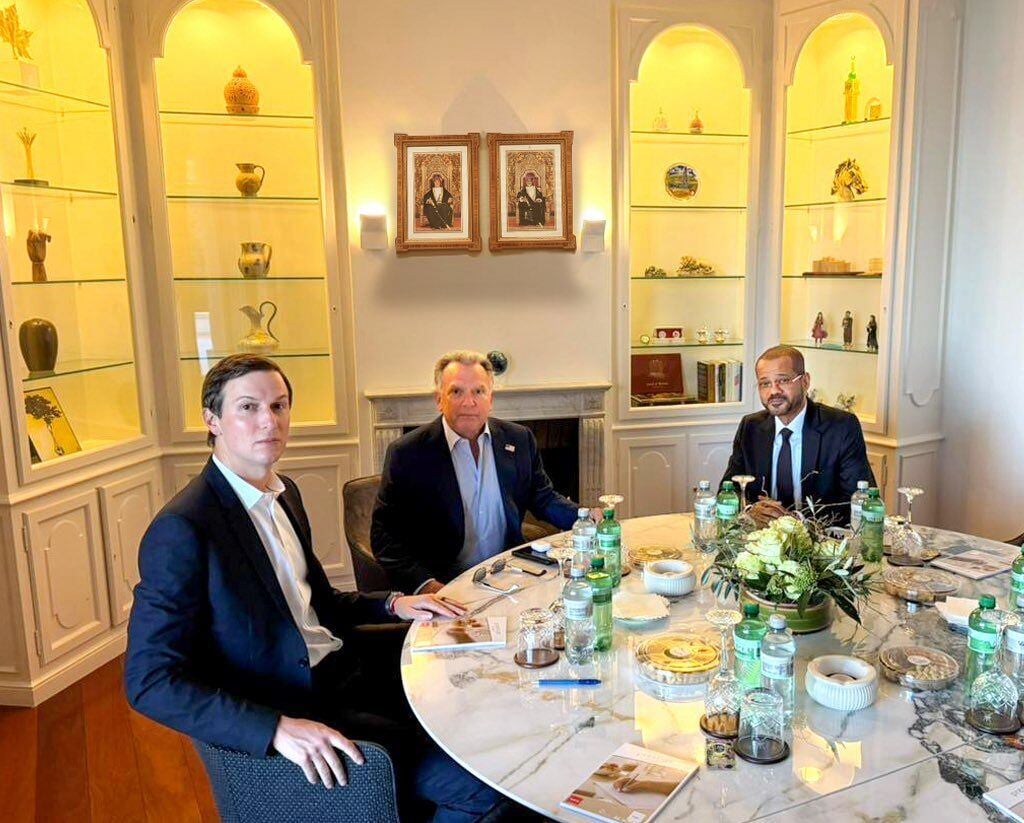
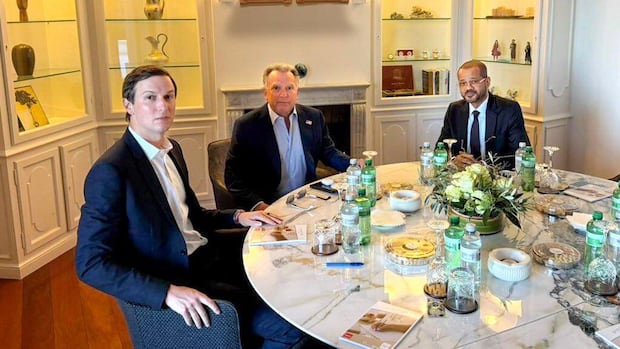
Oman’s Foreign Affairs Minister Badr al-Busaidi, right, is shown Thursday with White House special envoys Steve Witkoff, centre, and Jared Kushner, left. Oman is mediating the talks between the U.S. and Iran in Geneva, Switzerland. (Foreign Ministry of Oman/The Associated Press)
An Associated Press journalist saw al-Busaidi after he met with Rafael Grossi, the director general of the International Atomic Energy Agency (IAEA), the United Nations nuclear watchdog.
Al-Busaidi returned Thursday to the Omani diplomatic residence on the shores of Lake Geneva . A convoy believed to be carrying American diplomats later arrived at the compound, followed by another believed to be carrying Iranian diplomats. Oman later published images of Witkoff and Jared Kushner, Trump’s son-in-law, meeting with al-Busaidi at the residence, signalling the start of the talks.
After the June war, Trump has pushed to halt Iran’s enrichment of uranium entirely, as well as address Tehran’s ballistic missile program and its support of regional militant forces. Iran has maintained the talks must remain focused only on nuclear issues.
U.S. Secretary of State Marco Rubio told reporters Wednesday that Iran is “always trying to rebuild elements” of its nuclear program. He said that Tehran is not enriching uranium right now, “but they’re trying to get to the point where they ultimately can.”
The West and the IAEA say Iran had a nuclear weapons program until 2003. Before the June attack, it had been enriching uranium up to 60 per cent purity — a short, technical step away from weapons-grade levels of 90 per cent.
Trump, in his first presidential administration, pulled the U.S. out of a multilateral agreement that had established an inspection framework and placed limits on Iran’s enrichment of uranium. That deal, spearheaded by Barack Obama’s government, was heavily criticized by U.S. ally Israel.
In support of Israel, Trump in his second presidency ordered an attack last year on three of the Islamic Republic’s nuclear sites, part of a bruising 12-day war. Trump claimed the sites were “obliterated” at the time.
No inspections since last year’s bombing campaign
Iran has said it hasn’t enriched since June, but it has blocked IAEA inspectors from visiting the sites bombed. Satellite photos analyzed by The Associated Press also have shown activity at two of those sites, suggesting Iran is trying to assess and potentially recover material there.
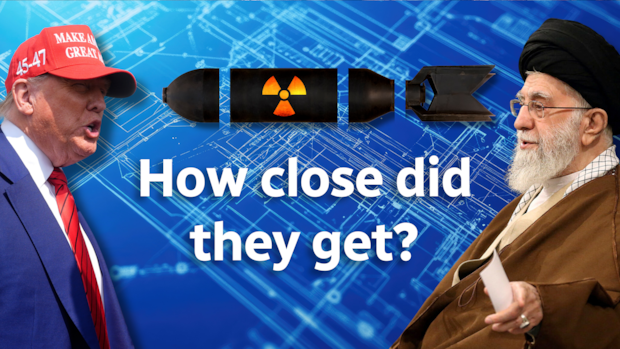
U.S. President Donald Trump justified bombing key Iranian nuclear facilities by claiming Iran was dangerously close to developing a nuclear weapon. But how could he be so sure? Andrew Chang examines Iran’s claim that its uranium enrichment program is purely for civilian energy — and why much of the West remains skeptical.
Images provided by Getty Images, The Canadian Press and Reuters.
U.S. intelligence agencies assess that Iran has yet to restart a weapons program, but has “undertaken activities that better position it to produce a nuclear device, if it chooses to do so.” While insisting its program is peaceful, Iranian officials have threatened to pursue the bomb in recent years.
If the talks fail, uncertainty hangs over the timing of any possible attack.
If the aim of potential military action is to pressure Iran to make concessions in nuclear negotiations, it’s not clear whether limited strikes would work. If the goal is to remove Iran’s leaders, that will likely commit the U.S. to a larger, longer military campaign.
There has been no public sign of planning for what would come next, including the potential for chaos in Iran. Democrats and some Republicans on Capitol Hill are alarmed at the possibility of a military campaign that is on the verge of occurring without congressional approval, but efforts to pass war powers legislation to curb Trump’s authority have fizzled.
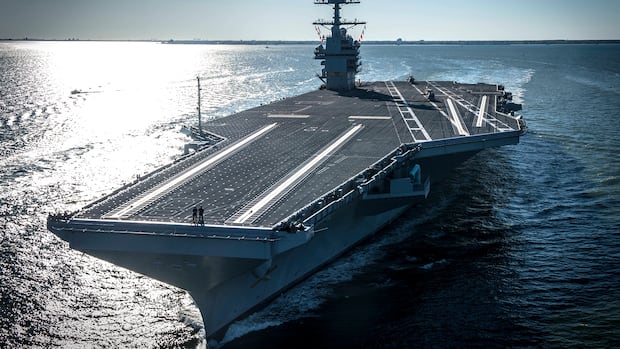
As U.S. President Donald Trump’s Mideast ‘armada’ draws closer to Iran, CBC News has tracked the location and movements of naval ships and military aircraft in the region.
There is also uncertainty about what any military action could mean for the wider region. Tehran could retaliate against the American-allied nations of the Persian Gulf or Israel. Oil prices have risen in recent days in part due to those concerns.
Satellite photos shot Tuesday and Wednesday by Planet Labs PBC and analyzed by the AP appeared to show that American vessels typically docked in Bahrain, the home of the U.S. Navy’s 5th Fleet, were all out at sea. The 5th Fleet referred questions to the U.S. military’s Central Command, which declined to comment. Before Iran’s attack on Qatar in June, the 5th Fleet similarly scattered its ships at sea to protect against a potential attack.