
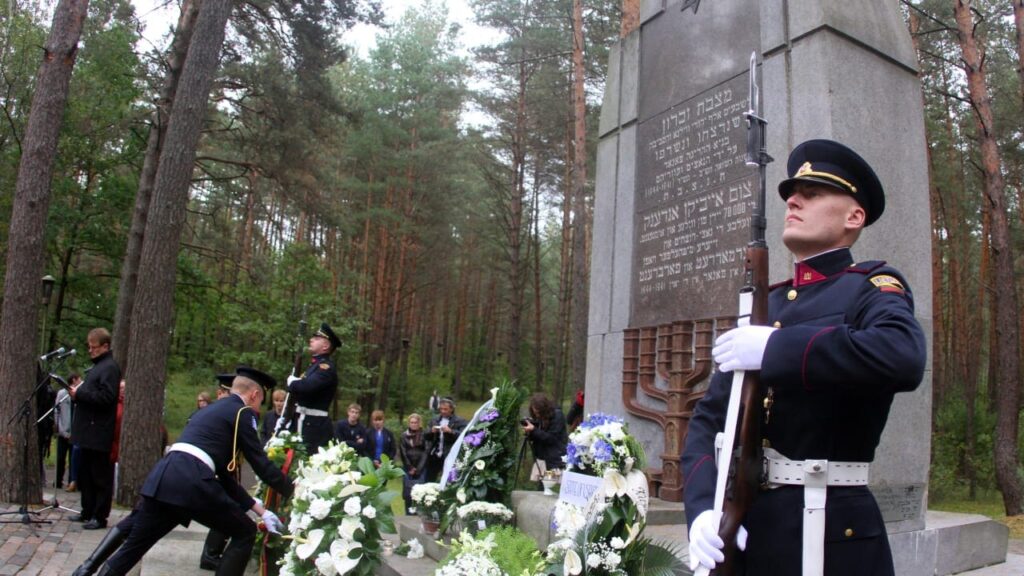
VILNIUS – In the forests surrounding the small Lithuanian town of Seduva, hundreds of Jewish men, women, and children were shot to death in the summer of 1941. Their names, once erased from memory, now line the walls of a new museum built to commemorate a world that vanished with them. Yet as Lithuania struggles to confront its past, antisemitism is once again finding legitimacy in the country’s present.
Seduva, a town of just 2,400 people located about a two-hours’ drive north of Vilnius on the road to neighboring Latvia, was for decades little more than a forgotten dot on the map. Until recently, its main attractions were an old windmill and a nearby restaurant hosting occasional events. Few Lithuanians, let alone foreign visitors, had any reason to stop there.

That changed last September with the opening of the Lost Shtetl Museum, a unique private Jewish museum that has transformed Seduva into a place of historical reckoning. The museum does not merely tell a local story. It confronts Lithuania with a vanished Jewish civilization, and with uncomfortable truths that much of the country still prefers not to face.
The state-of-the-art museum tells the story of Seduva’s Jewish community in the first half of the 20th century, a story that mirrors that of thousands of shtetls (little towns) across Eastern Europe. It is the story of a vibrant human landscape erased by the Holocaust, not by abstraction or distance but by neighbors, forests, and bullets.
The Jewish community of Seduva (Shadeve in Yiddish) was formally established in 1732, although Jews had lived there earlier. Like Jews in other shtetls across Lithuania, Poland, and Belarus, most of its residents were merchants, artisans, and craftsmen, deeply woven into the local economy and daily life.

On the eve of World War II, before the Soviet and then Nazi occupations, Jews made up 56.5% of Seduva’s population. Jewish life defined the town’s rhythm, its markets, workshops, synagogues, and schools. The ancestors of both Israeli President Isaac Herzog and Prime Minister Benjamin Netanyahu originated from this small town.
Herzog became the first foreign senior official to visit the 2,500-square-meter museum shortly before its official opening, a symbolic moment connecting Israel’s present leadership to the erased Jewish world of Eastern Europe.
Like the Jews of more than 200 Lithuanian shtetls, Seduva’s Jewish population was annihilated in the summer of 1941, just weeks after Nazi Germany invaded the Soviet Union. In July, the Jews were rounded up and forced into a ghetto. In early August, 150 Jewish men, including the town’s last rabbi, Mordechai Henkin, were taken to a nearby forest and executed. On August 25 and 26, the remaining Jews – 664 men, women, and children – were marched to another forest and shot to death.
As elsewhere in Lithuania, the genocide was not carried out by Germans alone. Local non-Jewish Lithuanians enthusiastically participated. In some locations, the killings were initiated not by the Nazis but by local collaborators eager to rid their towns of Jews and seize their property.
By the end of World War II, between 195,000 and 250,000 Lithuanian Jews, totaling around 95% of the community, had been murdered. Most were killed not in camps but in mass shootings, later known as the “Holocaust by bullets.” Entire Jewish communities vanished within weeks.
Confronting Lithuanian responsibility for the Holocaust remains deeply sensitive in a country that still largely refuses to acknowledge historical wrongdoing. Addressing this past, museum staff members say, it is like “walking through a minefield.”
Today, Seduva is home to descendants of those who murdered its Jews. “We do not blame anyone,” a guide at the Lost Shtetl Museum explains. “We only expose facts and try to get to the hearts of visitors by showing them the lives of people who lived here. Most Lithuanians know nothing about the Holocaust. There is no education program about the Holocaust in schools.”
Alongside walls listing the names of murdered Jews and destroyed shtetls, the museum also displays the names and photographs of local perpetrators, a quiet but radical act in a country where collaborators are often euphemistically referred to as anti-Soviet fighters or national heroes.
One section of the permanent exhibition addresses antisemitism in inter-war Lithuania and dismantles a deeply entrenched myth: that Jews were collectively communists who collaborated with Soviet occupiers and persecuted Lithuanians. This narrative, often framed as the so-called “Russian genocide in Lithuania,” has long been used to deflect responsibility for Jewish suffering and to recast Jews as historical villains.
The exhibition counters this claim with facts. Jews made up 13.5% of the 150,000 Lithuanians deported to Siberia, many of whom died there. Synagogues and Jewish schools were closed by the Soviets, Jewish businesses were expropriated, and many Jews actively supported Lithuanian national identity and independence. The idea of Jews as Soviet oppressors collapses under even minimal historical scrutiny.
This Portrayal of Jews as enemies of the Lithuanian nation is not confined to history books or fringe conversations. It has resurfaced forcefully and successfully in contemporary Lithuanian politics.
In early December 2025, a Vilnius district court convicted Remigijus Zemaitaitis, a populist politician and founder of the nationalist Dawn of Nemunas party, which is part of the current governing coalition, of inciting hatred against Jews, downplaying Nazi crimes, and minimizing the Holocaust. Despite the gravity of the offenses, he received only a symbolic fine of €5,000, far below the €51,000 requested by prosecutors.
Lithuania thus became the first European Union country whose government relies on the support of a convicted antisemite.
Zemaitaitis, a 43-year-old lawyer, presents himself as a victim of “political prosecution.” Rather than being denounced and politically isolated, he was publicly supported by his coalition partners, the Social Democratic Party of Lithuania (LSDP).
While stating that “any form of antisemitism, hate speech, or Holocaust denial is unacceptable and incompatible with our values,” party leaders emphasized that “the legal procedure isn’t over yet,” referring to the fact that
Zemaitaitis is appealing his conviction. However, in essence, it is a mantra that, in practice, has allowed the coalition to proceed unchanged.
This was not Zemaitaitis’s first legal reckoning.
In April 2024, Lithuania’s Constitutional Court ruled that Zemaitaitis had violated his parliamentary oath of office and the constitution by inciting hatred. To avoid impeachment, he resigned from parliament, founded his own party, and ran for president.
He finished fourth, with more than 132,000 votes, a result that revealed a reservoir of public support for his rhetoric. Months later, Dawn of Nemunas captured 15% of the vote in parliamentary elections, becoming the third-largest party in the Seimas.
Despite earlier pledges not to cooperate with him, the Social Democrats reversed course and formed a coalition with him. Zemaitaitis was not appointed a minister, but he remains a member of parliament. His party controls the Ministry of Environment.
National and international outcry failed to alter the political calculus. Antisemitism, once disqualified as a barrier to public office, had become negotiable.
Zemaitaitis’s Rhetoric is rooted in historical falsification and modern anti-Israel antisemitism. He has accused Jews of crimes against Lithuanians, distorted Holocaust history, and explicitly incited violence. In one post, he was quoted as encouraging murder: “A Jew was climbing a ladder and accidentally fell. Take a stick, kids, and kill the little Jew.”
Elsewhere, he claimed that Lithuanians suffered more than Jews during World War II and demanded that Jews apologize to Lithuanians, asking, “How much longer will our politicians kneel before the Jews who killed our people and contributed to the oppression and torture of Lithuanians and the destruction of our country?”
For Faina Kukliansky, chairwoman of Lithuania’s Jewish community of some 5,000 to 6,000 members, the political success of Zemaitaitis represents something far deeper than one extremist politician.

“I can’t say that is the same antisemitism as we saw on the attack on the synagogue in Halle, Germany, or the attack on Bondi Beach in Australia,” she says. “But we see antisemitism here at each step.
“Zemaitaitis was sentenced by the Constitutional Court, yet he and his party became part of the present ruling coalition,” she adds. “People support him. I do not know if to call him and his supporters real antisemites, because his main purpose was to enter the parliament, and he achieved it.
“But the fact is that almost 200,000 people voted for him. What does it mean? When you, as a Jew, walk in the streets, nobody is killing you, nobody is shouting at you, ‘Jew.’ But almost 200,000 people, latent antisemites, voted for Zemaitaitis and all of them feel quite comfortable with their political choice.
“The Constitutional Court and now a district court ruled that he broke the law. Despite all that, he is still sitting in the parliament and is part of the coalition. I do not have any hope for the future. We as a community do not have the means to fight with such people.”
Kukliansky argues that Lithuania has never fully accepted responsibility for the Holocaust. Although President Algirdas Mykolas Brazauskas asked forgiveness in Israel in 1995 for Lithuanian crimes during World War II, the gesture provoked backlash at home.
“People here were saying, ‘How can he ask the Jews to forgive us?’” Kukliansky recalls. “If you compare Lithuania to Germany, Austria, or other European countries where Jews were killed in the Holocaust, you will not find the same level of dealing with the past.”
She points to monuments honoring known collaborators, court decisions preventing their removal, and decades-long struggles over restitution and rehabilitation of Nazi collaborators. “Sometimes I am so tired of talking about it,” she says, “because nothing is going to change.”
A growing number of Lithuanians share Kukliansky’s concerns. A Eurobarometer survey conducted last November and published in February indicates a sharp rise in the number of Lithuanians worried about antisemitism in political life. In 2018, some 15% of Lithuanians considered antisemitism in politics to be a problem. Today, that figure stands at 38%.
However, only 14% of respondents believe that antisemitism has grown stronger in Lithuania over the past five years. Nearly half think the level of antisemitism in their country has not changed during that period. In January, the government adopted a widely criticized action plan to combat antisemitism and xenophobia.
Rabbi Sholom Ber Krinsky, who arrived from the United States in 1993 to help rebuild Jewish life in Vilnius, offers a more cautious perspective on antisemitism in Lithuania.

“Until the renewed independence of Lithuania in 1990, dealing with the Holocaust and Lithuanian responsibility was frozen,” he says. “Since independence, there has been a slow process of confronting the past. Processes take time.
“Antisemitism is not a Jewish issue but an issue of society,” Krinsky adds. “If the leadership of the state and the politicians are showing their people the way to deal with antisemitism, the Jewish community should support them.”
He acknowledges Zemaitaitis’s antisemitism but questions whether his electoral success reflects hatred or populism. “Twenty years ago, we had an extreme-right politician who disrupted a Hanukkah lighting and shouted, ‘Lithuania to the Lithuanians,’” he recalls. “The court fined him. He later moved to Russia.”
Despite Krinsky’s cautious optimism, security remains a central concern. Jewish institutions in Vilnius are lightly protected compared to those in Western Europe. “The state doesn’t protect us at all,” Kukliansky warns. “We protect ourselves, but we don’t have enough tools.”
The threat, she notes, is unpredictable. “The terrorists do not announce that they are going to kill Jews in a certain place. How long are we going to have this situation?”
On a recent weekend, the Lost Shtetl Museum was full of visitors. Since its opening, over 20,000 people have passed through its doors, and guided tours, including school groups, are booked months in advance.
Funded by a Jewish businessman whose family originated in Seduva, the museum represents a powerful attempt to force Lithuania to confront what was destroyed on its soil. The same philanthropist also funded a Jewish kindergarten in Vilnius, investing not only in memory but in Jewish continuity.
Whether remembrance alone can counter political legitimization of antisemitism remains an open, and urgent, question.
For now, Lithuania stands at a crossroads: between confronting the truth of its past or allowing distorted history and modern populism to shape its future.
This article was written in collaboration with EJC.